Trekking with Children in Nepal: Altitude Limits and Planning
There is no official height limit for children on Nepal treks, but there are sensible ones. How to choose routes under about 3,000 m, pace the days, spot trouble in a child who cannot say what hurts, and plan the logistics.

Nepal sets no official height limit for children, so the limit is yours to choose: keep a child's sleeping altitude below about 3,000 m, walk short days, and pick a route where a bus or jeep is never far away. In practice that means treks such as Poon Hill, the Australian Camp and Dhampus walk, the Ghandruk village trek and the Kathmandu Valley hikes, not Everest Base Camp or the Annapurna Circuit. The two things that matter most are a slow pace and an adult who knows how to read a child who cannot explain what is wrong.
This guide is general information, not medical advice; talk to a paediatrician or travel clinic before you book, especially for a child under five or one with asthma, heart or lung problems. It covers how altitude affects children, how to choose a route, how to pace and feed a family trek, what to watch for, and how permits and the guide rule apply. For the adult basics, read altitude sickness basics first.
Poon Hill Trek (Ghorepani)的開放行程
由正在尋找夥伴的健行者發布的真實行程。

What the health agencies say
Both the CDC Yellow Book and the NHS describe altitude illness as a risk for anyone who goes too high too fast. The NHS says you can get altitude sickness at altitudes above about 2,500 m, that symptoms usually begin six to ten hours after arrival, and that the main symptoms are headache, loss of appetite, nausea, tiredness, dizziness and poor sleep. For adults the guidance is to avoid sleeping more than 500 m higher than the night before once you are above 3,000 m, and to take a rest day every three to four days.
The extra problem with children is communication. A toddler cannot say "I have a headache", and an older child may stay quiet to avoid spoiling the trip. The CDC Yellow Book notes that young children cannot reliably report symptoms, so the adult has to watch behaviour instead: unusual fussiness or crying, refusing food or drink, vomiting, unusual sleepiness and a loss of interest in play are all warnings. There is no evidence that these treks are unsafe for healthy children on cautious routes, but there is no published safe age or height either, which is why you plan conservatively.
Choosing the route: stay low and stay near roads
A useful rule for a first family trek is to keep the sleeping altitude below about 3,000 m and to choose a route that can be shortened or ended by road. These four fit.
| Route | Days | Highest sleeping point | Notes |
|---|---|---|---|
| Poon Hill | 4 | Ghorepani, 2,860 m | The classic first trek; high point is Poon Hill at about 3,210 m; steep stone steps on day 1 and 2 |
| Australian Camp and Dhampus | 3 | Australian Camp, about 2,050 m | Short walking days after a one-hour drive; easy |
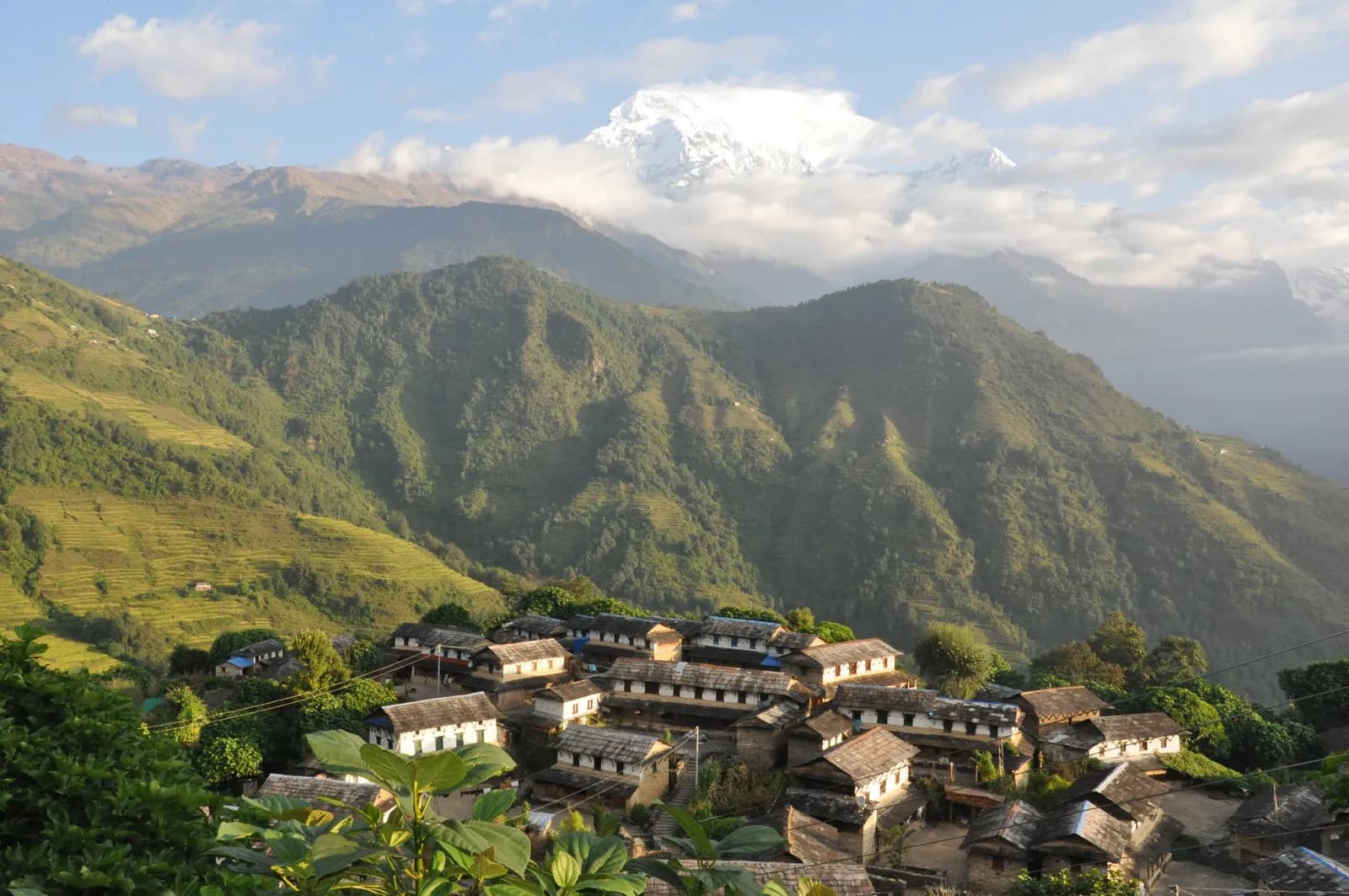
| Ghandruk village trek | 2 | Ghandruk, below 2,050 m | Gurung village, 4 to 6 hours on day 1 and 2 to 3 hours on day 2 |
| Nagarkot to Changu Narayan | 1 | Nagarkot, about 2,175 m | A day hike or an overnight; the easiest introduction |
Poon Hill is the one most families choose, and it is longer than it sounds: day 1 from Nayapul to Ulleri (about 2,070 m) is five to six hours, and day 2 to Ghorepani is four to five. If a child is not enthusiastic about stairs, the Australian Camp trek or a Kathmandu Valley hike is the better start. See our poon hill day by day and short treks from Pokhara for details.
Routes to avoid with young children include anything that sleeps above about 3,000 m and anything that is a long way from a road, such as Langtang Valley (Kyanjin Gompa at 3,870 m) or the Everest trail, which starts with a flight to Lukla. An older teenager who has done several lower treks is a different case, and the decision should be made with a doctor.
How to pace the days
Children tire differently from adults. They often charge ahead on day 1 and have nothing left on day 2, and they get cold quickly when they stop. Plan for these things:
- Short days. Aim for three to five hours of walking at a child's pace, with a long lunch stop and an early arrival at the lodge. Poon Hill stretches that on days 1 and 2, so add a night rather than hurry.
- A spare day. Build in a night at Ghorepani or Ghandruk for rest or bad weather. A five-day Poon Hill is a better trek than a four-day one for a child.
- Slow ascents. Do not exceed the NHS adult figures: no more than 500 m of extra sleeping altitude per night above 3,000 m, and a rest day every three to four days if you ever go that high.
- No carrying contest. A child's pack should hold a water bottle, a snack, a jacket and a toy, and nothing else. A porter carries the family gear; see guide versus porter roles.
- Walk games and breaks. Stops at villages, tea houses, schools and temples keep a trek interesting.
Food, water and warmth
Children dehydrate and chill quickly. Give water or tea regularly, because thirst is a poor guide, and bring familiar snacks as well as lodge food, because a child who refuses dal bhat still needs calories. Standard tea house dishes are simple and mild; our guide to dal bhat and the tea house menu explains what to order. Teach children to wash or sanitise hands before eating.
For warmth, plan layers rather than one heavy coat, a warm hat and gloves, and a sleeping bag rated for the nights you will have; see sleeping bag temperature ratings and the packing list. Ghorepani is cold on winter mornings, and children lose heat faster than adults. Spring and autumn are the best seasons; avoid the monsoon and midwinter for a first family trek.
Recognising trouble in a child
You are the monitoring system. Keep a simple daily check: appetite, energy, mood and sleep. Compare the child with how they were the day before and with other healthy children.
Signs to take seriously include a headache they can show you, vomiting, refusing food or drink, unusual sleepiness or difficulty waking, clumsiness or loss of balance, breathlessness at rest, a cough that is getting worse, and blue or grey lips. The NHS advises that if symptoms are mild you rest at the same altitude and do not go higher; if they worsen or do not improve after a day, go down by around 300 to 1,000 m if you can; and for confusion, balance problems, breathlessness at rest, a frothy cough or very sleepy behaviour, you should get medical help immediately and go down straight away. On a Poon Hill route that means walking or driving down toward Pokhara, which is one more reason to choose it; see HAPE and HACE warning signs.
Guide, permits and logistics
The Annapurna Conservation Area permit costs NPR 3,000 for foreigners as of October 2026, and the Nepal Tourism Board lists children under 10 as free for national parks and conservation areas; ask the agency to confirm the position for your date and your child's age. The guide rule matters for families too: a licensed guide through a registered agency is required in restricted areas (Department of Immigration) and, under the Nepal Tourism Board rule of April 2023, in national parks and conservation areas, where 2026 operator reports say checkpoints enforce it in Annapurna and Langtang but not in Khumbu (checked 19 October 2026). Read the guide rule explained or see /guide-rule-nepal.
A guide who is used to families is worth looking for: ask how many family treks they have led, whether they carry a first aid kit and have a child-sized plan for bad weather. Our vetting checklist applies to guides as well.
Sharing a trek with another family
Two families can split a guide and a porter and keep the children company. If you are looking for another family or a solo adult as an extra pair of hands, see how to find a trekking partner safely, and agree the pace before you book: children set the speed, and a partner who cannot accept that will make the trek miserable for everyone. The Poon Hill partner page lets you look for companions on that route, and our guide to sharing guide and porter costs shows how to divide the bill.
A sample family plan
A five-day Poon Hill works well for a school-age child. Day 1: drive Pokhara to Nayapul and walk to Ulleri or a lodge before it, ending early. Day 2: Ulleri to Ghorepani at 2,860 m in four to five hours, in short stages. Day 3: the sunrise climb to Poon Hill at about 3,210 m is optional for small children, who may prefer to sleep in and walk to Tadapani later. Day 4: Tadapani or a rest day. Day 5: down to Ghandruk and the drive back to Pokhara. If a child dislikes the sunrise start, skip it; there is no prize for finishing.
When not to go
Postpone the trek if a child has a chest infection, a fever, a stomach bug or is simply unwell, or if the family has not walked together before. A trial hike in the Kathmandu Valley, such as Nagarkot to Changu Narayan, is a good test of how much your child will walk. For everything else, the altitude and health category has the adult guidance you will need.
規劃這條健行路線
- Annapurna地區指南
- Kathmandu Valley地區指南
- Pokhara地區指南
- Trekking partner for Poon Hill Trek (Ghorepani)
- Australian Camp and Dhampus Trek trekking partners
- Trekking partner for Ghandruk Village 2-Day Trek
- Nagarkot to Changu Narayan Day Hike trekking partners
- Poon Hill Trek (Ghorepani)行程
- Australian Camp and Dhampus Trek行程
- Ghandruk Village 2-Day Trek行程
- Nagarkot to Changu Narayan Day Hike行程