Porter welfare and ethical trekking in Nepal
How to trek ethically with porters: the IPPG standards on clothing, shelter, food, medical care and loads, the 20 to 25 kg figure our pages cite, questions to ask an agency, what a fair day rate range looks like as of October 2026, tipping, and what to do on the trail.
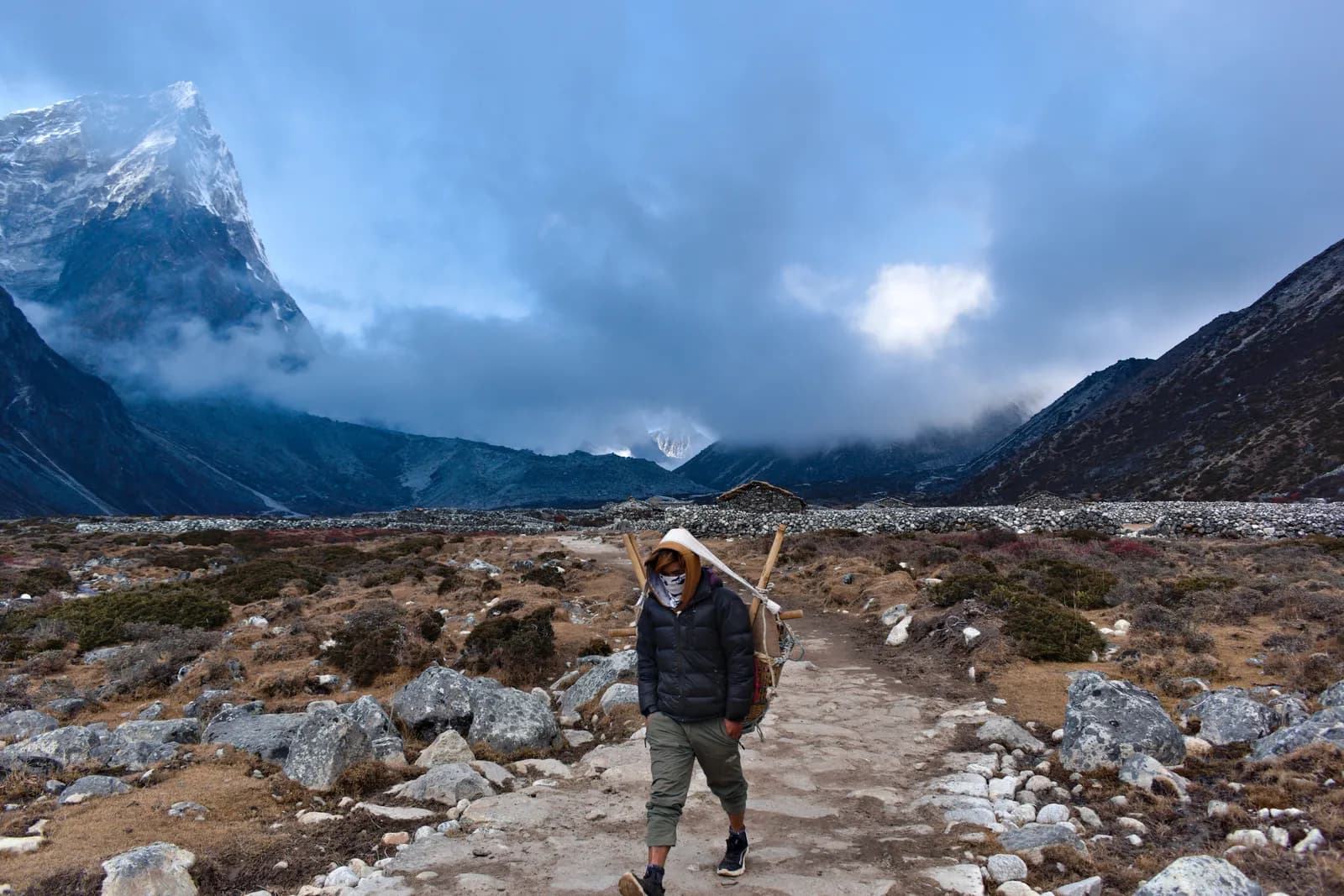
Ethical trekking with porters means three commitments: that the people who carry your bag are properly clothed, sheltered, fed, insured and paid, that their load is within sensible limits, and that you check this before you book instead of assuming it. The International Porter Protection Group (IPPG) sets the standards: adequate clothing and footwear, adequate shelter, food and drink, medical care and life insurance, and an appropriately sized load. Our region pages say about 20 to 25 kg per porter under many agency rules, and a market range for porter day rates is NPR 2,100 to 3,400 as of October 2026. This guide explains the standards, the questions to ask, what you can do on the trail and how packing light is part of ethics.
Everest Base Camp Trekの募集中トリップ
仲間を探しているトレッカーが投稿した実際のトリップです。
Why this matters
On a teahouse trek, a porter carries your main bag so you can walk with a daypack. On a camping trek in Kanchenjunga or Upper Dolpo, porters, mules or yaks carry tents, food, fuel and kitchen equipment as well as personal bags, and the crew spends the night at the same altitude as you in less comfort. MEDEX's Travel at High Altitude booklet says that if you or your travel company hire porters, you are responsible for them and must consider their health and safety as seriously as your own. It adds that porters who work trekking jobs do not always live at altitude all the time and can suffer altitude illnesses in the same way as visitors, and that in the past ill porters were seen as useless, paid off and sent home, with many dying while going down alone.
That is the context for every practical point below. Our guide to guide versus porter roles explains who does what; this post is about how to do it fairly.
The IPPG standards
MEDEX lists the standards the IPPG sets for all parties:
- Clothing and footwear. Adequate for the conditions, including snow and cold at altitude.
- Shelter, food and drink. A proper place to sleep and regular meals, not leftovers or a floor in a corridor.
- Medical care and life insurance. Treatment if ill or hurt, and insurance if the worst happens.
- An appropriate load. A weight that suits the person, the altitude and the terrain.
MEDEX also suggests questions to put to a company or to yourself: whether it follows the IPPG's guidelines on porter safety, what its policy is on equipment and health care for porters, how it trains staff to look after porters' welfare, how it monitors porter care by its local ground operator and whether it asks clients about the treatment of porters in a post-trek questionnaire. We think those are the right questions. Agencies that have answers are usually agencies that have thought about it.
Load limits: what our pages say
Our region and guide pages repeat the same figure from agency practice. The Kanchenjunga region page says porters carry about 20 to 25 kg each under many agency rules and to check how many your group needs. The Dolpo region page says loads should be limited to around 20 to 25 kg and that you should check that your agency provides proper clothing, insurance and shelter for porters. Our guide-versus-porter post says a porter typically carries 20 to 25 kg and usually serves two trekkers, within the limits agencies publish.
A few implications:
- The limit is for the load, not for each trekker. Two trekkers at 15 kg each are at 30 kg, which already exceeds a single porter's limit.
- It applies at altitude. A heavy load is harder at 4,500 m than at 2,500 m, so ask whether the agency reduces loads on high days.
- Count the porters, not the bags. A group of four with 20 kg each needs two or three porters, not one. See what to agree with trekking partners before you book.
- Pack light. The simplest ethical step is to reduce what you ask someone to carry. Read what not to bring.
Remember also that flights have baggage limits: Tara Air publishes 10 kg checked plus 5 kg hand carry on Lukla flights, according to our Lukla flight guide.
Pay: what a range looks like
Pay is part of welfare. Our cost data gives, as of October 2026, a market range of NPR 2,100 to 3,400 a day for a porter and NPR 3,400 to 4,700 a day for a guide in the Everest region, with porter ranges the same across the other regions we cover and guide ranges higher in remote regions such as Kanchenjunga and Dolpo (NPR 4,000 to 6,000). These are market ranges from operator guides, converted at NPR 134 to the dollar, not official rates; we found no current government or TAAN minimum wage on an official page, so we state none.
What matters for you:
- Ask what the agency pays staff, not only what it charges you. The gap between the two is the agency's margin, and a very cheap trek often means somebody is paid or equipped poorly.
- Compare quotes honestly. A package that is far below the ranges in our cost guide deserves questions.
- Agree tipping separately. Tips for guides and porters are customary at the end of a trek, according to our Manaslu page. We do not quote amounts because we have no verified source, so ask your agency what is normal on your route and discuss the plan with your partner. Where you can, give the tip directly to the person.
- Split fairly with partners. If you share a guide and porters, see splitting guide and porter costs fairly between partners.
Questions to ask an agency
Put these in an email before you pay. Good answers are specific.
- What load limit applies to porters, and how many porters will my group have?
- What clothing, boots, sleeping gear and shelter do porters receive at altitude?
- Are porters insured, and what happens if one is ill or injured? Who pays?
- Who is responsible for a porter who cannot continue, and does someone accompany them down?
- What are the working hours, rest days and days off?
- How are porters paid, and are tips pooled or handed over directly?
- Which IPPG guidelines do you follow, and can you say so in writing?
For restricted-area and camping treks, the Dolpo and Kanchenjunga pages say to choose a registered agency that handles the permit and employs insured guides and porters, and to ask who the guide is, how many rest and spare days are built in and what happens if a pass is closed by snow. Our camping gear guide covers what the crew should have.
On the trail: what you can do
Ethical trekking does not end with the contract.
- Ask about the team. Each evening, ask your guide whether the porters have a bed, food and warm clothing, and whether anyone feels unwell.
- Do not overload a bag at the last minute. Do not add a book, a bottle or souvenirs on the morning of a pass day.
- Share what you can. If you have spare warm layers, gloves or a hat, offer them through your guide. Do not make a show of it.
- Respect rest and pace. If a porter is slowing, do not complain; ask your guide what is going on.
- Watch for illness. Porters can get altitude illness. MEDEX's account of porters left ill on the trail, some of whom died going down alone, makes the point that nobody should be left to descend alone. If one seems unwell, tell your guide and agency at once, and be ready to pay for care or descent if you can. Our altitude sickness basics and HAPE and HACE warning signs explain what to look for, though for porters the rule is the same as for you: do not ascend with symptoms.
- Include everyone. Greet the crew, ask names, take photos with permission and thank the cook.
- Speak up. If you see a porter carrying too much, without boots or in snow without proper clothing, say so to your guide and later to the agency, and consider a review.
Guides, porters and the guide rule
The rules about guides and permits affect porter welfare indirectly. In restricted areas such as Upper Dolpo and Kanchenjunga a licensed guide through a registered agency is part of the permit, so the agency will employ the crew; in Annapurna and Langtang, the Nepal Tourism Board rule of April 2023 is enforced at checkpoints, while in Khumbu it is not (checked 19 October 2026). Our guide rule explainer has the details. Whichever route you choose, a regulated agency is not a guarantee of fair treatment; asking questions is.
Hiring directly versus through an agency
Some trekkers hire a porter or porter-guide directly. That can work and can pay more of your money to the person carrying, but you become the employer, with responsibility for insurance, clothing and medical care, as MEDEX says. If you hire directly, ask the porter what they need, agree the load and the rate in advance, arrange insurance and look after them as you would a partner. If you are unsure, hire through an agency that can answer the questions above.
Sharing and planning
Partners can make ethical trekking easier: you share the guide and the porters, so each person's bag counts, and you can agree standards together. Post your dates on a partner page such as Everest Base Camp, Kanchenjunga or Dolpo, and use the questions above before you book. For the rest of the culture and etiquette series, return to the trail etiquette and culture guide, and see the Everest Base Camp, Kanchenjunga Circuit and Upper Dolpo itineraries to see what the crew carries. The best measure of a trek is not the view at the top but whether everyone who made it possible came down healthy.