How much does a trek in Nepal cost? A line-by-line guide
Every cost line of a Nepal trek, which ones scale with group size, altitude and season, and how to build and check your own budget from written quotes instead of guesses.
The total cost of a Nepal trek is the sum of about a dozen lines, and most of them can be checked before you pay anyone. This guide lists every line, shows which ones fall as the group grows, which rise with altitude and which depend on the season, and tells you where to find a reliable number for each. Published figures vary between agencies, change between seasons and are often repeated from out-of-date pages, so every number below carries a date (October 2026) and a source, and the right method is still to ask for written quotes and check permits on official pages.
If you only remember one thing: the guide, the porter and the vehicle are shared costs, and everything else is personal. That is why partners cut the bill, and why a solo trekker should compare quotes more carefully than anyone.
Annapurna Base Camp Trek的开放行程
由正在寻找搭档的徒步者发布的真实行程。

The cost lines of a trek
| Line | Basis | Scales with group size? | Scales with altitude or season? |
|---|---|---|---|
| Park or conservation permit | Per person | No | No, but differs by nationality |
| Local municipality permit (Khumbu) | Per person | No | No |
| TIMS card, where required | Per person | No | No |
| Restricted Area Permit (Manaslu, Upper Mustang) | Per person, per day | No | Season and days |
| Licensed guide | Per day for the group | Yes, falls per person | Season and region |
| Porter | Per day, often per two trekkers | Partly | Season and region |
| Domestic flight (Lukla, Jomsom) | Per person | No | Season |
| Road transfers (bus, jeep) | Per person or per vehicle | Private vehicles yes | Season, road conditions |
| Lodging | Per person or per room | Room sharing helps | Altitude, season |
| Food and drink | Per person | No | Altitude |
| Showers, charging, wifi | Per person | No | Altitude |
| Insurance | Per person | No | Altitude cover |
| Gear rental or purchase | Per person | No | Season |
| Hotels before and after | Per person or per room | Room sharing helps | Season |
| Tips | Per person | No | Custom |
Permits: where to check
Permits are the one line with an official price, and as of October 2026 (checked on 18 October 2026) the foreigner rates are:
- NPR 3,000 for Sagarmatha, Langtang, Makalu Barun, Rara or Shey Phoksundo National Park, for the Annapurna (ACAP) and Manaslu (MCAP) conservation areas, for the Gaurishankar Conservation Area and for the Khumbu Pasang Lhamu trek card. Children under 10 are free for the parks.
- NPR 2,000 for the Kanchenjunga Conservation Area and NPR 1,000 for Shivapuri Nagarjun National Park.
- Restricted Area Permits in USD: Upper Mustang and Upper Dolpo USD 50 a day; Manaslu USD 100 a week plus USD 15 a day from September to November (USD 75 plus USD 10 from December to August); Tsum USD 40 a week plus USD 7 a day (USD 30 plus USD 7 off season); Nar Phu USD 100 a week plus USD 15 a day (USD 75 plus USD 15 off season); Kanchenjunga, Makalu and Rolwaling USD 20 a week.
- The TIMS card is NPR 2,000 for foreigners (SAARC nationals NPR 1,000) per the Nepal Tourism Board; the issuing agency may add a service charge.
Our permits page shows the same table with its sources. For national parks the Department of National Parks and Wildlife Conservation and the Nepal Tourism Board publish the current schedule, conservation areas such as Annapurna and Manaslu are run by the National Trust for Nature Conservation and Restricted Area Permits are issued by the Department of Immigration through registered agencies. Fees differ for foreigners, SAARC nationals and Nepali citizens. Because blogs frequently quote outdated numbers, always check the official page and keep a screenshot. Our permits explainer shows which permit each route needs.
What whole treks cost, as of October 2026
The "What it costs" section on each route page adds lodging, transport, permits, a guide and porters from our dated regional ranges (converted at NPR 134 to the dollar). The table shows the mid-range style, which means a guide plus one porter per two trekkers, for one, two and four people. Lodging and food are priced per night by altitude band, and each estimate leaves out international flights, insurance, hotels in Kathmandu or Pokhara, gear and tips, plus a few legs with no published fare, such as some jeep rides. The figures are per person, rounded outward.
| Route | Days | One trekker | Two sharing | Four sharing |
|---|---|---|---|---|
| Poon Hill | 4 | USD 240 to 370 | USD 170 to 260 | USD 150 to 230 |
| Mardi Himal | 5 | USD 310 to 470 | USD 220 to 330 | USD 200 to 300 |
| Annapurna Base Camp | 7 | USD 430 to 650 | USD 310 to 460 | USD 270 to 410 |
| Langtang Valley | 8 | USD 700 to 1,200 | USD 460 to 750 | USD 360 to 580 |
| Annapurna Circuit | 14 | USD 1,000 to 1,550 | USD 730 to 1,100 | USD 620 to 920 |
| Manaslu Circuit | 14 | USD 1,400 to 2,100 | USD 990 to 1,450 | USD 820 to 1,250 |
| Everest Base Camp | 12 | USD 1,350 to 1,900 | USD 1,100 to 1,550 | USD 1,050 to 1,450 |
| Upper Mustang | 12 | USD 1,600 to 2,250 | USD 1,350 to 1,900 | USD 1,300 to 1,750 |
Read the shape, not just the numbers. On the Manaslu Circuit one trekker pays about USD 1,400 to 2,100 and four sharing pay USD 820 to 1,250 each, because the guide (NPR 3,400 to 4,700 a day) and the Kathmandu to Machha Khola jeep are shared. On the Everest Base Camp trek the flights barely fall with group size, so the saving is smaller. The ranges come from operator guides dated 2026, listed under Sources.
Guide and porter
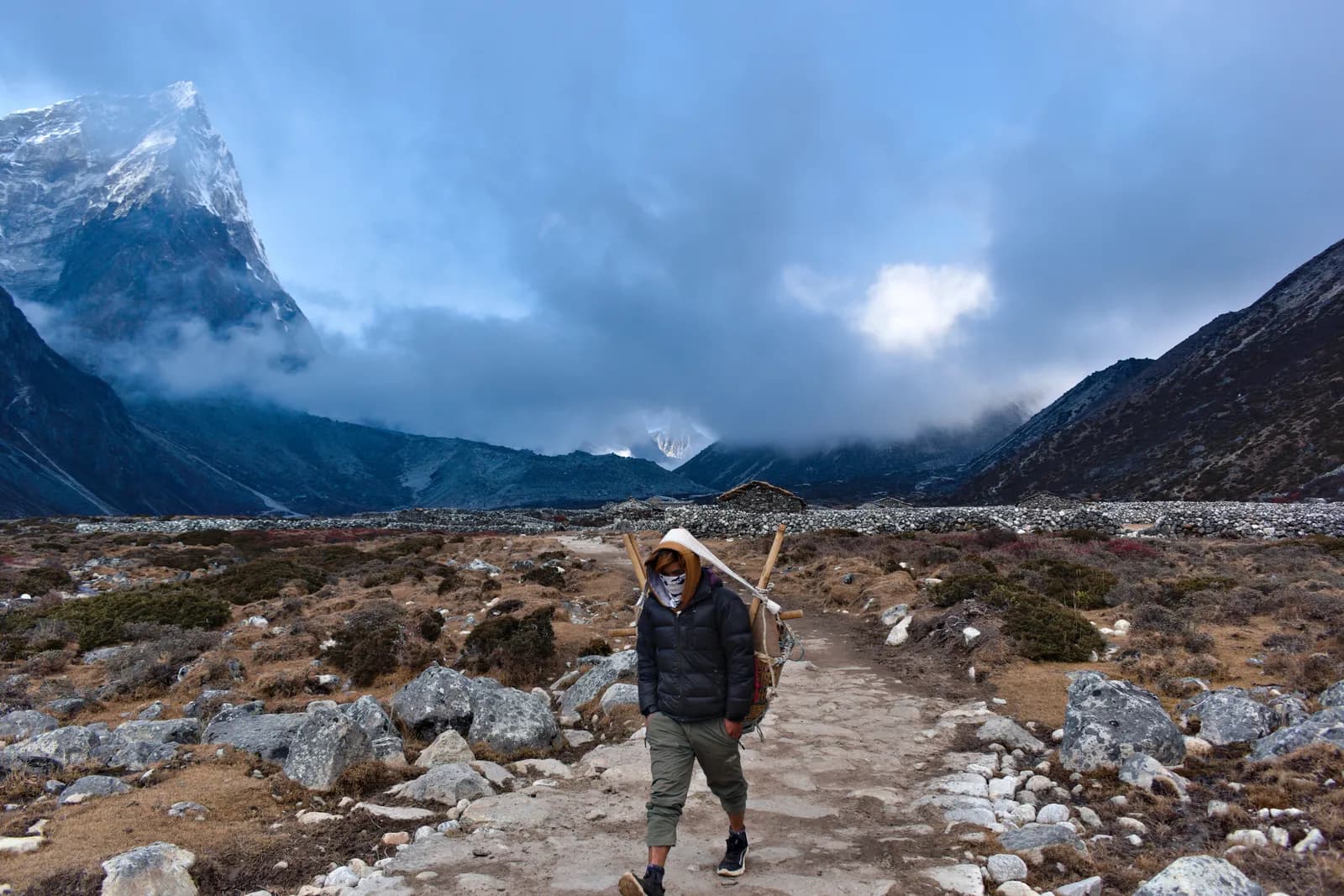
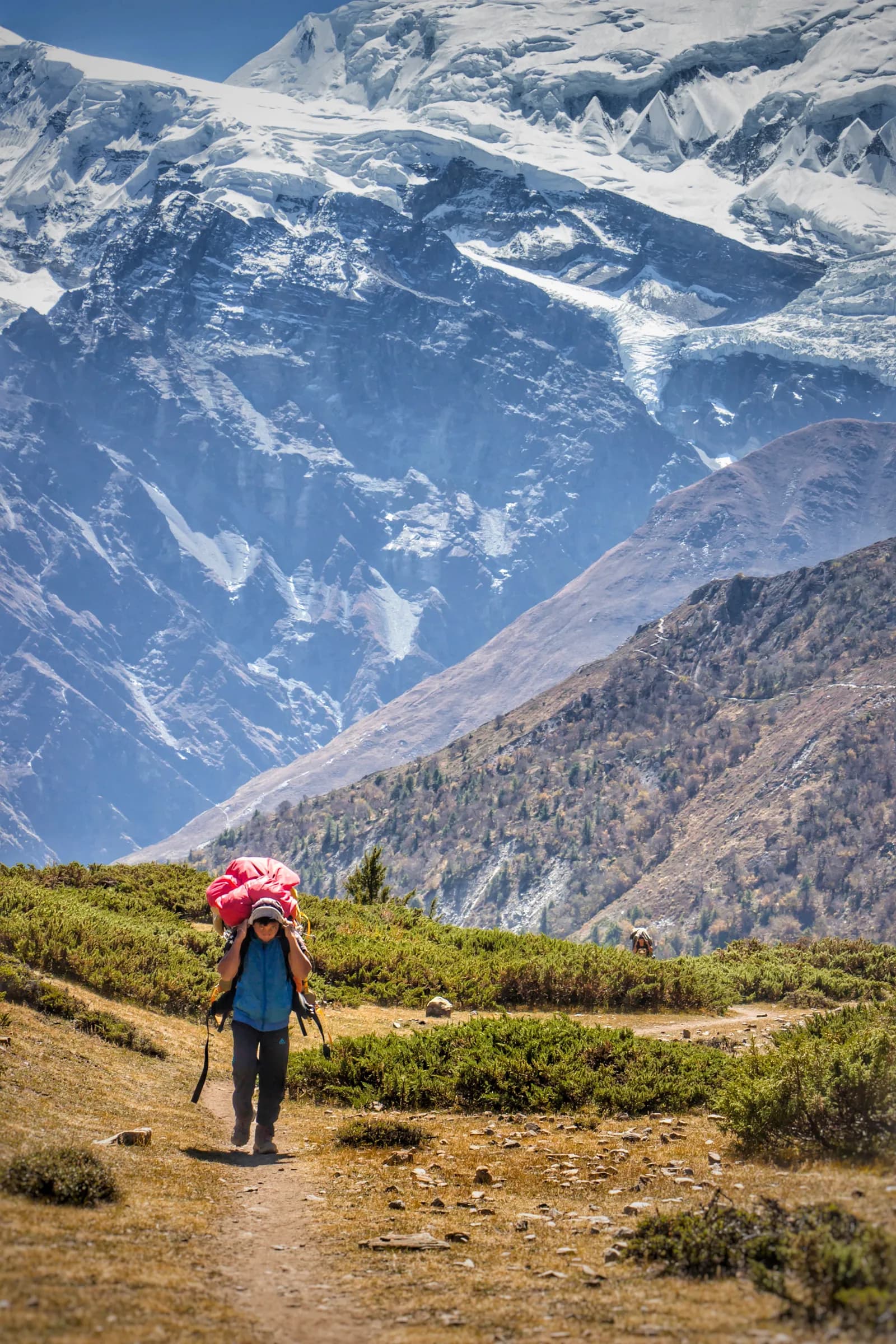
A licensed guide is normally priced per day for the whole group, plus their food and lodging, which agencies often include. A porter is also priced per day and usually carries for two trekkers. Because these are shared, group size matters more than any other variable. Our guide rule explainer has the arithmetic, and our ABC cost worksheet works through a full example with hypothetical inputs you replace with your quotes. Always ask what the daily rate includes and whether the porter's insurance and equipment are covered.
Transport
Flights to Lukla and Jomsom and jeeps to roadheads such as Syabrubesi, Machha Khola and Siwai are the large fixed transport costs. A flight is per person, while a private jeep is per vehicle and gets cheaper per person with a full load. Public buses are cheaper but slower, and road delays can add a night. See the transport guide for timings.
Lodging and food
Teahouse lodging is cheap, because the lodge expects you to eat there, and meal prices rise with altitude as supplies are carried higher. Dal bhat with refills is the best value on the menu. Hot showers, charging and wifi are usually extra and become more expensive at higher stops. A sensible way to budget is to ask your agency or two lodges for current menu prices at the stops above 3,500 m and multiply by days.
Insurance and emergencies
Travel insurance that covers helicopter evacuation at altitude is not a luxury. Check that it covers trekking up to the highest altitude of your route, ideally to 6,000 m, and that the insurer will pay the rescue company directly or reimburse quickly. The Himalayan Rescue Association publishes medical advice for trekkers, and our altitude sickness basics explains when to descend.
Costs people forget
- Nights in Kathmandu or Pokhara before and after the trek.
- Extra days when flights or roads are delayed.
- Gear rental or purchase, especially down jackets and sleeping bags.
- Tips for the guide and porters.
- Currency exchange costs and cash for places without machines.
- Visa fees and international flights, which are outside this guide.
How to build your own budget
- List the route, days and group size.
- Check each permit on its official page.
- Ask two or three registered agencies for a written, line-by-line quote with what is included.
- Ask two lodges for current menu prices at the highest stops.
- Add insurance, hotels, gear and a buffer for delays.
- Put it in a spreadsheet and divide the shared lines by group size.
A budget template to copy
| Line | Quote or source | Days or units | Total | Per person (divide shared lines by group size) |
|---|---|---|---|---|
| Park or conservation permit | Official page | 1 | ||
| Restricted Area Permit, if any | Agency quote | days | ||
| Guide | Agency quote | days | ||
| Porter | Agency quote | days | ||
| Flights or jeep | Agency or airline quote | legs | ||
| Lodging | Lodge menu or agency | nights | ||
| Food | Lodge menu | days | ||
| Extras (showers, charging, wifi) | Estimate | days | ||
| Insurance | Insurer quote | 1 | ||
| Hotels before and after | Hotel quote | nights | ||
| Gear rental | Shop quote | 1 | ||
| Tips and buffer | Your plan | 1 |
Paying safely
Pay agencies and guides directly, ideally at a registered office, and never send money in advance to someone you have not met. Get the quote in writing with what is included, the cancellation rules and the payment schedule. If a price is far below the others, ask what has been removed. Keep receipts for permits and agency payments until the trek is over, and make sure every member of a group sees the same quote before anyone pays.
Regional differences
Everest trips add the Lukla flight and a local municipality permit. Annapurna routes mostly need a road transfer and a conservation permit. Langtang adds a long road transfer. Manaslu and Upper Mustang add a restricted-area permit and an agency, making guide and permit the largest lines. See the regions guide for access and permits and the Everest Base Camp route page and Annapurna Base Camp route page for the day plans these costs sit on.
Saving money without cutting safety
Share the guide and transport with partners, stay in basic lodges, travel in the shoulder months, rent rather than buy gear and carry a filter instead of buying bottled water. Do not cut acclimatisation days, insurance or the licensed guide in restricted areas. If you want partners, see how to find a trekking partner safely.
规划这条徒步路线
照片
常见问题
来源
- Nepal Tourism Board
- Department of National Parks and Wildlife Conservation, Nepal
- Department of Immigration, Nepal
- National Trust for Nature Conservation (ACAP)
- Himalayan Rescue Association
- Nepal Tourism Board: Park Entry Fees
- Nepal Tourism Board: Trekking Permit (restricted areas)
- Himalayan Partner: Guide and porter price in Nepal 2026
- Third Rock Adventures: Nepal trek budget planner