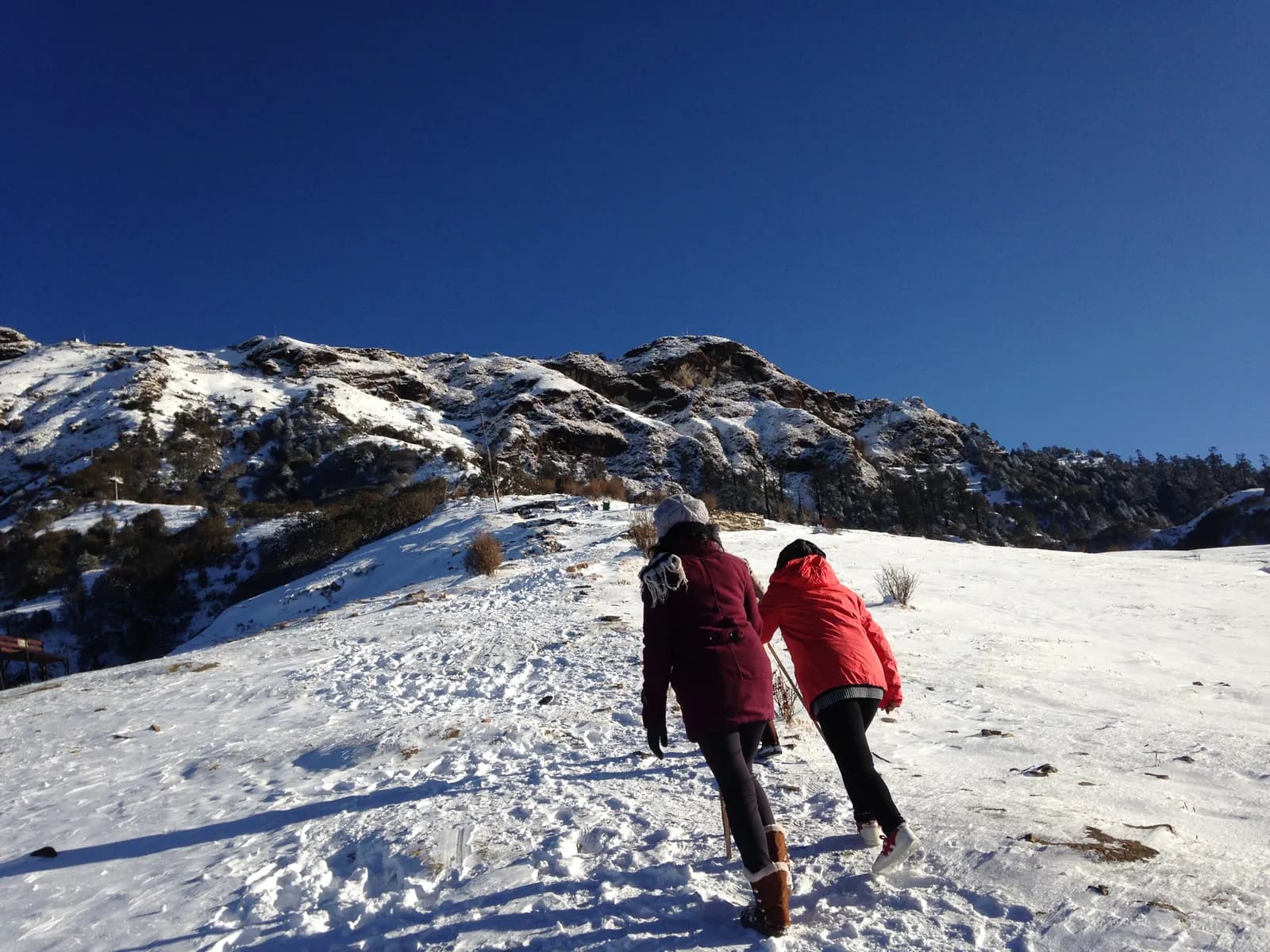
Winter trekking in Nepal, what to expect
What winter trekking in Nepal is really like from December to February: cold nights, short days, closed lodges and avalanche paths, where it works, where it does not, and how to decide each day.

Winter trekking in Nepal, from December to February, is cold, dry and quiet, with the best mountain visibility of the year and the hardest conditions on the high routes. Low and mid-altitude routes such as Poon Hill, Ghandruk, Helambu, the Pokhara foothills and the Kathmandu Valley rim stay walkable, while passes, glacier valleys and the restricted areas are snowbound, with lodges closed or empty. Plan around three limits: cold at night, daylight of only about 10.4 to 11.2 hours in Kathmandu by our calculation, and the chance that snow closes the route for a day or more.
This guide is the overview for the winter series. It explains what to expect, how to judge routes by altitude, what to ask before you move each day and what to pack. For month detail read December, January and February. Everything below comes from our region and route pages, checked on 19 October 2026, unless a source is named.
Trip terbuka di Poon Hill Trek (Ghorepani)
Trip sebenar yang disiarkan oleh pendaki yang mencari rakan.

What winter is like
Visibility. Winter air is dry and mornings are often the clearest of the year. The Poon Hill route page lists December to February as "cold, clear" beside the spring and autumn seasons, and our Kathmandu Valley page says views can be excellent after a clear night.
Cold. Our Everest page describes very cold weather, with temperatures far below freezing at altitude. An operator quoted on the Dhaulagiri page gives Hidden Valley night lows of minus 15 to minus 25 degrees Celsius, and the Kanchenjunga page says to dress for minus 15 at Lhonak and Ramche even in autumn and spring. Those are high camps, but they show the scale: the cold is not a small variation on autumn.
Heating. Dining rooms are usually warm and bedrooms are not. Our Langtang page describes stove-heated dining rooms and rooms with no heating, the Manaslu page says rooms are often unheated, the Jugal Himal page says there is no heating beyond a stove in the dining room, and the Everest page says high lodges burn yak dung or imported fuel because the forest is protected. Your sleeping bag is your heating.
Short days. On a flat horizon Kathmandu has about 10.8 hours of daylight in mid-November, 10.4 in mid-December, 10.6 in mid-January and 11.2 in mid-February, by our calculation. Valley walls cut the light further. Our daylight guide explains how to plan the day around it.
Closed lodges. Our Everest page says high lodges begin to close late in November, the Langtang page warns that lodges at the top may be closed, the Rara page says lodges close toward the end of November, and the Upper Mustang and Manaslu pages describe most lodges closed or upper villages often empty. Confirm with your agency before you set off.
Snow and avalanche risk
Snow is the main uncertainty. It slows walking, hides the trail and, on steep ground, brings avalanche risk. Our Annapurna page warns of avalanche risk in the Sanctuary between Deurali and Machhapuchhre Base Camp after snowfall, especially in spring and winter, and says to ask lodge owners before moving. Our Langtang page says avalanche paths cross the upper valley and not to stop or camp in them, especially in winter and early spring. The Rara page says heavy snow closes some trails and flights from December to February, and the Khaptad page, citing the Great Himalaya Trail, says winter snow closes the park from late December to the end of February.
The practical rule is to treat snow as information, not an obstacle to beat. Ask the lodge owner and recent trekkers what the next section looks like, start before the sun softens the snow, and be ready to turn back. Our snow and high pass conditions guide explains how it affects the passes.
Which routes work
A simple ladder follows from our region pages:
| Altitude band | Routes | Winter verdict |
|---|---|---|
| Below about 2,600 m | Kathmandu Valley rim walks, Pokhara foothills, Panchase (about 2,500 m) | Good; cold mornings but clear |
| Up to about 3,000 m | Poon Hill (sleeping 2,860 m, summit 3,210 m), Ghandruk | Good; snow and ice possible at Ghorepani |
| Up to about 3,700 m | Helambu (Tharepati 3,650 m) | Workable; cold at the top, easy to shorten |
| Up to about 3,900 m | Langtang Valley (Kyanjin Gompa 3,870 m) | Experienced walkers only; lodges at the top may be closed |
| Above about 4,000 m | Everest Base Camp, Gokyo, Annapurna Circuit, Manaslu, Upper Mustang | Not recommended without winter experience; lodges closed, passes unsafe |
The bands are our reading of the region pages, not an official rule. Our Solu page says winter brings snow above about 3,000 m and short days, and our Kathmandu Valley and Pokhara pages describe low walks as cold but dry. The Everest Base Camp route is described as very cold with some lodges shut above Dingboche in our January guide and as possible only for experienced, well-equipped trekkers.
Altitude does not take a winter break
The CDC Yellow Book's rule for ascent applies in every season: once above 3,000 m, move sleeping altitude by no more than 500 m a day, and add an extra acclimatisation day for each additional 1,000 m gained. Cold makes that harder to follow, because trekkers tempted by short days tend to climb too fast, and it makes problems harder to manage, because help is further away and lodges may be shut. Read the altitude sickness basics and the acclimatisation schedule before you go above 3,000 m.
A daily go or no-go checklist
Winter trekking is a series of small decisions. Before you leave each lodge, ask:
- What did the night bring? Fresh snow at your level or above changes the day.
- What do the owner and recent trekkers say about the next section? Ask specifically about snow depth, ice and avalanche paths.
- Is there time? Count the daylight hours and your walking time from our route plan, add a margin, and be at your next lodge before dark.
- Is the next lodge open? Confirm by phone or through your guide.
- Are we dry and warm? Wet clothing and wind turn a mild day dangerous.
- Is the group fit and together? The slowest person sets the pace; do not split up.
If the answers are uncertain, shorten the day or wait. Our buffer days guide explains why a spare day or two is part of a winter plan.
What to pack
- Sleeping bag rated well below the coldest night you expect; see sleeping bag ratings for Nepal.
- Down jacket, warm hat, insulated gloves and a thin pair for tasks; renting in Kathmandu is an option, as our down jacket guide explains.
- Waterproof boots and warm socks, with microspikes for icy sections; see crampons and microspikes.
- Insulated bottle, sun protection for snow glare and a headlamp with spare batteries.
- Layers you can add and remove, because the sun is warm and the shade is not.
Our general packing list covers the rest.
Permits and costs
Park and conservation area permits do not change with the season: as of October 2026 the ACAP permit is NPR 3,000 for foreigners, with online payment adding a 2.9% gateway charge and a permit issued at a check post costing double, and the Langtang National Park permit is NPR 3,000. Restricted-area permits for Manaslu, Tsum Valley and Nar Phu are priced lower from December to August than from September to November, but those regions are snowbound in winter. The lodge, guide and transport lines are not tracked by month, so a quiet month does not mean a cheap one; some lodges simply have fewer supplies. See the daily budget guide and the permits page.
The guide rule in winter
The Nepal Tourism Board announced in April 2023 that foreign trekkers must use a licensed guide in national parks and conservation areas. We found no separate Department of Immigration or park-authority notice, and 2026 operator reports say checkpoints enforce it in Annapurna and Langtang, the strictest, and most other parks, but not in Khumbu, where the municipality opted out (checked 19 October 2026). In restricted areas a licensed guide through a registered agency is part of the permit. In winter a guide also brings local knowledge of snow and lodges; see the guide rule explainer.
Who should go
Winter suits people who like quiet, cold and clear days, who are flexible and who own a warm sleeping bag. It does not suit first-time trekkers who want a high-altitude goal, people with poor circulation or anyone who cannot accept a day lost to snow. If you are new, read the first-time trekking guide and which Nepal trek is right for you, then pick a low route and find partners on the Poon Hill partner page. For other routes see the Annapurna, Langtang, Everest and Rara regions. All our seasonal guides are in the seasons and weather hub.
Rancang trek ini
- Panduan wilayah Everest (Khumbu)
- Panduan wilayah Annapurna
- Panduan wilayah Langtang
- Panduan wilayah Rara
- Trekking partner for Poon Hill Trek (Ghorepani)
- Trekking partner for Helambu Trek
- Find someone to trek Langtang Valley Trek with
- Trekking partner for Everest Base Camp Trek
- Itinerari Poon Hill Trek (Ghorepani)
- Itinerari Helambu Trek
- Itinerari Langtang Valley Trek
- Itinerari Everest Base Camp Trek