What to wear on Nepal trails: dress and modesty
How to dress on a Nepal trek so you are warm, practical and respectful: what covering shoulders and knees means in villages and at monasteries, what to wear at temples, shrines and homestays, what to avoid, and a scarf-and-sarong kit that solves most situations.
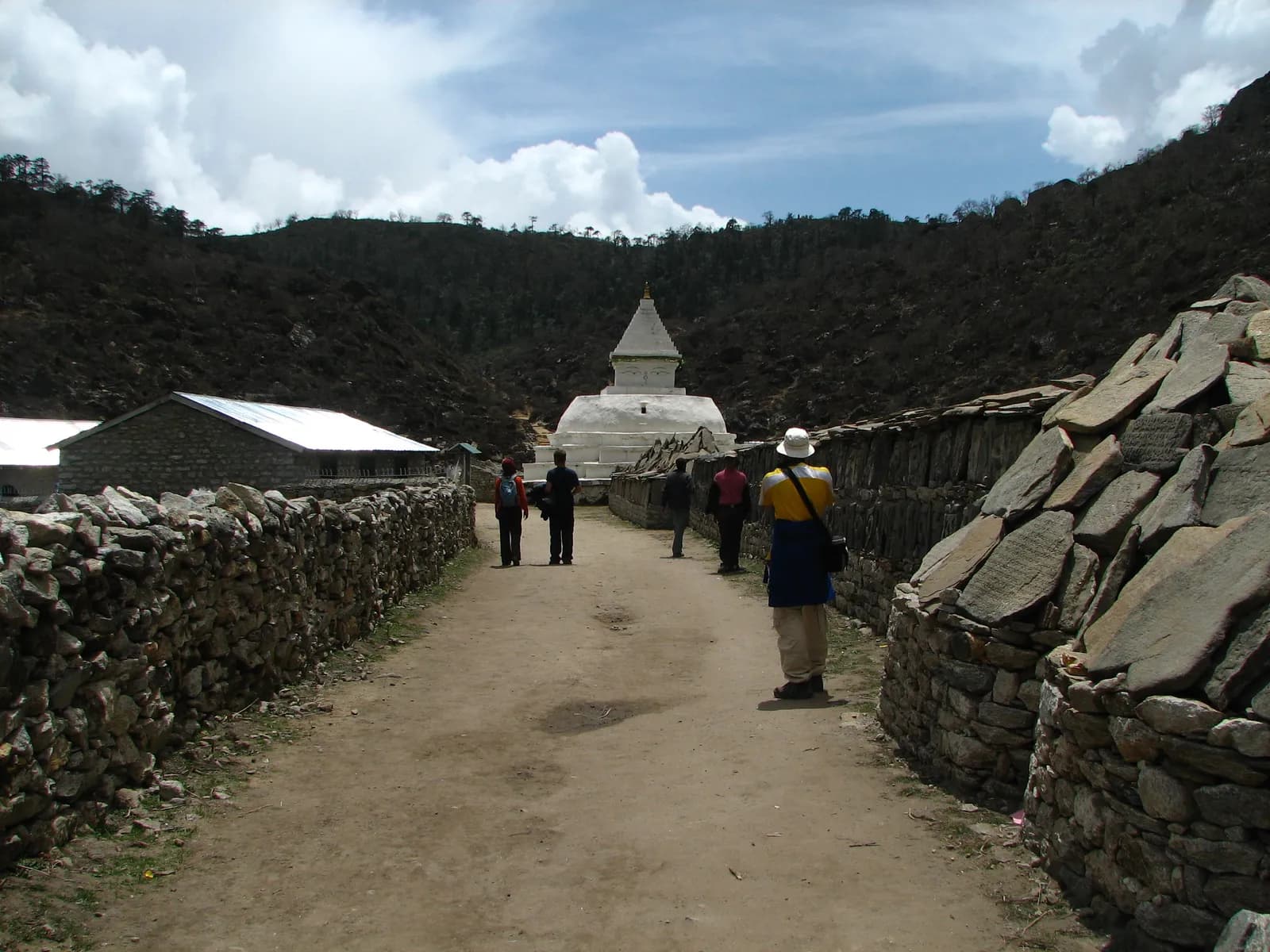
The rule our route pages repeat is simple: dress modestly in villages and in religious places, which in practice means covering your shoulders and knees, avoiding tight or revealing clothes and carrying a scarf or shawl for monasteries. A set of trekking trousers, a short-sleeved or long-sleeved top, a layer to throw on over it and a light scarf or sarong will satisfy every situation on the trail, from a tea stop in a Gurung village to the prayer hall of a Tibetan monastery. The rest of this guide explains where the line falls, why it falls there and how to dress for comfort and respect at once, using what our region and route pages say.
Our broader trail etiquette and culture guide puts dress in a list of habits: cover shoulders and knees in religious places, and avoid revealing clothes in villages. The reasons are not complicated. You are a guest in communities where many people are Buddhist or Hindu and where bare skin in a place of worship or at a family home is uncomfortable for hosts. Also, much of the trail is cold, dusty and sunny, and the clothes that cover you are usually the clothes that protect you.
Namo Buddha Day Hike के ओपन ट्रिप
पार्टनर खोज रहे ट्रेकर्स के असली ट्रिप।

What the route pages say
The same instruction appears in many places:
- Annapurna: walk clockwise around mani walls and stupas, dress modestly in religious sites and ask before photographing people.
- Everest: dress modestly in villages, remove shoes before entering a monastery and do not touch prayer wheels with your left hand or step over anything sacred.
- Manaslu: dress modestly in villages and monasteries and ask before photographing people.
- Upper Mustang: dress modestly in towns and monasteries and ask before photographing people.
- Tsum Valley: dress modestly and ask before taking photographs inside monasteries, and carry a scarf or shawl to wear in monasteries.
- Khaptad: treat the ashram, Tribeni and the lake as shrines, dress modestly and keep noise down.
- Short hikes near Kathmandu: dress modestly at the Nagarkot and Changu Narayan temple, remove shoes before entering temples at Namo Buddha, and dress modestly at the Peace Pagoda stupa in Pokhara.
If a guide or lodge owner asks you to cover up, do it without argument. They know the community.
What modest dress looks like
Legs. Trekking trousers, convertible trousers, long tights under a skirt, or a long skirt or sarong. Shorts above the knee are fine on a remote path in good weather, but carry something to pull on at villages and monasteries.
Shoulders and chest. A top with short or long sleeves and a neckline that is not low. Sleeveless tops and bare backs are best kept for the privacy of your room. Wool and synthetic tops with sleeves also protect against sun and cold.
Midriff. Cover it. A cropped top is not suitable in villages.
Head and neck. A scarf or buff doubles as sun protection and a head covering where needed. The Upper Mustang page lists a buff or scarf for dust.
Feet. Keep boots on the path and take them off where others do, at doors, inside monasteries and at many homes. Wear clean socks, because you will often be in them. Camp shoes or sandals are easy to slip on and off.
Swimwear. Our Tamang Heritage Trail page notes a swimsuit for the Tatopani hot springs. Use it only where others bathe, and wrap up between the pool and the lodge. Do not swim in sacred or village water sources: our Rara and other pages ask you not to swim in or wash in lakes, and the etiquette guide says not to bathe in sacred water.
At monasteries, temples and shrines
At religious sites the standard is higher. Cover shoulders and knees, wear a scarf or shawl, remove your shoes where others do, keep your voice low and put your phone on silent. Do not touch paintings, statues or ritual objects, and ask before photographing. Our monastery etiquette guide goes through the objects you will meet, and photography etiquette covers the camera.
Some sites are sacred to more than one tradition. Our etiquette guide notes Muktinath, below Thorong La on the Annapurna Circuit, which is a temple complex sacred to both Hindus and Buddhists, and Gosaikunda in Langtang, an alpine lake complex associated with Hindu pilgrimage. Dress modestly, remove shoes where asked, do not bathe or wash in sacred water and leave offerings alone. If you are unsure, watch what the pilgrims do or ask your guide.
Khaptad is another example. The Khaptad page tells you to treat the ashram, Tribeni and the lake as shrines. The route is a quiet national-park walk, but the same rule applies as at a monastery: modest clothes, low voices.
Dressing for comfort and respect together
The practical clothing for the trail is usually modest by default.
- Lower altitude and monsoon months: light, quick-dry trousers and a loose, long-sleeved shirt protect against sun, scratchy vegetation and insects. Rain jackets cover the rest.
- Mid altitude: layers of wool or synthetic base layer, a fleece and a shell cover the body, and a hat and gloves finish it. You will look modest without effort.
- High altitude: the same, plus a down jacket. Warmth makes modesty automatic.
- Dust and wind: the Upper Mustang pages say to carry a windproof jacket and trousers, sunglasses with side protection and a buff or scarf for dust.
- Sun: long sleeves and a brimmed hat are cooler than bare skin at altitude. Sunscreen and lip balm do the rest.
Our Nepal trek packing list and women's gear guide cover the clothing in more detail, and what not to bring suggests leaving cotton and jeans at home.
Homestays and village homes
In a homestay or a family lodge, you are in someone's house. Wear clean, covering clothes at meals, take your shoes off at the door, and keep your room tidy. Ask before taking photographs of people inside the house, and follow the host's lead on where to sit and what to touch. Our teahouse etiquette guide and guide to visiting local homes cover meals and gifts.
Washing and changing
Many lodges have shared bathrooms and thin walls. Wear a wrap or sarong between the shower and your room. Do not wash clothes or yourself in streams or lakes that people drink from, and keep soap away from water. A sarong also works as a changing screen, a towel and, when you need it, a skirt. It is the single most useful item in a modest-dress kit.
A modest-dress kit
For most treks, add these items to your packing list:
- one pair of light trekking trousers and one of long tights,
- two tops with sleeves, one wool or synthetic,
- a scarf or shawl, light enough to live in your day bag,
- a sarong or wrap,
- a buff for dust and sun,
- clean socks and camp shoes for evenings,
- a light layer to throw on over what you are wearing.
Respect goes both ways
Dress is one part of a broader courtesy. You will see local women and men dressed differently from you and from each other; do not copy or comment, and do not assume that being modest is something only done to visitors. Learn a few words, ask questions and thank people; see basic Nepali phrases for trekkers.
Planning and sharing
If you are sharing a trek with a partner, agree the basic standards before you go, so one person's choices do not embarrass the other. Our guide to what to agree with trekking partners before you book covers it. The Khaptad partner page and the Annapurna Circuit partner page list people planning trips. For other customs on the trail, return to the culture and customs guide. Dress for the weather first, and for the people second; with a scarf in your day bag, you rarely have to choose.
For route detail see the Everest region guide and the Annapurna region guide, and the Namo Buddha hike for a short temple walk.
इस ट्रेक की योजना बनाएँ
- Everest (Khumbu) क्षेत्र गाइड
- Annapurna क्षेत्र गाइड
- Kathmandu Valley क्षेत्र गाइड
- Khaptad क्षेत्र गाइड
- Namo Buddha Day Hike trekking partners
- Nagarkot to Changu Narayan Day Hike trekking partners
- Find someone to trek Khaptad National Park Trek with
- Namo Buddha Day Hike यात्रा-कार्यक्रम
- Nagarkot to Changu Narayan Day Hike यात्रा-कार्यक्रम
- Khaptad National Park Trek यात्रा-कार्यक्रम