Permit checkpoints on Nepal treks, what to expect
Where the permit checkpoints are on the main Nepal treks, what staff look at, how guide and TIMS checks differ by region as of October 2026, and how to pass through quickly.

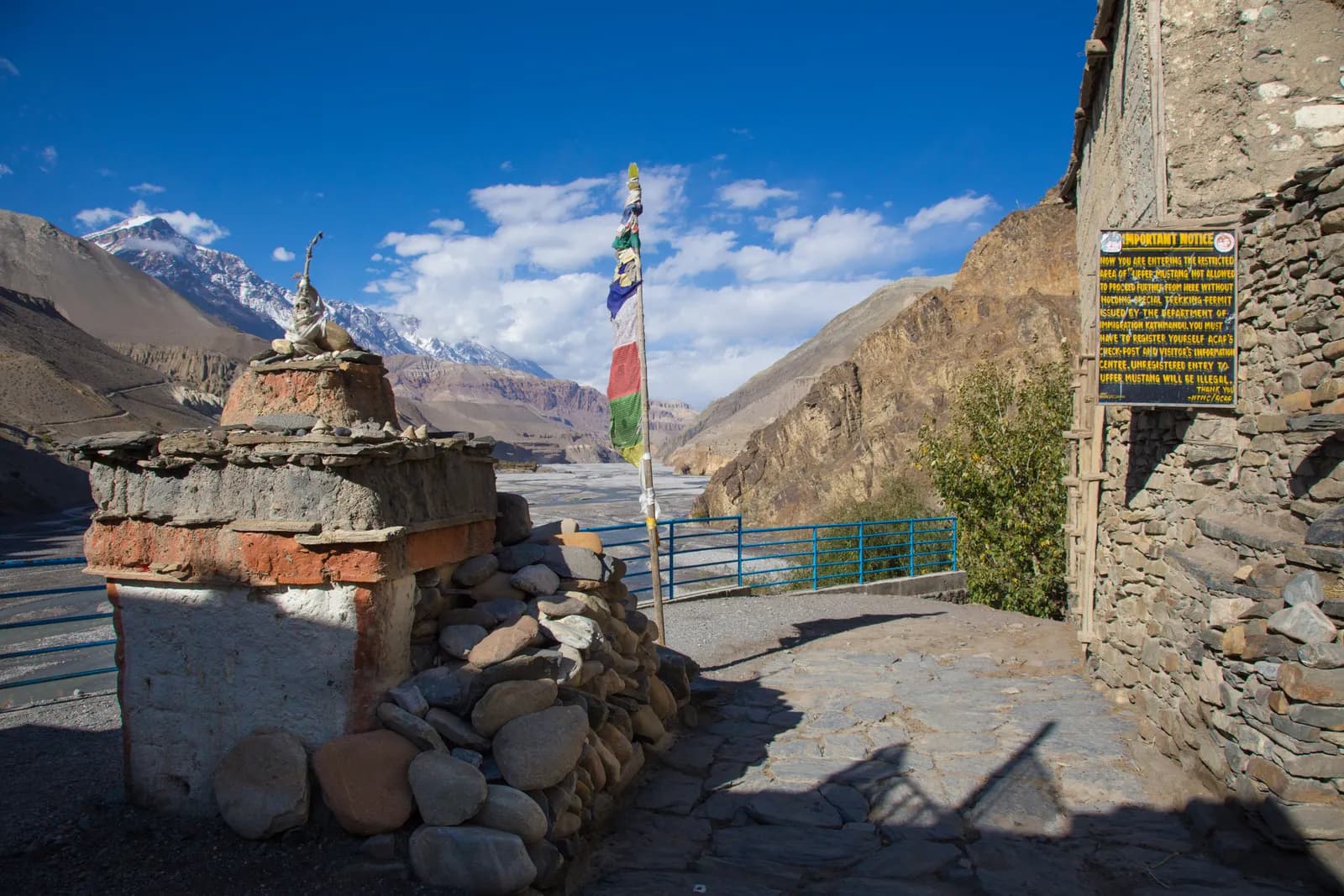
A permit checkpoint on a Nepal trek is usually a small office or a desk at the edge of a village where a staff member writes your name and permit number in a ledger. As of October 2026 the main checkpoints on our route plans are Birethanti or Siwai for the Annapurna Sanctuary and Poon Hill, Besisahar and Chame on the Annapurna Circuit, Monjo in Sagarmatha National Park, Syabrubesi for Langtang, Kagbeni at the start of Upper Mustang, and Jagat, Philim, Namrung and Samagaun on the Manaslu Circuit. What the staff check differs by region: permits everywhere, a licensed guide in Annapurna and Langtang, the TIMS card in some places, and in restricted areas that the guide and permit match the people walking.
This guide explains what to expect at each, what to carry and how the guide rule shows up at the desk. It is based on our route and region pages and on the sources listed below, with the guide-rule framing checked on 19 October 2026.
رحلات مفتوحة في Poon Hill Trek (Ghorepani)
رحلات حقيقية نشرها متنزهون يبحثون عن شركاء.

What a checkpoint is for
Checkpoints serve two purposes. They collect or verify the entry fee for a protected area, and they record who is on the trail, which helps if weather closes a pass or a landslide blocks a road. Some do both and some only one. A national park gate such as the one at Monjo checks the park permit. A conservation area post inspects the ACAP or MCAP permit. A restricted-area post, such as Kagbeni on the way to Upper Mustang or Jagat on the Manaslu Circuit, checks the Department of Immigration permit. For the full list of permit types see Nepal trekking permits explained.
Checkpoints by route
Our route and region pages name these checkpoints. If your route is not listed, ask your agency or guide:
| Route or area | Checkpoint | What is inspected |
|---|---|---|
| Poon Hill, Annapurna Sanctuary | Birethanti, or Siwai for the Sanctuary | ACAP permit; guide in practice |
| Annapurna Circuit | Besisahar, Chame and elsewhere | ACAP permit; guide in practice; TIMS varies |
| Everest Base Camp, Gokyo | Monjo (Sagarmatha National Park) and the Khumbu trek card point near Lukla | Park permit and Khumbu card; no guide check |
| Langtang Valley | Syabrubesi, with the park entrance at Dhunche | Park permit, TIMS, guide in practice |
| Upper Mustang | Kagbeni | Restricted Area Permit and ACAP; guide required |
| Manaslu Circuit | Machha Khola, Jagat, Philim, Namrung, Samagaun | Restricted Area Permit, MCAP, ACAP, guide |
| Nar Phu | Koto | Restricted Area Permit, ACAP |
| Makalu | Seduwa | Park permit |
| Dolpo | Juphal or Sulighat | Park permit; restricted permit for Upper Dolpo |
The Poon Hill route page notes that permits are checked at Birethanti on day 1, and the Manaslu Circuit page puts the Restricted Area Permit check at Jagat on day 2. Our Langtang Valley page describes Syabrubesi as a village with a permit checkpoint, and the Everest Base Camp page covers Monjo and the Khumbu trek card.
What staff look at
You can expect up to four checks, depending on the area:
- The permit. Staff compare the permit with your passport and record your name and permit number. On some routes they take a photocopy.
- The guide. In the Annapurna Conservation Area and in Langtang, the Nepal Tourism Board rule of April 2023 requires a licensed guide in national parks and conservation areas, and 2026 operator reports say the checkpoints enforce it. We found no separate Department of Immigration or park-authority notice for that rule, so it rests on the Board's announcement and on what checkpoints do in practice. In Khumbu the municipality opted out of the rule and issues its own trek card, so the guide is not checked there (checked 19 October 2026). In restricted areas a licensed guide through a registered agency is part of the permit; the Department of Immigration restated this in June 2026.
- The TIMS card. Our permit data records that checkpoint practice in 2026, from operator reports, has TIMS checked in Langtang and some other regions, varying in Annapurna and not used in Khumbu. The Nepal Tourism Board TIMS page lists a licensed guide with TIMS for listed routes from 31 March 2023. TIMS is issued by agencies at NPR 2,000 for foreigners (SAARC nationals NPR 1,000) per the Board, so ask what your agency charges in total.
- The route and dates. On restricted-area routes the permit lists your itinerary and dates, so a change of route or an unplanned extra day needs the agency to sort it out.
For a fuller explanation of who needs a guide and why, read the guide rule explainer and the guide rule page.
What to carry
Staff will ask for the original permit and often for your passport. Carry:
- The original permits in a zip bag, and a photocopy or clear photo of each.
- Your passport, or at least a photocopy of the photo page and the visa page, although staff may want to see the original at a restricted-area checkpoint.
- Your TIMS card, if you have one, and the Khumbu trek card receipt in the Everest region.
- A few passport-sized photos for any form that has to be filled in on the spot. Our permit paperwork checklist covers what to bring.
Keep the paper permits until you leave the park or conservation area. The Everest and Annapurna region pages both say checkposts inspect them in more than one place along the route, so do not stash them at the bottom of a duffel carried by a porter who is a day ahead of you. Keep them in your day pack.
Money at the checkpoint
The costs at a checkpoint should not surprise you. As of October 2026 the Annapurna (ACAP) and Manaslu (MCAP) conservation area permits are NPR 3,000 for foreigners if bought through the NTNC e-permit page or in Kathmandu or Pokhara, but a permit issued at a check post costs double, and online payment adds a 2.9% gateway charge. The Sagarmatha National Park permit and the Khumbu Pasang Lhamu trek card are NPR 3,000 each for foreigners, per the Nepal Tourism Board and the municipality (the trek card fee comes from the municipality's archived page of 13 June 2026). Children under 10 are free for the park and conservation area permits. See the ACAP permit guide and the Sagarmatha permit guide for details. Carry enough rupees for fees that are paid on the trail.
How to pass quickly
- Buy the permits before you leave. The double fee at a check post is the main reason, but queues are the second.
- Have the paperwork ready as you walk in. The staff member records the details, so have the permit in your hand rather than in the bag.
- Let the guide handle the conversation. If you have a guide, they will usually do the talking and show their licence.
- Be patient in the busy months. Our region pages describe April and October as the peak months, when lodges fill, so expect more people at the desk too.
- Arrive in daylight. Our sources give no opening hours, so ask your guide or lodge about local practice, and plan the day so you do not reach a checkpoint after dark.
If something is wrong
A name misspelt, the wrong dates or a missing stamp is easier to fix at the start than at the next checkpoint. Check every line of each permit before you leave the office. If a checkpoint refuses to let you pass, ask what is missing, stay calm, and call your agency. Our guide on what happens if you trek without a required permit covers the consequences, and the guide on what to agree with partners covers who holds the group paperwork.
Travelling with partners
When partners share a trek, everyone's permits should be bought for the same route and dates, and each person should photograph everyone else's permit. A person who joins late or leaves early changes nothing for a park permit, but for a restricted-area permit the agency has to list every trekker. If you are still looking for people to walk with, use the Everest Base Camp partner page or the Manaslu Circuit partner page, and browse the Annapurna, Langtang, Everest and Manaslu regions for routes. All our rules guides are in the permits and rules hub.
خطط لهذه الرحلة
- دليل منطقة Everest (Khumbu)
- دليل منطقة Annapurna
- دليل منطقة Langtang
- دليل منطقة Manaslu
- Trekking partner for Poon Hill Trek (Ghorepani)
- Find someone to trek Manaslu Circuit Trek with
- Trekking partner for Everest Base Camp Trek
- Find someone to trek Langtang Valley Trek with
- مسار Poon Hill Trek (Ghorepani)
- مسار Manaslu Circuit Trek
- مسار Everest Base Camp Trek
- مسار Langtang Valley Trek
الصور
الأسئلة الشائعة
المصادر
- NTNC e-permit (ACAP and MCAP)
- Nepal Tourism Board: Park Entry Fees
- Nepal Tourism Board: TIMS Card
- Department of Immigration, Nepal
- Kathmandu Post: Everest region, Nepal Tourism Board dispute over solo trek ban heats up (3 April 2023)
- Annapurna Guide Requirement 2026: What the Rules Mean in Practice (Awesome Holidays Nepal, operator report)
- Is a Guide Mandatory for Langtang Valley Trek 2026? (Trekkers Nepal, operator report)