Down Jacket for Nepal: Rent or Buy in Kathmandu
For one Nepal trek, rent your down jacket in Thamel or Pokhara; for a second trek or a cold-season route, buy. Includes a fill-power guide and a decision table.

For a single Nepal trek, a down jacket is the most sensible thing to rent, and for a second trek, or a cold-season route, it becomes one of the few items worth buying. Rent it in Thamel or Pokhara if this is your one big trek and you will not wear it at home; buy it if you trek regularly, if you run cold, or if you want a jacket whose fit and condition you control.
What matters in both cases is not the price tag or the logo but warmth, fit, cleanliness and whether it will stay dry.
Looking for someone to share a trek with? See trekking partners in Nepal.
This guide helps you decide, explains what the numbers on a down jacket mean, lists what to check in a Kathmandu rental shop and shows where on our routes the jacket actually earns its place. Our general packing list covers the wider layering system, and the sleeping bag guide covers the other big warm item.
Trip terbuka di Everest Base Camp Trek
Trip sebenar yang disiarkan oleh pendaki yang mencari rakan.

Where you will need it
The jacket is not a daily garment on a Nepal trek. You carry it in your daypack and put it on when you stop or when the sun goes. Our spring Everest packing list calls an insulating jacket essential above Namche, and the packing list shows that for the 4,000 to 5,000 m band (Everest Base Camp, Annapurna Circuit) a down jacket is part of the basic kit.
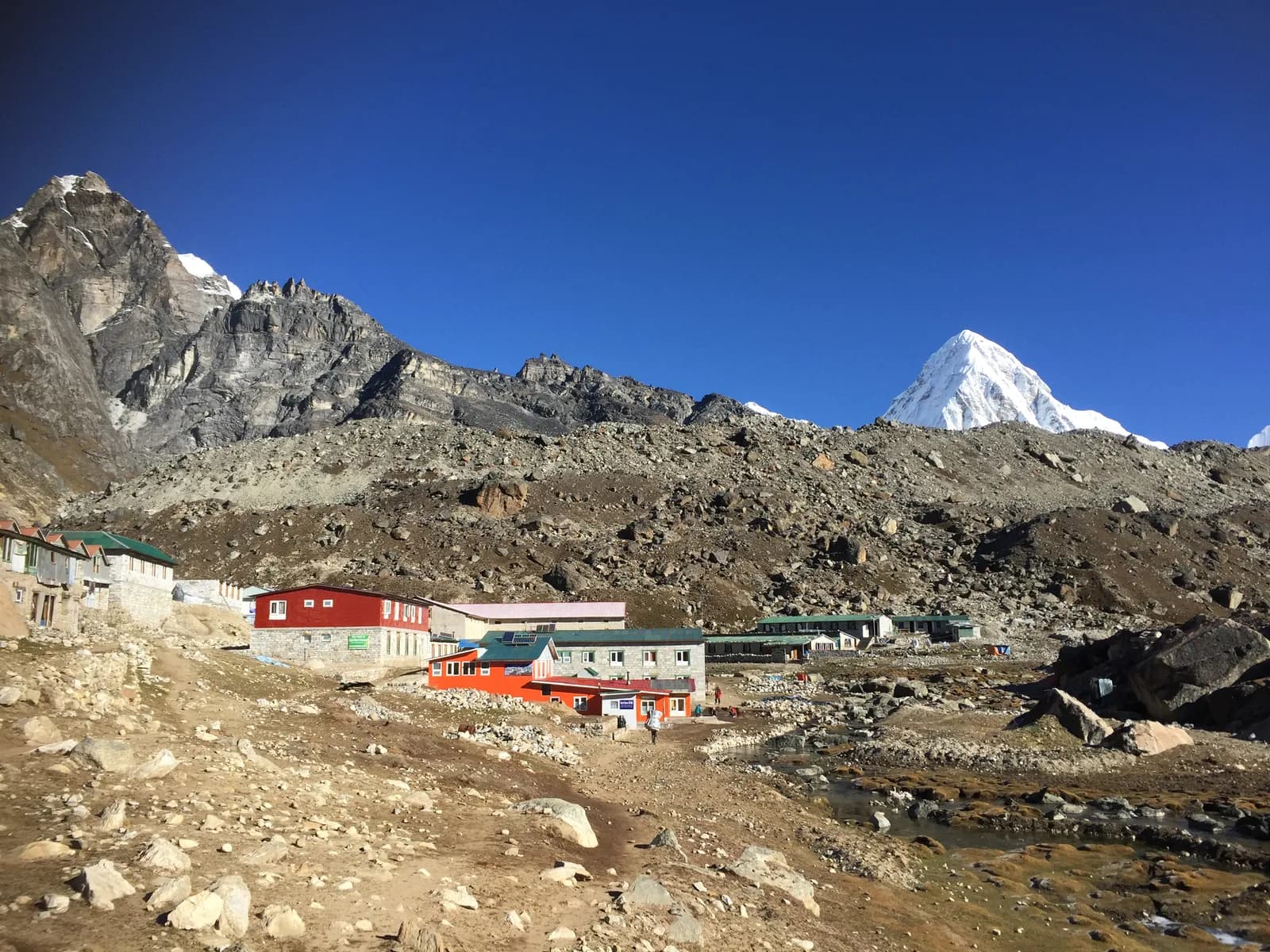
On the Everest Base Camp route the days at Dingboche (4,410 m), Lobuche (4,940 m) and Gorak Shep (5,164 m) are where it lives on your back, and the Kala Patthar start (5,545 m) is the moment you will be glad of it. On the Annapurna Circuit, the pre-dawn start from Thorong Phedi (4,540 m) for the 5,416 m pass is the same story. For a lower route such as Poon Hill, the sunrise at 3,210 m calls for a warm layer, and in winter it is a necessity. On the high passes the jacket sits over a fleece and under a shell. Our packing list's pass-day system keeps the jacket in the daypack for the first hour and adds a hat and mittens before you feel cold.
What the numbers mean
Down jackets are described by fill power, which Wikipedia defines as the number of cubic inches displaced by an ounce of down. At the same weight, higher fill-power down insulates better. Outdoor insulation generally ranges from about 400 to 900 in3/oz, with 500 to 650 considered warm and light enough for most conditions and 800 to 900 used for very light or very cold-weather gear. Down rated as low as 550 still provides reasonably good insulation.
Three consequences:
- A fill-power number tells you quality, not total warmth. The amount of down in the jacket matters as much as its quality. A thin jacket with high fill power can be less warm than a thick one with lower fill power.
- Labels can mislead. In the United States, a product labelled "100% down" may contain only down feathers, but one labelled simply "down" may be a mixture of fibre and feathers, according to the article. Those are US labelling rules, and our packing list warns that counterfeit branded gear is common, so a label alone is not a guarantee.
- Check by hand. A good down jacket feels light, springs back after being squeezed and has even loft without cold spots or flat seams.
Down and water
Wet down loses its insulating value. Wikipedia says that when down gets damp its thermal properties are virtually eliminated, and it clumps, mildews if left damp and holds odours. That is why the jacket should live in a dry bag inside your daypack or duffel. On dry-season routes such as the Everest trek in spring and autumn, down works well. For monsoon trips and rain-shadow routes with wet approaches, read our monsoon trekking guide and consider whether synthetic insulation makes sense for you.
Rent or buy: a decision guide
| Question | Points to renting | Points to buying |
|---|---|---|
| How many treks will you do? | One | Two or more |
| Will you wear it at home? | No | Yes, in cold winters |
| Do you run cold? | No | Yes, you want a warmer jacket |
| How picky are you about fit? | Not very | Very |
| Do you mind a stranger's jacket? | No | Yes |
| Is your route low or high? | One trip to 5,000 m | Multiple high or winter trips |
The packing list summarises the standard advice: rent a down jacket, sleeping bag and poles if you trek once, and buy boots, socks and base layers in advance because fit matters. We do not quote rental or purchase prices here because we have no dated source for them, so ask two shops and compare.
How to rent well in Kathmandu or Pokhara
Thamel in Kathmandu and Lakeside in Pokhara have many shops that rent gear, and Namche Bazaar has rental shops too, according to our Everest packing guide. A systematic check:
- Try it on over your base layer and fleece. You want room for those two layers, with sleeves long enough to cover your wrists when you raise your arms.
- Test the zip full-length. A broken zip at 5,000 m is a real problem.
- Look at the seams and baffles. Feathers poking through the fabric show wear. Flat patches show loss of down.
- Smell the lining and the collar. A musty or sweaty jacket has been stored damp or not cleaned.
- Check for a hood if you will be on exposed passes.
- Compare two or three jackets and choose the warmest and cleanest, not the cheapest or the best-known.
- Confirm the terms: the deposit, the return date, what happens if there is damage and whether you can swap it if it disappoints.
Decide a day early so you can go back to the shop. If you are trekking with a partner, go together and compare jackets on each other.
A pass-day walk-through
The jacket's job is easier to judge with a concrete morning. Take Kala Patthar on day 9 of the Everest plan, a dawn climb to 5,545 m from Gorak Shep at 5,164 m. You wake in an unheated room, and our packing list's pass-day system applies: a base layer and a thin fleece under a windproof shell, the down jacket in the daypack for the first hour, a warm hat and mittens on before you feel cold, and goggles or sunglasses in a pocket. You start walking in the dark and warm up as you climb, so you take the jacket off or never put it on. At the top, standing still for photographs in the wind, the jacket goes on over everything, and this is the moment that decides whether it was a good rental. A jacket that fits over a fleece and shell, with a hood that closes and a zip that works with gloves, turns a cold wait into a comfortable one. A jacket that is too tight, or one whose down has slumped to the hem, does not.
The same routine applies on the Annapurna Circuit's pass day, which is an 8 to 10 hour day over Thorong La that starts early from Thorong Phedi. Trying the jacket in the shop with the layers you will actually wear is the cheapest way to avoid finding out at altitude.
Renting in Namche
Some trekkers prefer to wait and rent at Namche, which has shops. That has a risk: stock and sizes may be limited in the busiest weeks, and you would be choosing at altitude when you have already started to feel the cold. Our advice is to sort the jacket before you fly, and to treat Namche as a fall-back.
If you buy
Buying makes sense if you will use the jacket again. Look for a hood, a zip that works with gloves, inner pockets for a phone and a power bank and a size that fits over a fleece. A reputable seller or your home country shop gives you recourse if a "down" jacket turns out to be something else. Keep it in a dry bag and store it uncompressed at home.
Partners and sharing
Trekking with partners lets you compare notes and share kit decisions, though not the jacket itself. Agree before you leave what each of you is bringing so you do not duplicate items such as a first-aid kit. For how to agree responsibilities, see what to agree with trekking partners before you book.
A short checklist
- Warm enough for your coldest day, not your average one.
- A fit that allows a fleece underneath.
- A working zip and a hood.
- Clean, dry and free of damp smell.
- A dry bag to keep it in.
- A decision made the day before you fly, not at altitude.
For the route-specific side, read the Everest spring packing list, and for the colder months see March, November and January.