Acclimatisation schedule for Nepal treks, how fast to ascend
How many metres you can climb per night, where the rest days go and a worked sleeping-altitude schedule for Everest Base Camp and the Annapurna Circuit.
An acclimatisation schedule is a plan for how high you sleep each night and where you stop for a rest day. Above 3,000 m, let your sleeping altitude rise by no more than about 500 m a night and take an extra night for every 1,000 m you gain. That is the rule the CDC Yellow Book repeats from wilderness-medicine guidance, and it is the number to hold your itinerary against. This article is general information, not medical advice.
Below you will find that rule applied to two real routes, the Everest Base Camp trek and the Annapurna Circuit, with the sleeping altitude of every night written out so you can see where a standard itinerary is generous and where it is tight. If you are new to the symptoms, read altitude sickness basics first.
Trip terbuka di Everest Base Camp Trek
Trip sebenar yang disiarkan oleh pendaki yang mencari rakan.

The rule in plain terms
Three habits do almost all of the work:
- Count sleeping altitude, not walking altitude. What matters is the height of the bed you wake up in.
- Climb high, sleep low. A day walk 300 to 600 m above your lodge, followed by a night back at the lodge, is the cheapest acclimatisation there is.
- Make the rest day a real one. An acclimatisation day means a short hike and an early night, not a long climb to prove you are fit.
Fitness does not change any of this. Strong, young trekkers get altitude illness as often as anyone, mostly because they are the ones who can keep up a fast schedule.
Everest Base Camp: night by night
The classic 12-day return trek has two rest days. The altitudes are approximate and vary by a few metres between sources.
| Night | Sleep at | Sleeping altitude | Change from previous night |
|---|---|---|---|
| 1 | Phakding | about 2,610 m | below Lukla (2,860 m) |
| 2 | Namche Bazaar | about 3,440 m | +830 m, but starting below 3,000 m |
| 3 | Namche (rest day) | 3,440 m | 0 |
| 4 | Tengboche | about 3,860 m | +420 m |
| 5 | Dingboche | about 4,410 m | +550 m |
| 6 | Dingboche (rest day) | 4,410 m | 0 |
| 7 | Lobuche | about 4,940 m | +530 m |
| 8 | Gorak Shep | about 5,160 m | +220 m |
Two nights are worth a closer look. The jump from Phakding to Namche is large on paper but it starts below the 3,000 m line, which is why the plan gets away with it, and why the Namche rest day matters the day after. The Tengboche to Dingboche and Dingboche to Lobuche steps are right on the 500 m ceiling, so the Dingboche rest day is not optional if you want a margin.
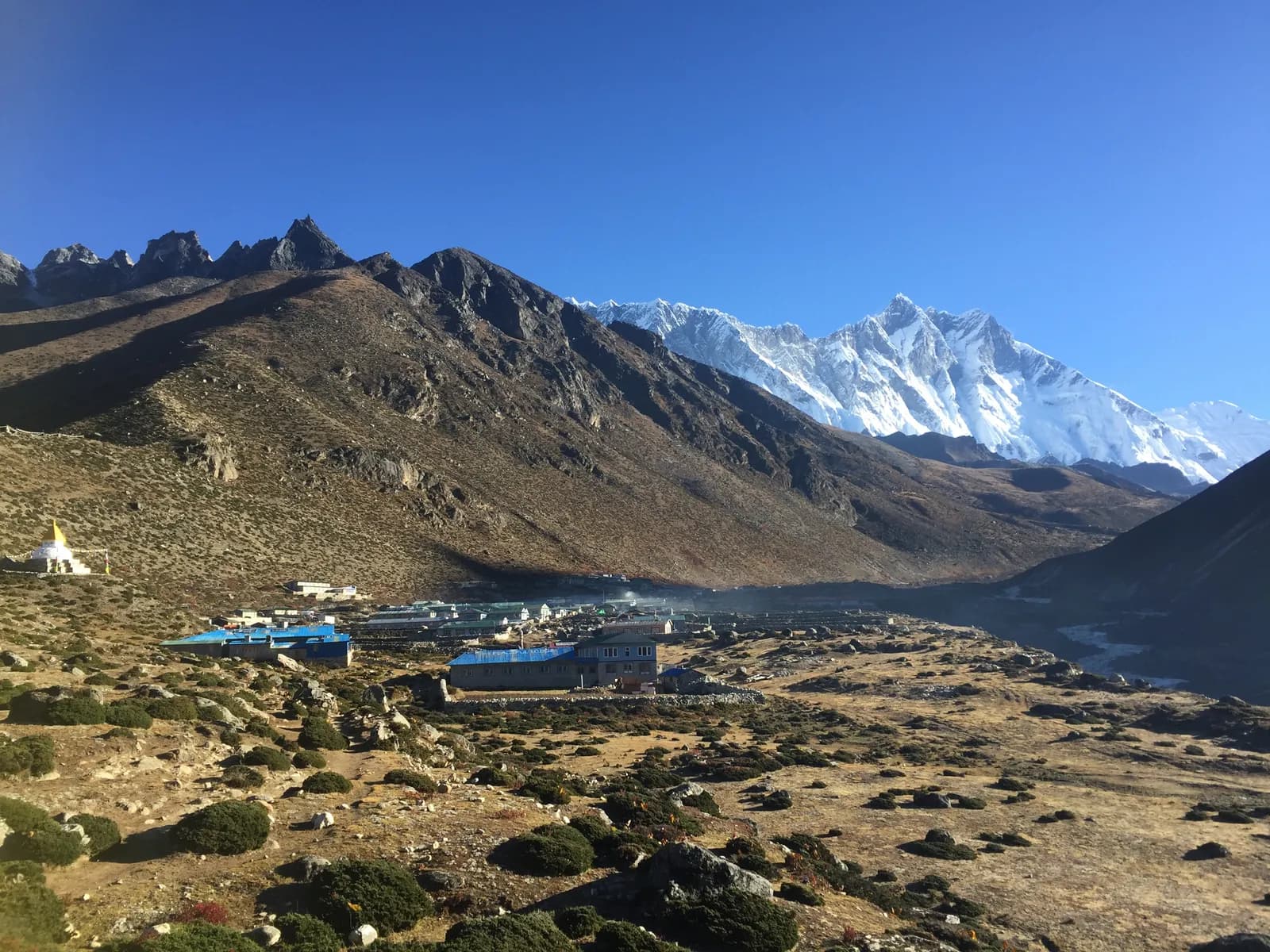
On the Namche rest day, walk up to the Everest View Hotel area or the Khumjung side, about 400 m higher, and come back down to sleep. At Dingboche, the ridge above the village toward Nangkartshang gives you the same effect: you can reach around 5,000 m and sleep at 4,410 m.
The top of the route is where people get caught out. Gorak Shep at 5,160 m is the highest bed on the route. Kala Patthar (about 5,545 m) and base camp (about 5,364 m) are day trips from it, so a poor night at Gorak Shep is a reason to skip them and go down, not to push on. See the Everest itinerary day by day for the full plan, and the Sagarmatha National Park guide on the region page for where the villages sit.
Annapurna Circuit: night by night
The circuit gains height more gently than Everest for most of its length and then asks for a big step at the pass. Approximate sleeping altitudes on a standard 12 to 14 day schedule:
| Night | Sleep at | Sleeping altitude | Change |
|---|---|---|---|
| Chame | Chame | about 2,670 m | below the line |
| Pisang | Upper Pisang | about 3,300 m | +630 m |
| Manang | Manang (via Humde or Ngawal) | about 3,540 m | +340 m |
| Rest | Manang | 3,540 m | 0 |
| Yak Kharka | Yak Kharka or Ledar | about 4,050 m | +510 m |
| Thorong Phedi | Phedi | about 4,540 m | +450 m |
| Pass | Cross Thorong La (5,416 m) | descend to Muktinath, about 3,800 m | down 740 m |
The numbers show the logic of the usual itinerary: Manang is the acclimatisation stop, and the nights at Yak Kharka and Thorong Phedi stay inside the 500 m step. Note that Chame to Upper Pisang is a step of about 630 m, above the guideline, which is why some trekkers sleep in Lower Pisang instead; either way, treat Manang as non-negotiable. Trekkers who skip Phedi and push on to High Camp, a few hundred metres higher, from Yak Kharka make a step far beyond 500 m, which is the single most common way the circuit goes wrong. If you stay at High Camp, do it only after a spare night at Yak Kharka or Phedi and only if you feel well.
At Manang, the standard rest-day hikes are to Gangapurna Lake and the Praken Gompa ridge, both of which put you a few hundred metres above the village. The Himalayan Rescue Association post in Manang gives an afternoon talk on altitude in the trekking seasons; check the hours on arrival, since they have varied. The best time for the Annapurna Circuit explains why the pass day itself depends on the weather window.
Building your own schedule
If you are designing a route that is not on either list, work it out like this:
- Write down the altitude of every possible bed (lodge altitude is on most route pages and maps).
- Starting at 3,000 m, mark any night where the next bed is more than 500 m higher.
- Insert a rest night after any 1,000 m of cumulative gain, and one before any step that crosses 500 m.
- Keep your highest bed at the end, not in the middle, when the route allows it. Out-and-back trails like Everest Base Camp do this naturally.
If your schedule is already fixed by a flight date, add one buffer day near the top rather than pulling the whole plan earlier. A spare day at 4,000 m does more than a second acclimatisation hike at 3,500 m.
What to do if you fall behind
Signs that you should add a night before climbing: a headache that is not gone after rest, fluid and food; a night of unusually poor sleep; a resting pulse that stays well above your normal; or noticeable breathlessness at rest. Stay where you are. If symptoms are worse in the morning, or you develop a wet cough, confusion or clumsiness, go down, because descent is the treatment that works.
Tell your partner your plan. A shared schedule is only safe if everyone agrees in advance that the slowest person sets the pace; see how to find a trekking partner safely for the conversations to have before you start walking.
A short checklist before you book
- Does your itinerary have a rest day in Namche (or Manang) and a second above 4,000 m?
- Does any night step up by more than 500 m above 3,000 m?
- Is there at least one spare day between your last high night and your international flight?
- Do you know the nearest place with a medical post on your route?
- Have you agreed with your partners who decides when to turn back?
More depth on how this fits with the rest of your preparation is in the altitude and health hub and the route-choice guide.