

Crampons and microspikes for Thorong La and Cho La
Most trekkers need microspikes, not full crampons, on Nepal high passes like Thorong La and Cho La. How the two differ, how to fit them and when to carry them.
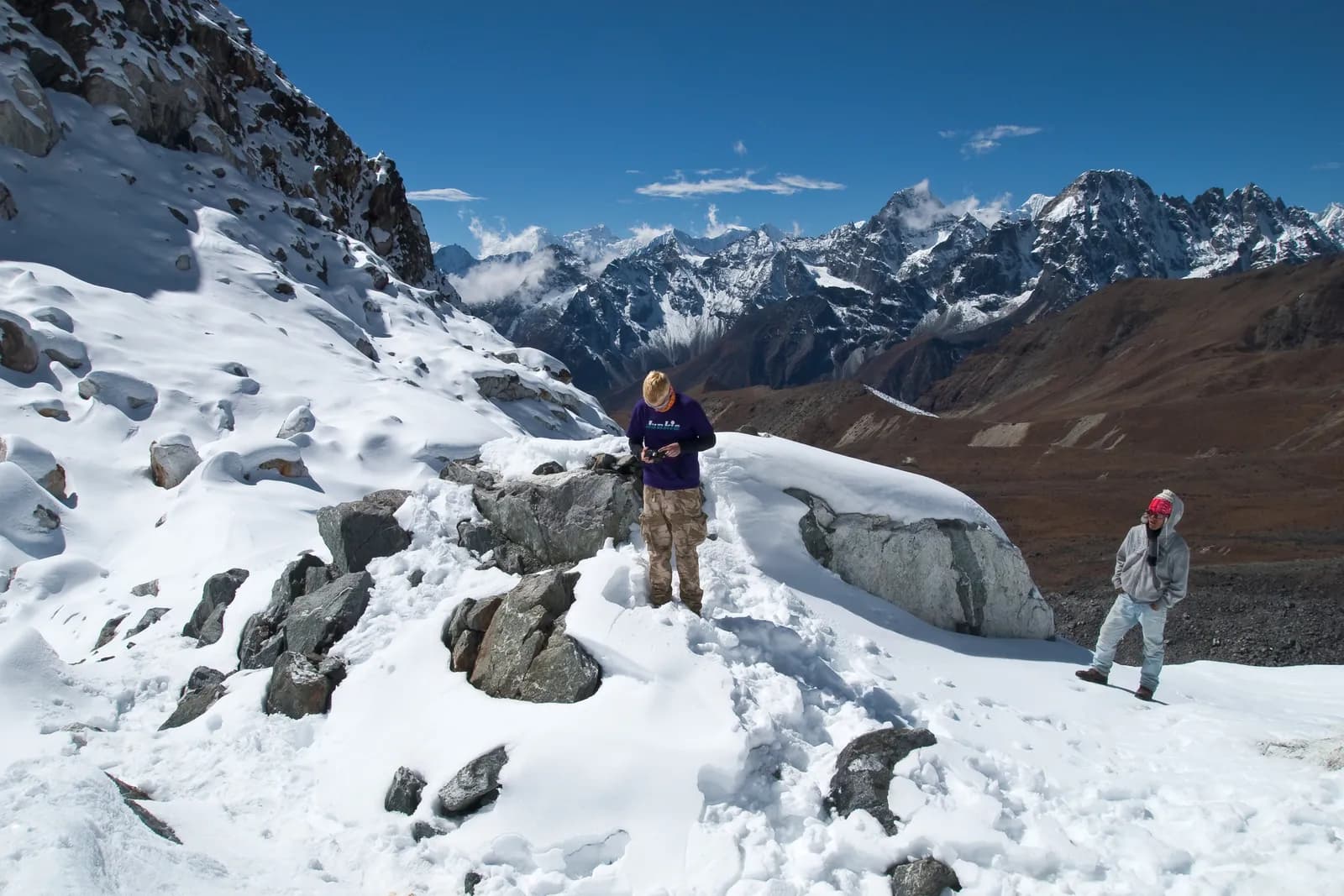
For most trekkers on Nepal's high passes, microspikes are the right traction device and full crampons are rarely needed. Thorong La, Larkya La, Renjo La and the standard crossing of Cho La are trekking passes, not mountaineering routes, but they can hold hard-packed snow and ice, and the right traction makes a risky descent safe.
This guide explains the difference between the devices, when to carry them and how to use them.
Crossing a pass is easier in company: find a trekking partner for the Annapurna Circuit.
It is general information. Conditions change daily, so confirm with your guide what is needed on your dates. The conditions themselves are discussed in snow and high-pass conditions.
Trip terbuka di Annapurna Circuit Trek
Trip nyata yang diposting trekker yang mencari teman.

Microspikes versus crampons
| Feature | Microspikes | Crampons |
|---|---|---|
| Design | Chain with short spikes, rubber harness | Rigid or semi-rigid steel frame, long points |
| Boots | Fit most trekking boots and even trail shoes | Need stiff or semi-stiff boots with a good welt |
| Best for | Packed snow, icy trails, frozen stream crossings | Steep ice, glaciers, hard snow slopes |
| Weight | About 300 to 500 g | About 800 g to 1 kg |
| Learning curve | Low | Moderate; training advised |
| Typical use on Nepal treks | Thorong La, Larkya La, Cho La | Technical peaks, steep glacier sections |
Most trekking boots are too flexible for crampons, which is why microspikes are the practical default. Crampons on soft boots can come off or damage the boot.
Which pass needs what
| Pass | Usual conditions | Traction advice |
|---|---|---|
| Thorong La (5,416 m) | Packed snow in shoulder months; icy patches on the descent | Microspikes advisable in March, November and winter; often not needed in a dry October |
| Larkya La (about 5,106 m) | Snow and glacier-side ice, long descent | Microspikes advisable; ask your agency |
| Cho La (about 5,420 m) | Rock, boulders, a short glacier on the Gokyo side | Microspikes commonly used; crampons and rope after snow |
| Kongma La (5,535 m) | Steeper, often snowy | Microspikes; some groups use crampons |
| Renjo La (5,360 m) | Stone staircase, snow in early season | Microspikes occasionally |
The Annapurna Circuit and Everest Three Passes guides have the day-by-day detail. The Everest Three Passes route is more technical than Base Camp, so agree gear with your agency; the Everest Three Passes route page sets out the schedule.
When to carry them
Carry microspikes when:
- you are crossing a pass in March, early April, late November or winter;
- there has been recent snowfall or a cold snap;
- your route includes a glacier, such as Cho La;
- you are doing a pre-dawn crossing when surfaces are hardest.
You may leave them behind in a dry, warm October or May on Thorong La, but many guides carry a pair as insurance. The weight is small compared with the risk of a slip on a long descent.
How to fit them
- Size. Microspikes come in small, medium, large and extra-large, matched to boot size. A loose fit slips and a tight one tears.
- Put them on before the ice. Stop on a flat spot, sit down and fit them properly.
- Check the harness. The rubber should sit evenly with the chains under the sole.
- Walk with a wider stance. Spikes can catch the opposite ankle or trouser leg.
- Take them off on rock. Walking on bare rock wears the spikes and can make you slip.
Practise at home before you go. Gaiters help keep spikes from catching trouser hems.
Using them on the pass
- On firm snow, walk flat-footed and plant your whole foot.
- On steep descents, face downhill, take small steps and use poles.
- On glacier ice, keep to the track and follow your guide's line.
- Check the straps regularly, because cold stiffens the rubber and can loosen the fit.
If conditions are worse than microspikes can handle, such as hard blue ice or steep snow slopes, turn back or wait. Traction does not remove the avalanche or exposure risk.
Where to rent or buy
Gear shops in Thamel (Kathmandu) and Lakeside (Pokhara) rent microspikes, and some sell them. Namche and Manang also have rental shops at certain times. Inspect them before you pay: look for bent chains, torn rubber and missing spikes. If you trek often, buy a good pair in your home country, since quality varies. Our packing list and the packing list for Everest Base Camp in spring explain how traction fits with the rest of your kit.
Other kit for snow days
- Trekking poles with snow baskets, if you have them.
- Gaiters to keep snow out of boots.
- Warm waterproof gloves and a spare pair.
- Sunglasses or goggles to prevent snow blindness.
- A headlamp for pre-dawn starts.
See the altitude and health hub for frostbite and cold-injury basics.
If you are guided
Ask your agency what gear they provide. Some supply microspikes and sometimes crampons, ropes and ice axes for technical crossings, and others expect you to bring or rent your own. Ask before you pay, and ask what happens if conditions are worse than expected. A guide who has crossed the pass recently is the best source of advice.
A decision guide
- Is the route a trekking pass, and not a technical climb? Microspikes are probably enough.
- Is it the shoulder season or has it snowed recently? Carry them.
- Is there a glacier? Ask your guide what is required.
- Are conditions worse than microspikes can handle? Wait or turn back.
Two crossings in detail
Thorong La, the descent to Muktinath
The descent from the pass is long, about 1,600 m to Muktinath (roughly 3,800 m), and the first part is the part where traction matters. The top of the descent is exposed, wind-blown and often covered in a crust of compacted snow that has been trodden by hundreds of boots. In the early morning, that crust is hard and slippery. After the first hour, the trail leaves the snow and becomes loose scree and dirt. A sensible routine is to put your microspikes on at the pass if the surface is icy, walk the snowy section carefully, and take them off when the trail turns to bare ground. Poles help on the long, steep final section toward Muktinath.
Cho La, the Gokyo-side glacier
The Cho La crossing climbs from Dzongla over rock, then drops across a boulder field and a short glacier toward Thangnak. The glacier is small, but the surface can be ice with a dusting of snow that hides cracks. Guides usually follow a track that has been used for weeks, and microspikes give grip on the icy sections. After a heavy snowfall, the track may be buried and crevasses harder to see, and some agencies add a rope or wait for the track to be re-established. If you are on a guided trip, do not leave the line your guide chooses.
How slips happen
Most traction-related injuries on trekking passes follow a pattern:
- Tired legs on the descent. After a long climb and an early start, concentration drops, and a step on ice goes wrong.
- Spikes left in the pack. The icy patch is short, and the group does not stop to fit them.
- Spikes worn on rock. A foot slides off a bare boulder because the chains are not gripping.
- Loose fit. A harness that has stretched in the cold slips off mid-stride.
- Crowding. Groups bunch on a narrow track and someone steps off the edge.
The antidote is to stop and fit traction before the ice, walk slowly and keep space between people.
Care and maintenance
- Dry them after use, because wet chains rust and rubber degrades.
- Rinse off salt or mud and inspect for bent links.
- Store in a bag so spikes do not puncture your pack or sleeping bag.
- Check the rubber for cracks before each trip, especially if the devices are old, since cold makes rubber brittle.
A damaged pair is worse than none. If the harness fails on a pass, you have no traction and a hazard in your pack.
What your guide may bring
Many Nepal agencies carry a small shared kit for the group on pass days: a few pairs of microspikes in common sizes, a rope for glacier sections and occasionally helmets or harnesses on more technical crossings. The quality and size range vary, so do not assume a pair will fit you. If you have large or small feet, bring your own or rent a pair in Kathmandu in your size. Agree on the kit in writing when you book, especially for the Everest Three Passes.
If you are trekking with partners
Traction is personal gear, but its use affects the group. Agree before the pass who carries what, how you will stop to fit spikes together and what the turnaround time is. If you do not have a partner yet, see how to find a trekking partner safely, and match on experience as well as pace, since one inexperienced person on a glacier changes the plan for everyone.
Route pages: Annapurna Circuit and the Everest region.


