Monastery etiquette: prayer wheels, mani walls and gompas
How to behave at gompas, nunneries, mani walls, chortens and prayer wheels on Nepal's Tibetan-Buddhist and Bon treks: direction, dress, photographs, donations, and what to ask your guide.

The short version of monastery etiquette on Nepal's Tibetan-Buddhist treks is this: walk clockwise around mani walls, chortens and monasteries, turn prayer wheels clockwise, dress modestly, ask before photographing people or the inside of a gompa, leave shoes where others leave them, do not touch religious objects, and give donations to the monastery rather than sweets or money to children. Most of this is common sense once you know the reason behind each custom, and the rest is following what the people around you do. This guide covers the objects you will meet, the customs that go with each and the situations where visitors most often get it wrong.
It draws on the route and region pages for the Tsum Valley, Upper Dolpo and Upper Mustang, where monasteries are among the main reasons to go, and complements our broader trail etiquette and culture guide.
Tsum Valley Trek के ओपन ट्रिप
पार्टनर खोज रहे ट्रेकर्स के असली ट्रिप।
Mani walls and mani stones
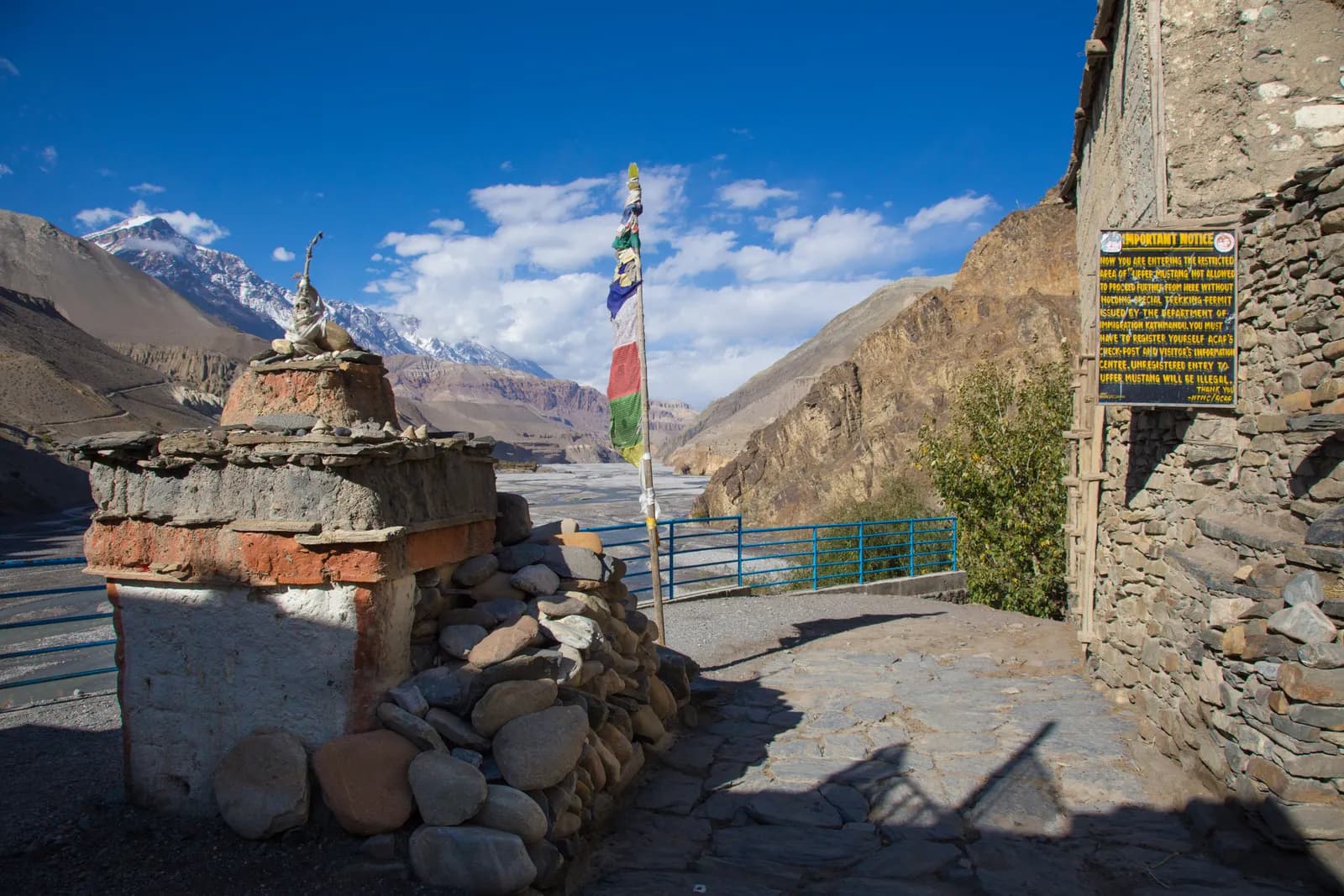
Mani stones are stones inscribed with the six-syllable mantra of Avalokiteshvara, Om mani padme hum, as a form of prayer. Along trails in Tibetan Buddhist regions they are stacked in long walls, often placed beside roads and rivers or at the entrance to a village. The Buddhist custom, as Wikipedia describes it, is to pass a mani wall from the left side, which means keeping the wall on your right and walking clockwise, tied to the clockwise direction in which the universe revolves in Buddhist doctrine. On the trail this means that when a mani wall splits the path, you take the side that keeps the wall to your right. The route pages repeat the habit: walk clockwise around mani walls and chortens.
Do not walk on mani stones, sit on them, move them or take one as a souvenir. If a wall blocks the way, walk around it, and if your guide goes one way, follow.
Chortens and stupas
A chorten, like the ones at the entrance to many villages in Tsum, Dolpo and Mustang, is a religious monument that is circled clockwise. The same rule applies: keep it on your right. Avoid climbing on it or leaning your pack against it. When you stop for a rest, choose a stone nearby.
Prayer wheels
A prayer wheel is a cylinder that contains a long strip of rolled paper printed or inscribed with mantras, most commonly Om mani padme hum, and it is turned clockwise, the direction in which the mantras are written. Spin it gently with your right hand as you walk past, and do not stop a wheel someone else is turning. Some wheels are turned by water, and some by hand. Rarely, advanced practitioners turn particular wheels the other way, but a visitor should follow what locals do. Do not touch the mantra strip.
Entering a monastery or nunnery
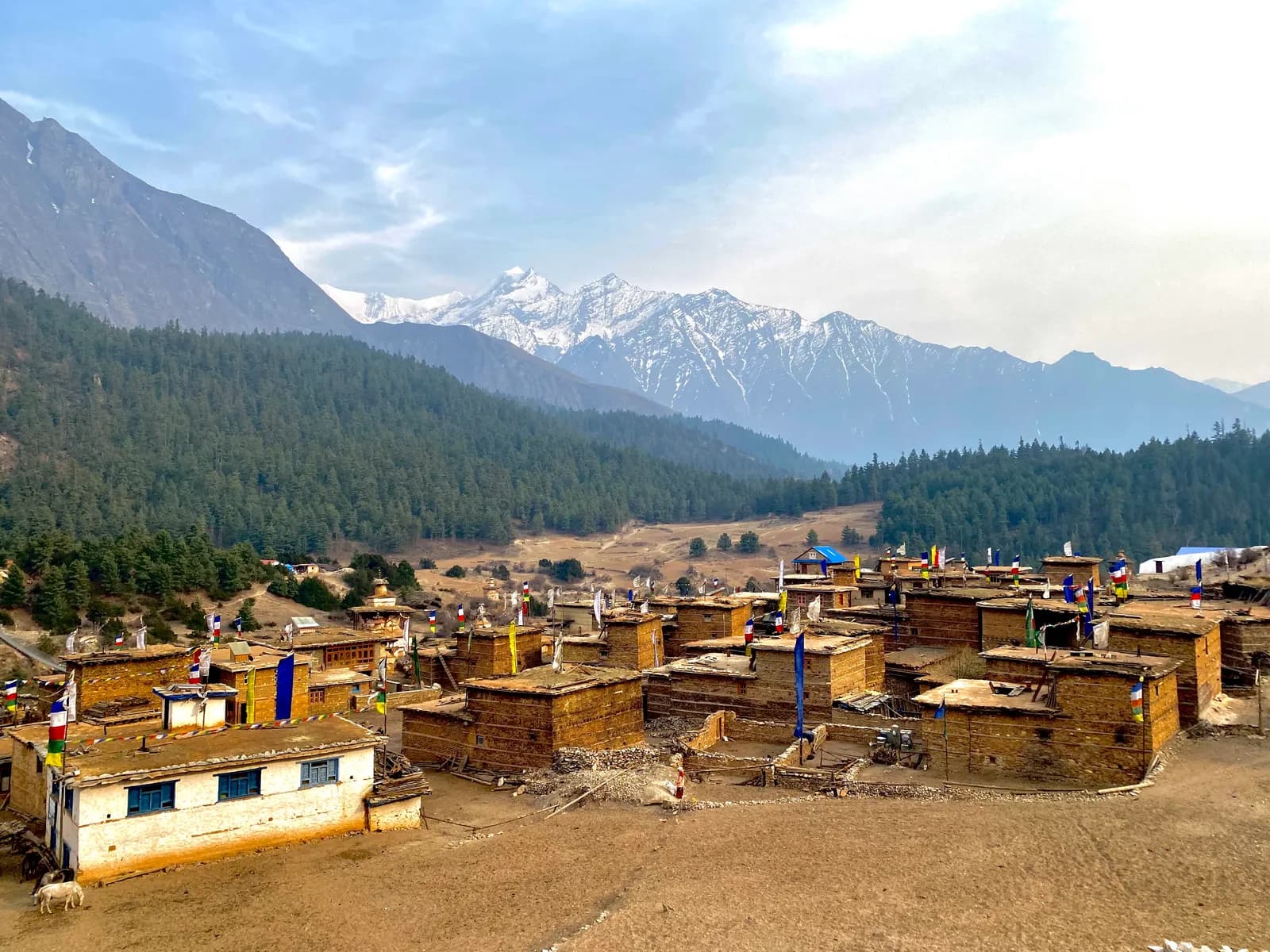
The route pages describe a range of sites: Mu Gompa near the Tibetan border, the highest and most remote monastery in the Tsum Valley and a centre of Buddhist learning; Rachen Gompa, a nunnery near Lar; Shey Gompa in Dolpo, an 11th-century Kagyu monastery beside the Crystal Mountain that pilgrims circle each year; and the Bon monastery at Ringmo and the Buddhist and Bon gompas at Dho Tarap. The same manners apply at all of them.
- Ask before entering. If the door is closed or no one is around, wait for a monk or caretaker or your guide. Do not walk into a ceremony.
- Dress modestly. Cover shoulders and knees, and carry a scarf or shawl, as the Tsum Valley page suggests.
- Shoes. Take them off where others do. If you are unsure, ask your guide.
- Be quiet. At Rachen Gompa the nuns live there, so keep your voice low. Switch your phone to silent.
- Do not touch. The Upper Mustang route page says not to touch paintings, and the same care applies to statues, texts and ritual objects.
Upper Mustang: walls, caves and wall paintings
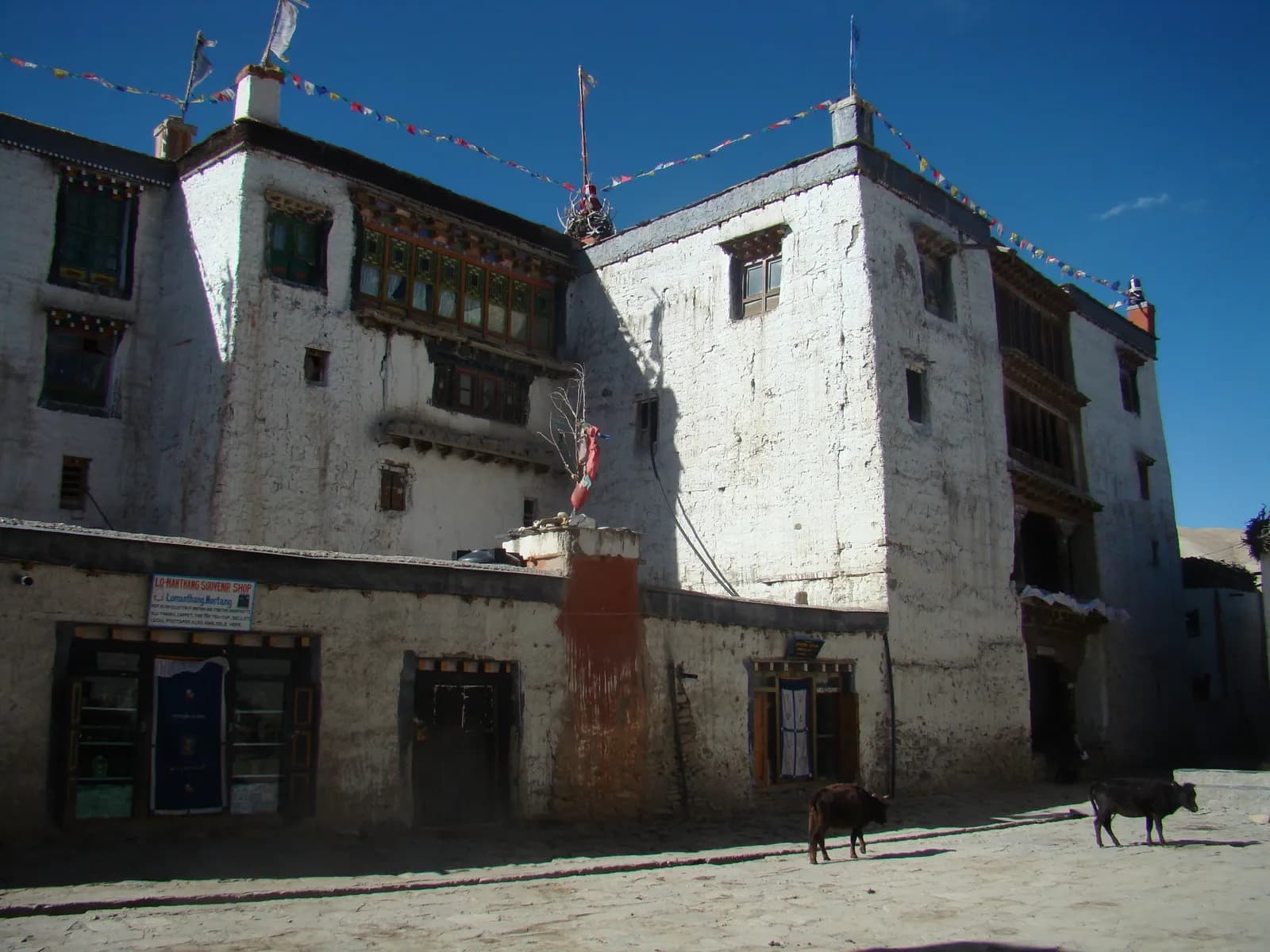
On the Upper Mustang route you pass Ghami's long mani wall, the fortress and monastery at Tsarang, Lo Manthang's walled city with its palace and three great monasteries, the Chhoser caves nearby and Ghar Gompa, an ancient monastery near the Dhakmar red cliffs. The route page asks you to get permission before photographing inside monasteries, not to touch paintings, never to use flash on wall paintings and to avoid disturbing caves and monasteries. Lo Manthang also hosts the Tiji festival in spring, when the town is crowded and ceremonies are the main event, so keep back from dancers and processions and follow the instructions of the monks and your guide. These sites are not museums. People live and pray there, and a visit is a privilege.
Photographs
The route pages say to ask before photographing people, ceremonies and monasteries. That means asking permission, usually through your guide, and accepting a no. Some monasteries forbid photography inside the main hall, and some ask for a fee or donation. Never photograph a monk or nun in prayer without permission, never use flash in a prayer hall and put the camera away during ceremonies. Avoid drones: the Rara route page forbids them without permission, and the same caution applies at religious sites.
Donations, butter lamps and gifts
A small donation is a respectful way to thank a monastery. The Dolpo route page suggests small gifts for monasteries, such as butter lamp donations, but never sweets or money for children, and the Dolpo region page says gifts should go through the local committee, not to children. Ask your guide how much is appropriate, give it to the monk or caretaker rather than leaving it on an altar, and take a receipt if the monastery offers one. Do not give money to children or pay for photographs of people, because it encourages begging and changes how visitors are seen.
Bon and other traditions
Dolpo reached outsiders as the last Tibetan culture on the Nepal side of the border, and many villages follow Tibetan Buddhism or the older Bon religion, which pre-dates Buddhism in Tibet. Customs at Bon sites can differ from those at Buddhist ones, including the direction in which you circle a site. We could not verify the rules from a single reliable page, so ask your guide which direction applies and follow it. The general rule is the same: do what the people around you do.
Let your guide set the pace
Your guide is the quickest source of local manners, and on restricted-area treks you have one by rule. At the start of a monastery visit ask three questions: may we go in, may we photograph, and what is an appropriate donation? Then watch what the guide does at the door and copy it. If you arrive in a village in the middle of a ceremony or a festival, ask whether to wait outside. Choosing local lodges and shops and buying from local families, as the route pages advise, is itself a form of respect, because it keeps money in the valley that keeps the monasteries running.
When you get it wrong
You will probably make a small mistake sooner or later, such as stepping on the wrong side of a wall or touching a wheel you should not. Apologise quietly, correct it and carry on. Nobody expects visitors to know everything, and respect is shown more by attention than by perfection. For other customs on the trail, such as teahouse manners and photography of people, return to the etiquette guide.
इस ट्रेक की योजना बनाएँ
- Manaslu क्षेत्र गाइड
- Upper Mustang क्षेत्र गाइड
- Dolpo क्षेत्र गाइड
- Trekking partner for Tsum Valley Trek
- Upper Dolpo: Shey Phoksundo to Shey Gompa trekking partners
- Trekking partner for Upper Mustang Trek (Lo Manthang)
- Tsum Valley Trek यात्रा-कार्यक्रम
- Upper Dolpo: Shey Phoksundo to Shey Gompa यात्रा-कार्यक्रम
- Upper Mustang Trek (Lo Manthang) यात्रा-कार्यक्रम