Supporting local businesses while trekking in Nepal
Where your money does the most good on a Nepal trek, from eating where you sleep and hiring locally owned agencies to buying handicrafts, carrying small notes and tipping fairly.
The simplest way to support local businesses on a Nepal trek is to eat your meals where you sleep, hire a locally owned agency with fairly paid staff, buy handicrafts from the people who make them and tip your guide and porters fairly at the end. Most of the economy you walk through is a chain of small family businesses, from the lodge and its kitchen to the porter and the weaver, and a few sensible habits let your money stay in those households. This guide explains where spending matters most, with the cost ranges the pack uses, so you know what is fair.
Everest Base Camp Trek的開放行程
由正在尋找夥伴的健行者發布的真實行程。

Eat where you sleep
The single most important custom on teahouse treks is to eat dinner and breakfast in the lodge where you stay. Room rates are low, in the Annapurna region NPR 300 to 800 a night below 2,500 m and NPR 1,300 to 2,000 above 3,800 m (as of October 2026), because the family expects to earn the real income from meals. If you stay in a lodge and eat elsewhere, or carry your own food and ask for the room only, you leave the family short, and some lodges may charge more for the room or ask you to pay a higher rate.
Prices rise with altitude because everything is carried up by porter or mule. A dal bhat costs NPR 500 to 1,000 below 2,500 m in the Annapurna region and NPR 1,300 to 1,600 above 3,800 m, while in Khumbu the high band is NPR 1,200 to 2,000 (as of October 2026). Do not haggle over meal prices on the menu; in many villages they are fixed by agreement among the lodges, and they reflect the cost of carrying supplies. See our teahouse prices guide for the full table and the cost guide for how it fits into a budget.
If you have a food allergy or you cannot eat a particular dish, tell the lodge when you arrive. They will usually adapt. If you want a snack between meals, buy tea and biscuits at a tea house on the trail, not only from your own bag. The hand-painted sign at a tea shop in Monju, on the way to Namche Bazaar, in the photos above is the sort of small business that depends on passing trekkers stopping for a cup of tea.
Use locally owned agencies, guides and porters
A trekking agency is a business like any other, and the choice you make with it matters. Locally owned, registered agencies keep more of the fee in Nepal and typically employ guides and porters directly. Ask who owns the company, where it is registered, how guides and porters are paid and insured and whether they are given proper clothing and equipment. Agencies advertised abroad often subcontract to local operators, so ask who will actually run your trek and what the local company charges.
Guide and porter day rates in the pack, from operator guides and converted at NPR 134 to the US dollar, are NPR 2,700 to 4,000 for a guide and NPR 2,100 to 3,400 for a porter in the Annapurna and Langtang regions, and NPR 3,400 to 4,700 for a guide in Khumbu (as of October 2026). No official minimum wage was found, so these are market ranges, not rules. If a quote is far below these figures, ask how the difference is covered, because it usually comes out of someone's wages or equipment. Our guide to splitting guide and porter costs shows how to share the cost with partners and still pay fairly.
On the guide rule, the framing is this: a licensed guide through a registered agency is required in restricted areas (Department of Immigration) and, under the Nepal Tourism Board rule of April 2023, in national parks and conservation areas, where 2026 operator reports say checkpoints enforce it in Annapurna and Langtang but not in Khumbu (checked 19 October 2026). Hiring a local guide is therefore both a legal question in many areas and the most direct way to put money into a local household.
Buy crafts and food at the source
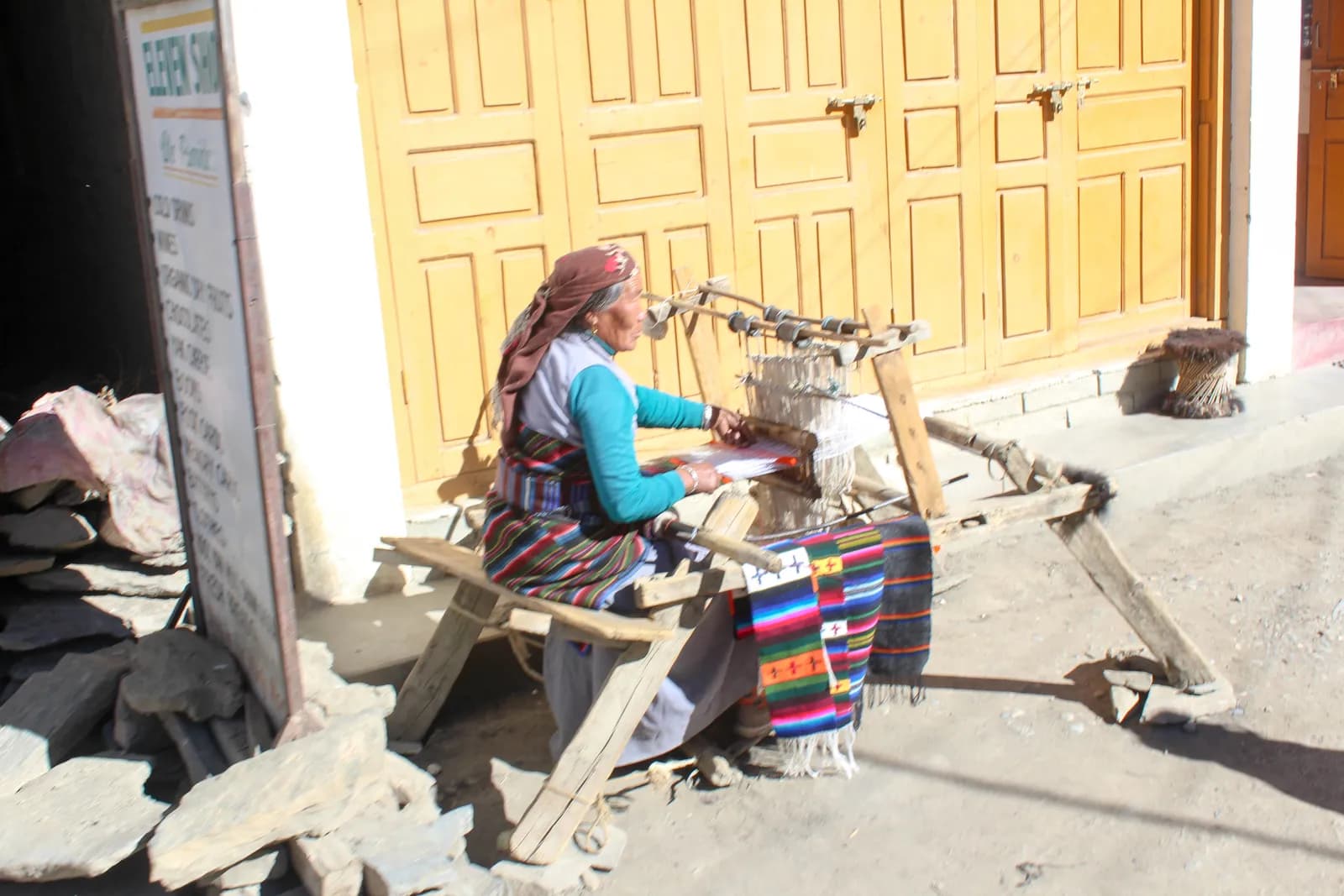
Handicrafts are the clearest way to put cash directly into a household. In the photograph of a woman weaving on a loom at Ranipauwa, the village at Muktinath, you can see the sort of work you can buy: woven scarves, shawls, socks, hats and bags, knitted or woven in the village, often by women. Buy from the person who made the item if you can, ask how long it took and pay a fair price. Gentle bargaining is normal in markets, but there is little to gain by pushing a knitter to the floor over a small amount. A rough guide is to ask for a modest reduction once, and accept the answer.
Other places where your money goes directly to local families:
- Village bakeries and tea shops, in places such as Namche Bazaar, where many are family-run.
- Cooperatives, such as women's weaving groups, which sell at fixed prices.
- Local honey, dried apples and cheese, which we cover in our piece on regional specialties.
- Lodge extras, like a hot shower, charging a phone or a flask of hot water, which are priced because fuel and electricity are costly.
- Homestays, where one household earns the full amount.
Avoid buying items that look suspiciously mass-produced, particularly "antiques" and religious objects. If you want a singing bowl or a thangka painting, buy from a reputable shop in Kathmandu or Bhaktapur rather than from a vendor who cannot say where it was made. Do not buy anything made from wildlife products, and do not buy old prayer wheels, manuscripts or carved stones, which are part of living religious practice.
Carry cash, and small notes
Cash machines are rare outside the larger towns, and card payments are usually not available on the trail. Withdraw rupees in Kathmandu, Pokhara or a big town before you start, and carry smaller notes, because lodges and tea shops are often unable to change large ones. A mix of 100, 500 and 1,000 rupee notes works for most purchases. Keep your cash in several places, and do not rely on being able to change money or get more up the valley. Our transport guide covers money and trailheads.
Paying promptly and in cash, at the price on the menu, is part of being a good customer. Pay the bill the evening before an early start, so the family is not waiting for you in the morning, and settle any extras like showers and charging at the same time.
Tip fairly
Tips are an expected part of a guide's and porter's income. The standard approach is to agree the total with your group on the last evening, put it in an envelope and hand it over together with thanks, giving more to the guide and an amount to each porter that reflects the work. Ask your agency what is usual for the length of the trek, and discuss it with your trekking partners in advance so that no one is embarrassed. If you meet someone who carried a heavy load for your group for two weeks, a few extra words of thanks and a photograph with their permission cost nothing.
Tipping lodge staff is not expected, but if a family looked after you particularly well, a small cash thank-you is a kind gesture and is better than a gift.
Reduce waste and plastic
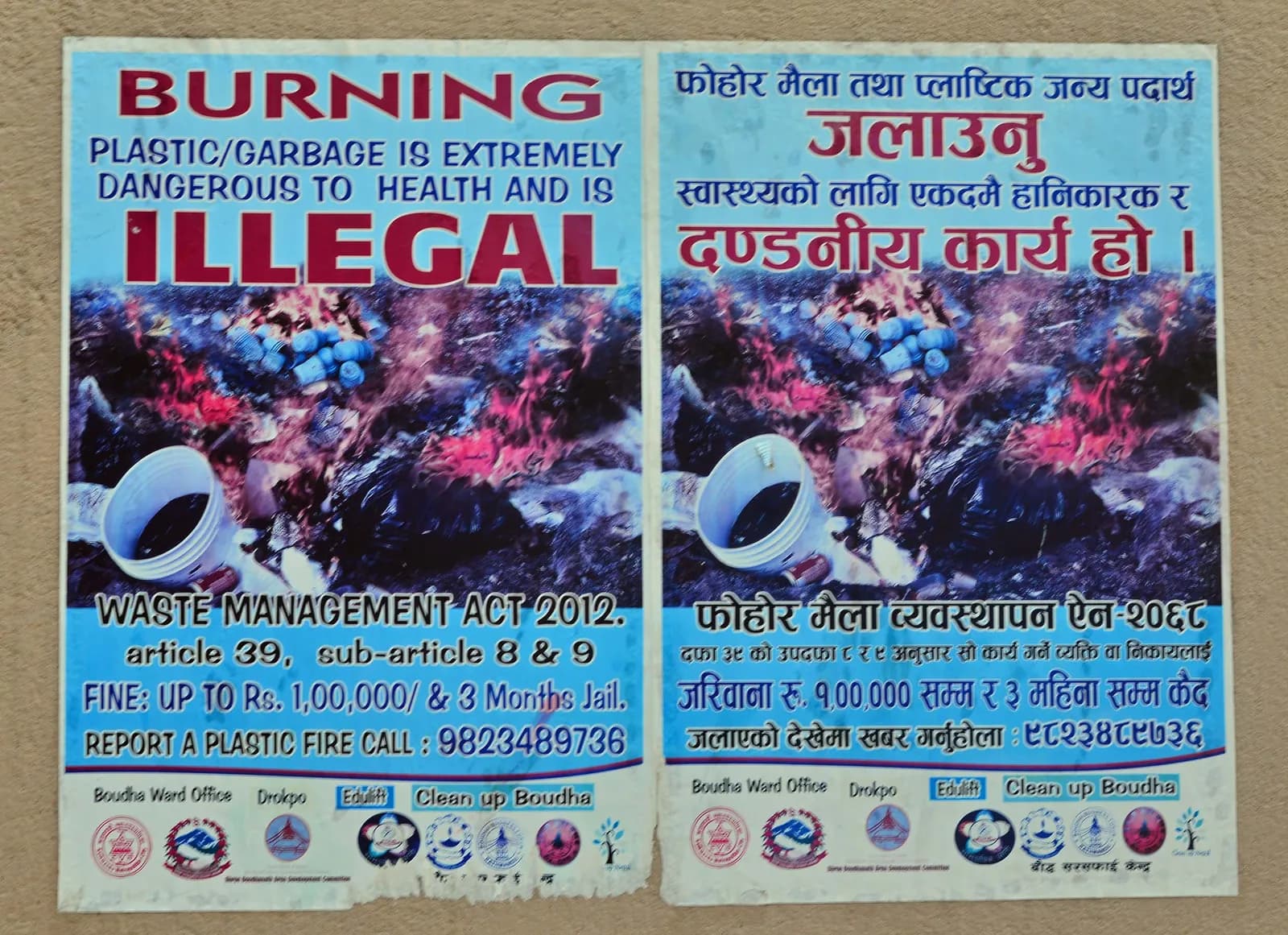
Mountain villages have no good way to dispose of plastic bottles. A refillable bottle with a filter or purification tablets, plus hot water from the lodge, avoids a bottle a day, and you still spend money in the lodge on meals and tea. Take your own rubbish out if you can, including batteries and sanitary products, and use the lodge's bins only for food waste where indicated. Avoid buying items with excess packaging at the last shop before the trail. These small habits protect the places you came to see.
A short checklist
- Eat dinner and breakfast where you sleep, and pay the menu price.
- Choose a registered, locally owned agency and ask how staff are paid.
- Buy crafts directly from the maker at a fair price.
- Carry rupees in small notes; do not count on cash machines.
- Agree a tip with your group and hand it over together.
- Carry a filter or tablets rather than buying bottled water.
For related guidance, read our trail etiquette guide, donations and school visits and the culture and customs hub. To plan a route and find companions to share costs, see the Everest Base Camp itinerary, the Annapurna Base Camp itinerary, the Everest region page and the Annapurna Base Camp partner page.