Everest region trekking guide: Khumbu routes, permits and logistics
How the Everest (Khumbu) region works: the three classic treks compared, the Lukla flight and its Ramechhap detour, the two permits, acclimatisation and how many days to plan.
The Everest region, known locally as the Khumbu, offers three classic treks: Everest Base Camp with Kala Patthar (12 to 14 days), the Gokyo Lakes (11 to 13 days) and the Three Passes loop (17 to 20 days). You reach it by flying from Kathmandu to Lukla, or from Ramechhap in the busiest months, then walking up the Dudh Koshi valley through Namche Bazaar. Two permits are needed, both NPR 3,000 as of October 2026, and a guide is strongly advised but not required in Khumbu. The best months are October and November, then March to May.
That is the short version. The rest of this guide explains how the region is laid out, how the three treks differ, what the flight and the permits involve and how to decide how long to take. For the stage-by-stage detail of each trek, use the route pages and itineraries linked below. This page is about choosing and planning.
Everest Base Camp Trek的開放行程
由正在尋找夥伴的健行者發布的真實行程。
How the Khumbu is laid out
Nearly everything in the region sits inside Sagarmatha National Park in Solukhumbu District. The park was gazetted in 1976, covers 1,148 km2 and became a UNESCO World Heritage Site in 1979. It runs from about 2,845 m at Monjo, where the park gate stands, to the summit of Everest at 8,848 m.
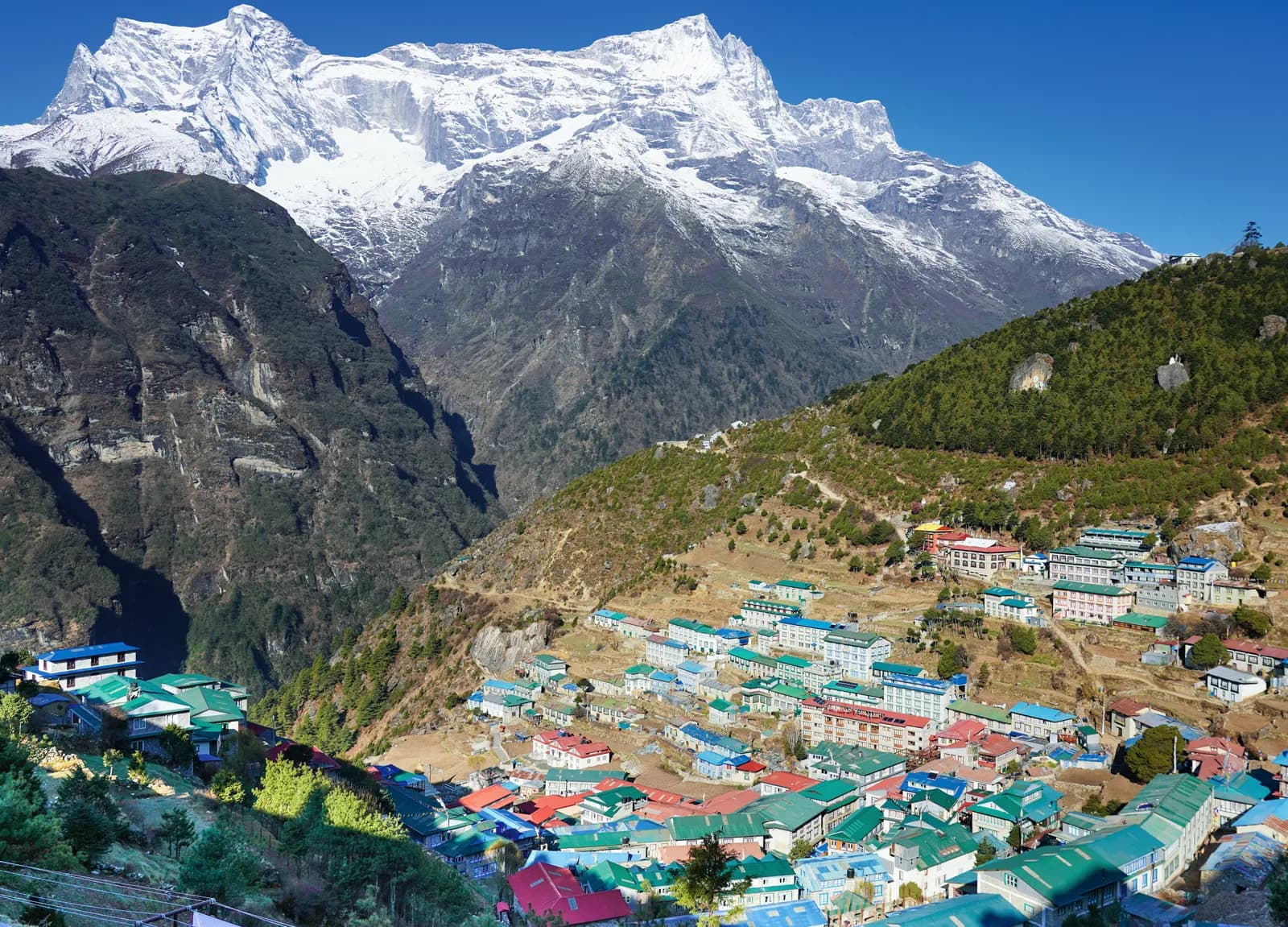
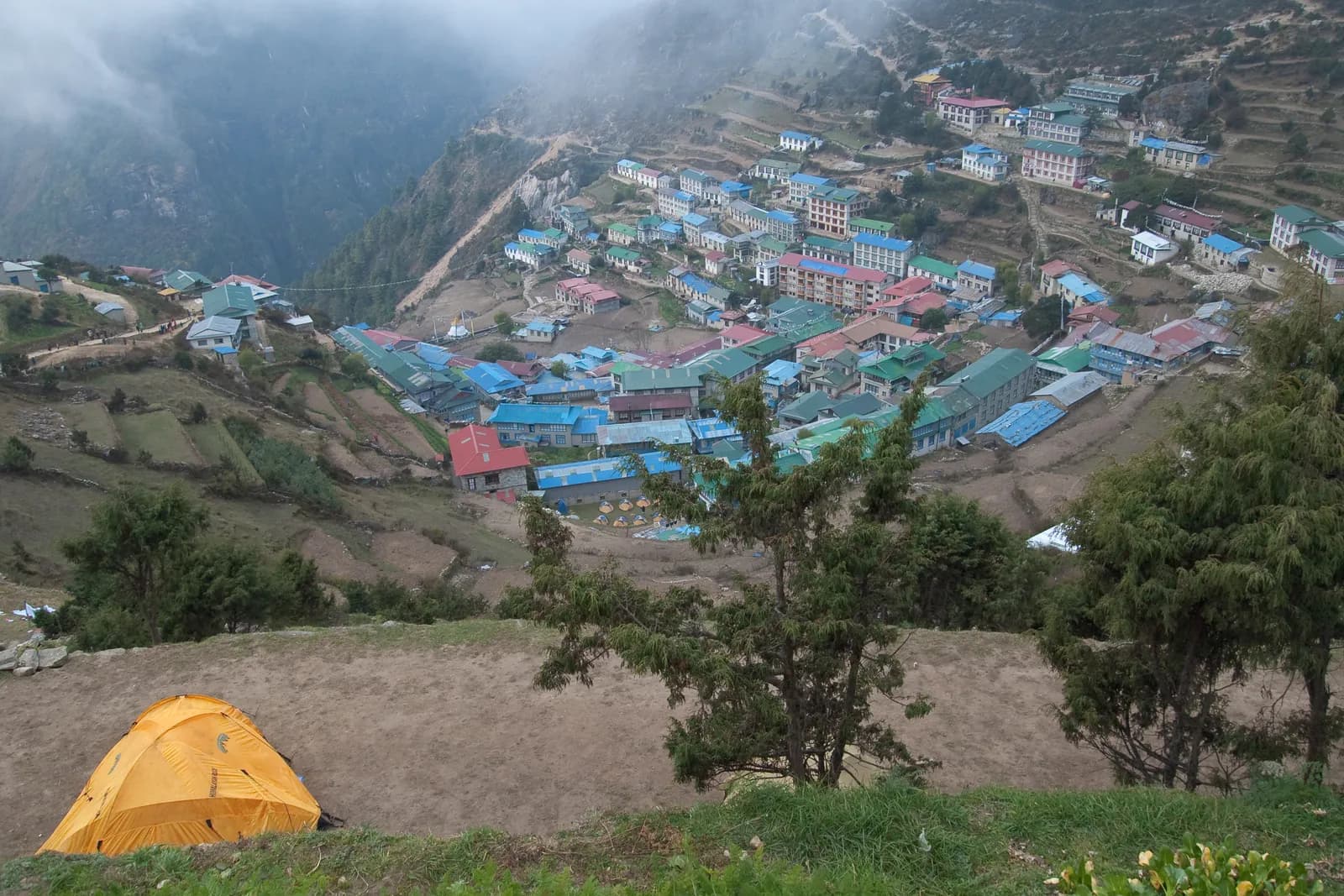
Think of it as one trunk and three branches. The trunk is the Dudh Koshi valley from Lukla (2,846 m) up to Namche Bazaar (3,440 m), the Sherpa trading town where every trek spends at least two nights. Above Namche the valley splits. One branch follows the main river to Tengboche, Dingboche and Lobuche, and ends at Gorak Shep and Everest Base Camp. A second branch climbs the western valley through Dole and Machhermo to the Gokyo lakes. The third, the Three Passes, joins the two valleys over high glaciated cols and then loops back to the trunk.
This shape matters because every plan is a variation on the first four or five days. Whatever you choose, you will walk the same stretch to Namche, and you will acclimatise at the same town. Only after that do the treks diverge.
The three treks compared
| Trek | Typical days | Highest point | What it is like |
|---|---|---|---|
| Everest Base Camp | 12 to 14 | Kala Patthar, about 5,550 m | The classic: the busiest trail and the strongest lodge network |
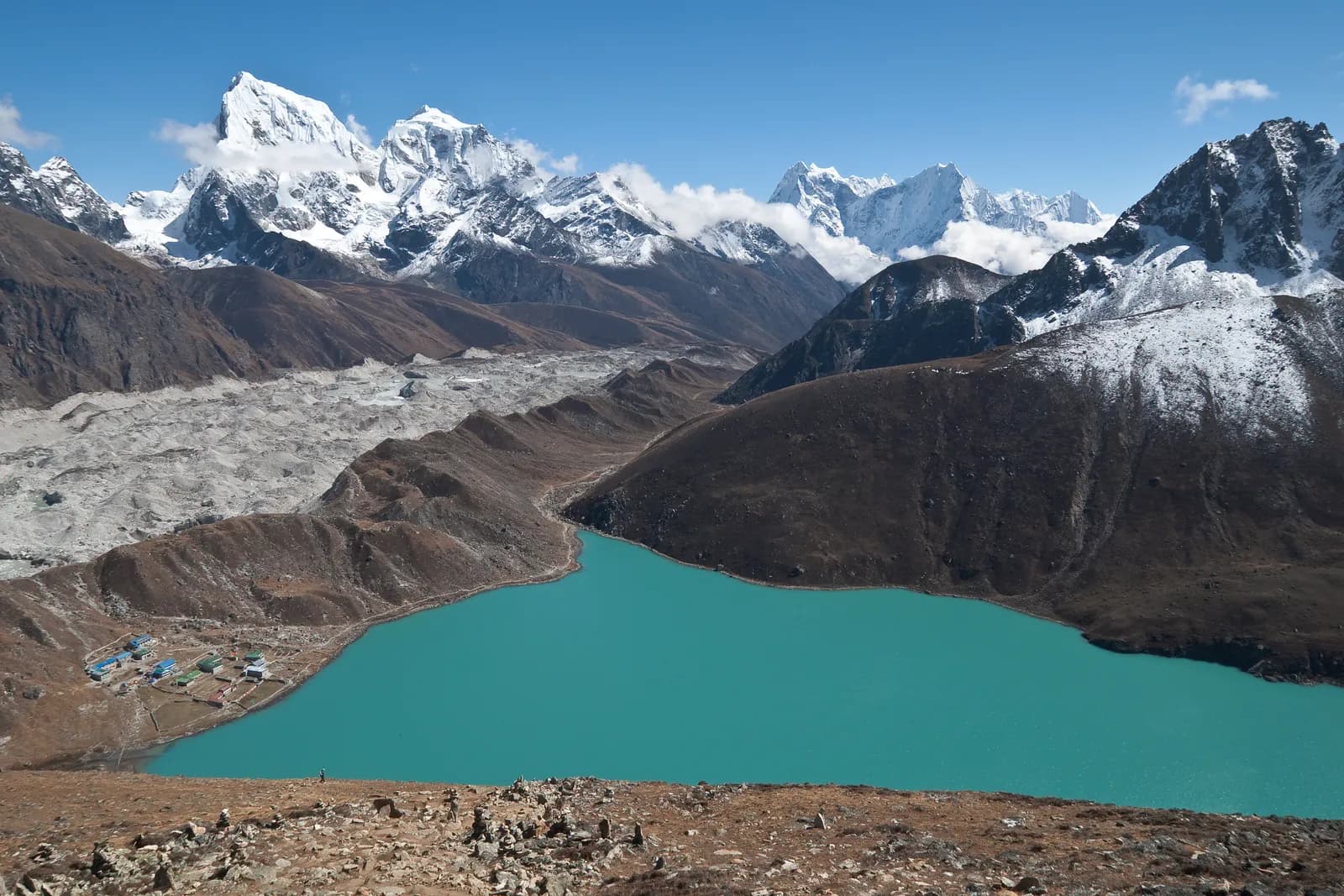
| Gokyo Lakes | 11 to 13 | Gokyo Ri, 5,357 m | A quieter valley with turquoise lakes and the Ngozumpa Glacier |
| Three Passes | 17 to 20 | Kongma La, 5,535 m | A full loop over three glacier-edge passes; demanding |
Base Camp is the right choice if you want the famous goal, the widest choice of lodges and the reassurance of other trekkers around you. Be honest about what Base Camp itself is: a rocky camp area at the foot of the Khumbu Icefall, with the best view of Everest coming from Kala Patthar rather than from camp. Gokyo suits people who would rather have the Dudh Pokhari lake and a sunrise from Gokyo Ri, where four of the world's six highest peaks are visible, and who accept two nights above 4,700 m. The Three Passes is a trip for a second visit or for strong walkers who have already spent time above 5,000 m.
If you cannot decide, read the head-to-head comparison in Everest Base Camp versus Gokyo Lakes. If you have only a long weekend of Nepal and cannot commit to a full trek, the Everest View Hotel walk above Namche, at about 3,880 m, is a self-contained half day that gives a first look at Everest, Lhotse and Ama Dablam.
Getting to the trailhead
The standard route is a 35 to 40 minute flight from Kathmandu to Lukla. The airstrip is short and sloped, and flights depend on cloud and wind, so departures cluster in the early morning. In the busiest months many flights operate from Ramechhap (Manthali) instead, a drive of four to five hours from Kathmandu that starts in the small hours. Ask your airline or agency which airport your ticket uses before you plan anything else.
Fares are the biggest single transport cost. As of October 2026, the cost data for this region puts the Kathmandu to Lukla flight at about USD 190 to 240 each way for foreigners, and notes that fares rose on 1 March 2026. Our Kathmandu to Lukla flight guide goes through the delays and the Ramechhap arrangement in detail.
Plan one to two spare days at each end. Cancellations are normal rather than exceptional, and a trek that has no buffer will eventually meet the weather. Do not book an international flight for the day after your planned return.
If you would rather avoid flying, a jeep road reaches Salleri and Phaplu in Solu, and roads run toward Jiri. Walking in from Phaplu or Jiri adds several days, but it climbs gradually, costs less in fares and sidesteps the flight lottery. It is a good option for travellers with time to spare and a preference for quieter trails.
Permits and the guide question
Two permits are normally needed. The Sagarmatha National Park entry permit costs NPR 3,000 for foreigners per entry as of October 2026, and is issued at the Nepal Tourism Board in Kathmandu or at the park gate in Monjo. The Khumbu Pasang Lhamu Rural Municipality trek card, also NPR 3,000 for foreigners, is bought on the trail near Lukla. Bring your passport and spare passport photos. TIMS is not required on the Everest route, so you do not need to buy one for it. Read Sagarmatha National Park entry and the Khumbu local permit for where each one is checked.
On the guide rule, the wording matters. A licensed guide through a registered agency is required in restricted areas, and under the Nepal Tourism Board rule of April 2023 in national parks and conservation areas. In practice, 2026 operator reports say checkpoints enforce it in Annapurna and Langtang but not in Khumbu, because the Khumbu Pasang Lhamu municipality opted out and issues its own trek card (checked 19 October 2026). So in the Everest region a guide is strongly advised but not required. The page on the guide rule by region and our explainer on the guide rule for foreigners set out the sources.
Advice and requirement are different things. A guide here is less about the law than about the altitude: he or she watches how you are acclimatising, reads the weather, knows which lodge has room and handles an evacuation. Many solo trekkers hire a guide-porter for exactly those reasons and for the cost split described below.
Altitude is the real difficulty
Nothing in the Khumbu is technically hard on the main trails. The difficulty is that almost everything is above 2,800 m, and the classic treks go above 5,000 m. Altitude sickness is the main medical risk, and the people who get into trouble are usually the ones who climbed too fast.
Use the general rules from the Wilderness Medical Society and the CDC Yellow Book: above 3,000 m sleep no more than about 300 to 500 m higher each night, add a rest day roughly every 3 to 4 days or every 1,000 m of sleeping height, and never go higher with symptoms. A headache with nausea, dizziness or unusual breathlessness at rest means stop. Confusion, a loss of balance or a wet cough means descend now.
Rest days are not wasted days. Use them for a short hike high and then sleep low, which on the Base Camp route means the Everest View Hotel walk from Namche and a climb above Dingboche. The Himalayan Rescue Association runs a seasonal aid post at Pheriche with talks in the main trekking months, and attending one is a good use of an afternoon. See the acclimatisation schedule for a night-by-night plan.
When to go
October is the most popular month, with the steadiest weather and the fullest lodges. November is colder but very clear and quieter, and the high lodges start to close late in the month. March has cold nights and clear days, and April is the spring peak, with rhododendrons flowering below Namche. May is warmer and hazier. The monsoon from June to August brings cloud, wet trails, leeches at low altitude and cancelled flights, and few trekkers go. December to February is very cold, and some lodges above Dingboche shut. The passes are unsafe in snow.
Our best time for Everest Base Camp page compares the months in more depth.
Lodges, food and what to carry
Lodges in the Khumbu are called tea houses. You get a simple twin room, a dining room with a stove and a menu; the usual arrangement is that rooms are cheap, or free, when you eat your meals at the same lodge. Everything above Lukla comes up by porter, yak or mule, so food, charging, hot showers and Wi-Fi all get more expensive the higher you go. As of October 2026 the regional cost data gives a dal bhat of about NPR 1,000 to 1,800 between 2,500 and 3,800 m, and NPR 1,200 to 2,000 above 3,800 m. Dal bhat comes with refills, which makes it the sensible choice.
Bring rupees in small notes. ATMs in Lukla and Namche are sometimes empty or offline, and nothing above Namche can be relied on. For gear, see the Nepal trek packing list; at these altitudes the sleeping bag rating and a proper down jacket matter more than anything else.
Culture: this is Sherpa country
The Sherpa people came over the passes from Tibet several centuries ago and run most of the lodges, the yak herds and the monasteries. Tengboche monastery, founded in 1916 and rebuilt after a fire in 1989, is the most visited. Pass mani walls and chortens with the stonework on your right, do not touch prayer wheels with your left hand, take your shoes off at a monastery door and ask before taking photographs inside. Khumbila, above Khumjung, is regarded as a protective deity, and climbing it is forbidden. Read Sherpa culture on the Everest trail before you go.
What it costs and how sharing helps
As of October 2026 the regional cost data gives a market range of NPR 3,400 to 4,700 per day for a guide and NPR 2,100 to 3,400 for a porter. These are market ranges quoted by operators, not a government schedule. The guide and a porter cost the same for one trekker as for two, so a partner cuts your share sharply. Split what is shared (the guide, a porter, a private vehicle in Solu if you go by road) and keep personal items separate: flights, permits, food and rooms are each person's own. If you want a partner for dates and pace, the Everest Base Camp partner page lets you post a plan, and splitting guide and porter costs fairly between partners covers the arithmetic.
Choosing your plan
If this is your first high trek, take the full Base Camp itinerary with its rest days, or Gokyo if you prefer fewer people, and add a spare day. If you have a week and want a taste of the valley, stay in the Namche, Khumjung and Thame area. If you are strong, acclimatised and have 18 days, the Three Passes is the best of the region. Whichever you choose, read the Everest Base Camp itinerary day by day for the shared first days, check the Everest region page for the data behind this guide, and come back to the regions guide and the region guides category to compare it with the others.