Choosing a trekking agency in Nepal: 25 questions to ask
Twenty-five questions to put to a Nepal trekking agency about registration, guides, porter welfare, itinerary safety, insurance, price and cancellation, with the answers that should reassure you or worry you.

Choose a Nepal trekking agency by checking that it is registered, that its guides are licensed and trained, that it pays and equips porters properly, that the itinerary includes enough acclimatisation days and that the price is itemised in writing. The right questions take ten minutes and filter out most of the weak operators. This guide gives you 25, grouped by theme, with the kind of answer that should reassure you and the kind that should make you walk away, so you can compare agencies on more than their price.
Annapurna Base Camp Trek的開放行程
由正在尋找夥伴的健行者發布的真實行程。

Registration and legitimacy
- What is your company's registration and licence number? A real agency gives it at once. Check it with the relevant authority and note it in your records.
- Are you a member of TAAN? Membership of the Trekking Agencies' Association of Nepal is a useful signal. It is not a guarantee, but agencies that are members have accepted an association's code.
- Where is your office? Look for a street address in Kathmandu or Pokhara and consistent phone numbers. A company that exists only on a messaging app is risky.
- Who owns the company, and who will operate my trek? Many foreign-based sellers subcontract to a Nepali agency. You want to know who is responsible when something goes wrong.
- Can I see recent independent reviews? Look for specific, recent, unedited comments on several platforms, not only testimonials on the agency's own website.
Guides and porters
- Who is my guide, and what is their licence number? Ask for the name, licence, years of experience on your route and languages.
- Is the guide trained in first aid and altitude illness? For anything above 3,500 m, ask about a wilderness first-aid course and experience recognising altitude symptoms. Our altitude sickness basics tell you what a good guide should do.
- How many trekkers will each guide look after? A guide with a group of four is manageable, and a guide with eight is stretched, especially if people walk at different speeds. For a larger group, ask for an assistant guide.
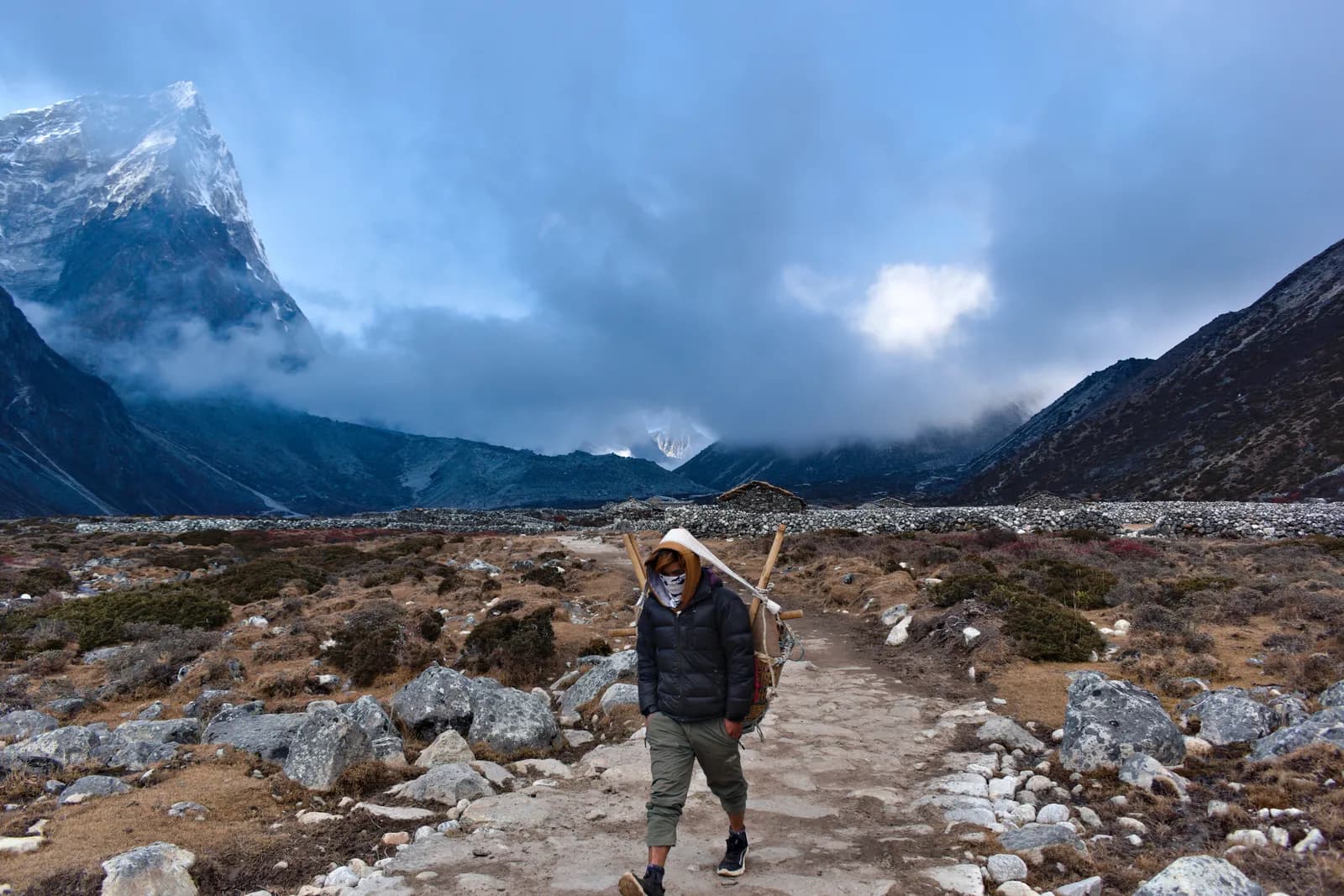
- How are porters paid, insured and equipped? Responsible agencies pay a fair daily wage, provide insurance, warm clothing, footwear and shelter, and respect a maximum load. The International Porter Protection Group sets out standards, and a good agency can describe its own. Our guide to guide and porter roles explains the difference.
- What is the porter's maximum load, and who decides? If an agency cannot answer, that tells you something.
The guide rule affects what you ask. A licensed guide through a registered agency is required in restricted areas (Department of Immigration) and, under the Nepal Tourism Board rule of April 2023, in national parks and conservation areas, where 2026 operator reports say checkpoints enforce it in Annapurna and Langtang but not in Khumbu (checked 19 October 2026). An agency that tells you a guide is never needed, or that you can ignore it in an area where it is enforced, is not giving you the full picture.
Itinerary and safety
- How many rest or acclimatisation days are in the plan? The CDC suggests, above 3,000 m, raising your sleeping altitude by no more than about 500 m a night, with an extra night for every 1,000 m gained. Check the plan against this. A 12-day Everest Base Camp itinerary has rest days at Namche Bazaar and Dingboche; a plan with none above 3,500 m is a warning.
- Do you build in spare days for weather and flights? Flights to Lukla and Jomsom are often delayed. Ask what the agency does if you are stuck and who pays.
- What is your policy if a client shows signs of altitude sickness? The right answer is that the guide stops the ascent, descends if symptoms worsen and the agency never pressures anyone to continue.
- How does the guide communicate with your office? Ask about phone, satellite or local SIM coverage, and how often the guide reports in.
- Who arranges and pays for a helicopter evacuation, and how fast? Ask for the process in writing, and check that your own insurance covers it. The Himalayan Rescue Association clinics at places like Manang and Pheriche are described in our HRA clinics guide.
Price and what it includes
- Can I have an itemised written quote? Look for guide days, porter days, permits, transport, accommodation, meals and insurance for staff. Our cost guide shows what each line normally costs.
- Which permits are included, and who obtains them? For example, the Annapurna Conservation Area permit is NPR 3,000 for foreigners and the Sagarmatha National Park permit NPR 3,000 plus the Khumbu trek card NPR 3,000 (as of October 2026). If an agency's price excludes these, you need to know.
- What is not included? Tips, showers, charging, drinks, personal gear and your own insurance are normally extra.
- Why is your price lower or higher than others? Ask politely. A good agency can explain, for instance, the quality of guides, a smaller group or included hotels.
- How do you pay your guides and porters? Day rates in the pack, from operator guides (as of October 2026), are NPR 2,700 to 4,000 for a guide and NPR 2,100 to 3,400 for a porter in the Annapurna region, and NPR 3,400 to 4,700 for a guide in the Everest region. A quote far below that range is a red flag.
Payment, cancellation and complaints
- What is the payment schedule? A deposit with the balance on arrival is common. Avoid full payment months ahead.
- How can I pay safely? Use a traceable method such as bank transfer to the company's account or a secure card payment, and keep receipts.
- What happens if I cancel, if flights are cancelled or if a pass closes? Get the terms in writing, including refunds and who covers extra nights.
- Do you have a complaints process? A good agency can tell you who to contact if something goes wrong.
- Can I speak to a past client? A confident agency will usually put you in touch, or point to detailed reviews.
How to read the answers
You do not need a perfect answer to every question. What matters is that the agency answers clearly, in writing, without evasion. Warning signs include refusal to give a registration number, pressure to pay in full or in cash quickly, a price far below the market without an explanation, no mention of acclimatisation days, vague answers about porter welfare and claims that permits or guides are never required. If two agencies give similar answers, choose the one that communicates best, because that is the one you will deal with when plans change.
If you are comparing quotes for the Annapurna Base Camp trek, ask each agency the same questions about acclimatisation and porters. Our red flags guide for partners covers a related set of warning signs when you share a trek with someone you met online, and the partner vetting checklist covers that side of the booking.
What to do after you choose
Once you have chosen, follow the steps in our guide on how to book a Nepal trek: get the quote in writing, agree the payment schedule, arrange insurance and leave spare days. Meet your guide before the trek starts, check the equipment for porters and confirm the daily plan. If you want to share a guide and costs, use the Annapurna Base Camp partner page or the trekking partner hub to find someone, then ask each agency for a group quote.
For the broader beginner path, see the first-time trekking guide and the first-timers hub. FindTrekkingPartner is not a trekking agency: it does not sell treks, employ guides or handle money, and the agency you choose is the one you contract with.