

Everest View trek itinerary: a short Namche-based version
A 5-day Everest View itinerary built from the Base Camp plan: fly to Lukla, sleep at Phakding and Namche, walk to the Everest View Hotel at about 3,880 m and Khumjung, with an optional Tengboche extension.
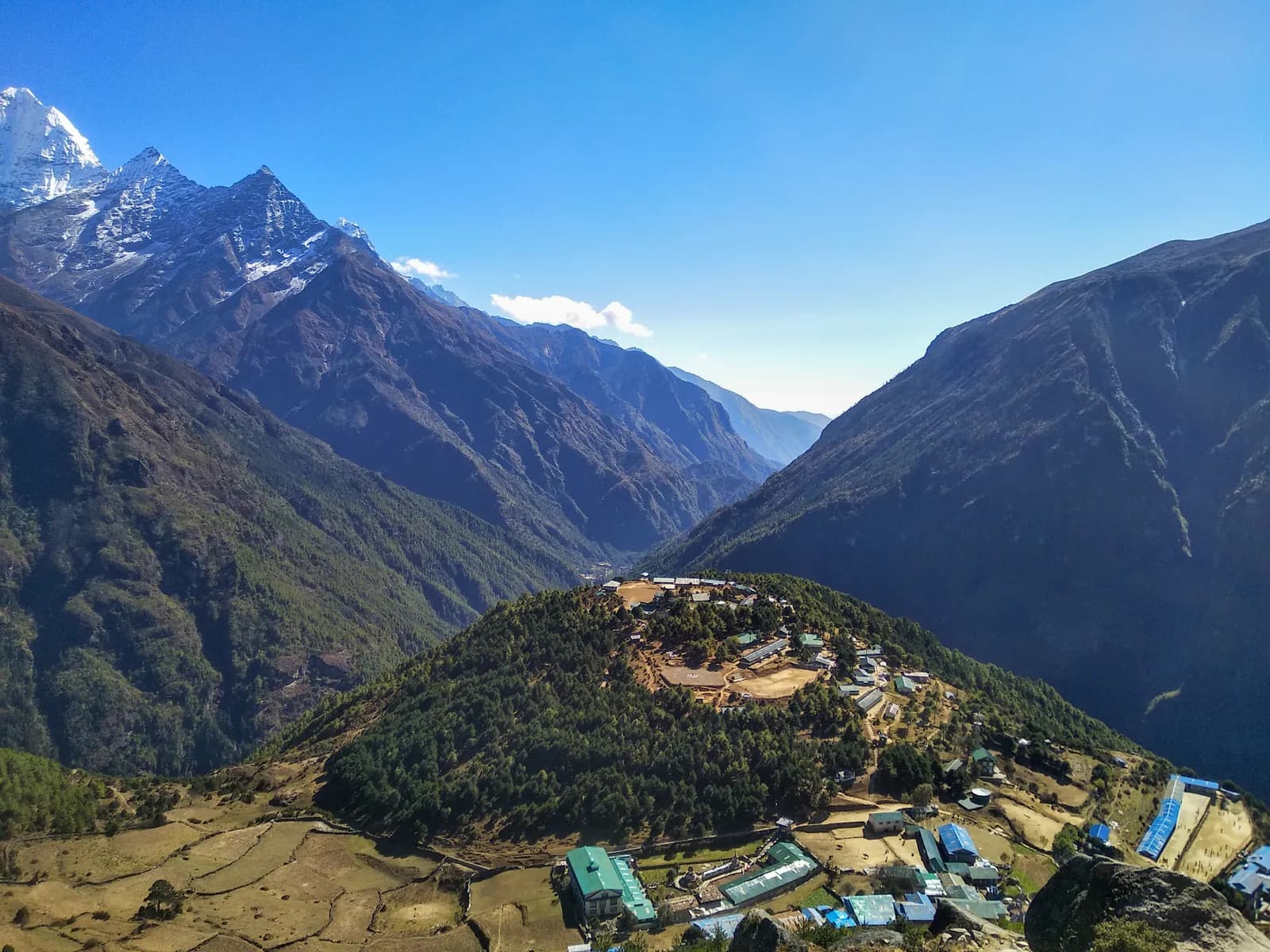
There is no separate Everest View route in our data, so this short version is built from the Everest Base Camp day plan. You fly from Kathmandu to Lukla, sleep at Phakding (2,610 m) and Namche Bazaar (3,440 m), walk on the rest day to the Everest View Hotel at about 3,880 m for the first wide view of Everest, Lhotse and Ama Dablam, continue to Khumjung and Khunde, then walk back down to Lukla and fly out. It takes five days with a spare day for flight delays, and it never goes above about 3,900 m.
It is the smallest trek that still feels like the Khumbu, and it suits anyone with limited time who wants the valley, a Sherpa town and a mountain view without committing to 12 days. The full route and its data are on the Everest Base Camp page, and the region is explained in the Everest region trekking guide.
Everest Base Camp Trek的开放行程
由正在寻找搭档的徒步者发布的真实行程。
The 5 days at a glance
| Day | Plan | Time | Sleep |
|---|---|---|---|
| 1 | Fly Kathmandu to Lukla, walk to Phakding | 3-4 h walk | 2,610 m |
| 2 | Phakding to Namche Bazaar | 6 h | 3,440 m |
| 3 | Rest day: Everest View Hotel, Khumjung, Khunde | 3 h | 3,440 m |
| 4 | Namche Bazaar to Lukla | 7 h | 2,860 m |
| 5 | Fly Lukla to Kathmandu | 1,400 m |
Keep a sixth day in Kathmandu as a buffer. Lukla flights are often delayed or cancelled, and a plan with no spare day will meet the weather sooner or later.
Day 1: Lukla to Phakding
Fly early from Kathmandu to Lukla, about 35 to 40 minutes. The runway is short and sloped, so flights run in the morning when the cloud is up, and in the busiest months many flights leave from Ramechhap, a drive of four to five hours that starts in the small hours. Walk down the Dudh Koshi valley through Cheplung and Ghat to Phakding at 2,610 m. The track is gentle, with mani walls and suspension bridges. Early night: tomorrow is the first big climb. See the Kathmandu to Lukla flight guide.
Day 2: Phakding to Namche Bazaar
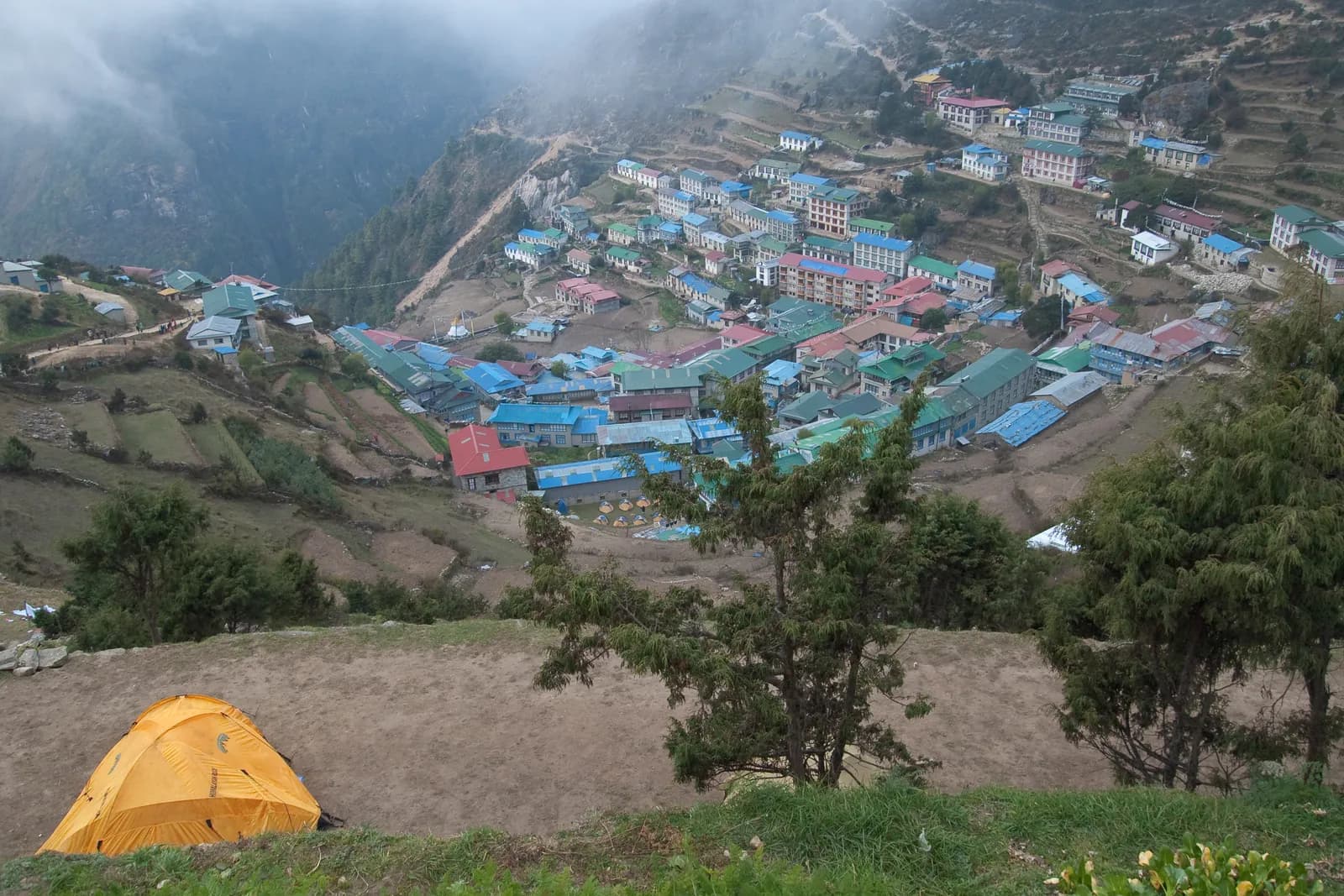
Cross the Dudh Koshi on suspension bridges and enter Sagarmatha National Park at Monjo, where permits are checked. At Jorsale the trail drops to the river and crosses the Hillary Bridge, then climbs steeply for about two hours through pine forest to Namche Bazaar at 3,440 m. On a clear day you catch a first view of Everest and Lhotse between the trees. Namche is the trading centre of the Sherpa community, with bakeries, shops, a bank machine and a Saturday market. You stay two nights.
Day 3: Everest View Hotel and Khumjung
This is the day the trek is named for. The classic acclimatisation walk climbs to the Everest View Hotel at about 3,880 m, a gain of about 440 m from Namche, for a wide view of Everest, Lhotse and Ama Dablam. From there you continue to Khumjung and Khunde, where the school, hospital and monastery are among the lasting results of Edmund Hillary's work in the valley, then return to Namche for the afternoon. Keep to the plan: the point of a rest day is to climb high and sleep low, so do not walk more than about 500 m above the town. For an easier day, visit the Sherpa museum above Namche.
Day 4: Namche to Lukla
A long downhill day of about seven hours: down to the Hillary Bridge, through Jorsale and Monjo, and on through Phakding and past Benkar and Chhumoa. The track is busy with porters and animals, so stand on the uphill side. After a last climb through Ghat and Cheplung you reach Lukla at 2,860 m. Confirm your flight time with the lodge or your agency.
Day 5: fly out
Take the morning flight to Kathmandu, weather permitting. If your flight was moved to Ramechhap, add the four to five hour drive back. Do not book an international flight for this day or the one before it.
Option: add Tengboche
If you have two more days, add Tengboche, which the Base Camp plan reaches on day 4 from Namche in about five hours at 3,860 m. It is the site of the Tengboche monastery, founded in 1916 and rebuilt after a fire in 1989, and it adds a night at roughly the same height as Namche. The extended plan runs: day 4 Namche to Tengboche, day 5 Tengboche back to Namche, day 6 Namche to Lukla, day 7 fly out. It gives you a monastery and a forest, and it stays below 3,900 m. For what to respect at a monastery, read Sherpa culture on the Everest trail and monastery etiquette, prayer wheels and mani walls.
Altitude: short does not mean risk-free
A first night at 2,610 m and a second at 3,440 m is a fast rise for someone who was in Kathmandu at 1,400 m the day before. The usual guidance from the Wilderness Medical Society and CDC Yellow Book is to sleep no more than about 300 to 500 m higher each night above 3,000 m and never to ascend with symptoms. This plan keeps close to that, and the rest day at Namche is what makes it work. If you wake on day 3 with a headache that does not clear, skip the Everest View climb and stay low. See altitude sickness basics and what normal looks like day by day at altitude.
Permits and the guide question
You need a Sagarmatha National Park entry permit, NPR 3,000 for foreigners per entry as of October 2026 (NPR 1,500 for SAARC nationals, children under 10 free), and a Khumbu Pasang Lhamu Rural Municipality trek card, NPR 3,000 (NPR 2,000 for SAARC countries and China). Our cost data records no confirmed TIMS price, so ask your agency whether one is needed. See Sagarmatha National Park entry and the Khumbu local permit.
On guides, a licensed guide through a registered agency is required in restricted areas, and under the Nepal Tourism Board rule of April 2023 in national parks and conservation areas, where 2026 operator reports say checkpoints enforce it in Annapurna and Langtang but not in Khumbu, because the Khumbu Pasang Lhamu municipality opted out and issues its own trek card (checked 19 October 2026). A guide is strongly advised but not required here. See the guide rule by region.
Season and cost
October and November are the steadiest months, March to May the second window, and the monsoon brings cloud and cancelled flights. Winter is very cold. See best time for Everest Base Camp. As of October 2026 the Everest cost data gives the Lukla flight at about USD 190 to 240 each way, which dominates a short trek, a guide day of NPR 3,400 to 4,700 and a porter day of NPR 2,100 to 3,400 as operator market ranges, not official rates, and a dal bhat of NPR 1,000 to 1,800 between 2,500 and 3,800 m. Carry rupees, as machines in Namche can be empty.
Sharing and where next
The flight is the big fixed cost, and two people pay the same guide as one. Post your dates on the Everest Base Camp partner page and read splitting guide and porter costs fairly between partners. If this short version leaves you wanting more, the Everest Base Camp itinerary and the Gokyo Lakes itinerary use the same first days. More plans are in the route guides category and the day-by-day itineraries hub.
Who this short version suits
It suits people with a long weekend of Khumbu time, travellers who want to test how they feel at 3,400 m before committing to a longer trek, and families or older walkers who prefer shorter days. It is also a sensible shake-down for gear: you learn whether your boots, layers and sleeping bag work, and you can adjust before a bigger trip. It is not a good fit for anyone who needs certainty of getting out on day 5, since a cancelled flight can eat the spare day and more. Read the Kathmandu to Lukla flight guide and keep the buffer.
What to pack for five days
Waterproof boots, a base layer, a fleece, a warm jacket for evenings in Namche, a shell, hat, gloves, sunglasses, sunscreen, poles, a headlamp and a water bottle with a purification method. Lodges provide blankets, but a light sleeping bag liner helps. Carry rupees in small notes, and a power bank, since charging costs extra. See the Nepal trek packing list for the full set.
The regional data is on the Everest region page.


