Kala Patthar versus Gokyo Ri and Other Everest Viewpoints
Kala Patthar gives the closest view of Everest; Gokyo Ri gives the widest panorama with four 8,000 m peaks and the lakes. How they compare on height, effort, views, crowds and which trek each belongs to.

Kala Patthar (about 5,545 m in our route data) gives the closest view of Everest, with Nuptse and Changtse in front of it; Gokyo Ri (5,357 m) gives the widest panorama, with four 8,000 m peaks, the Ngozumpa Glacier and the Gokyo lakes below, and a quieter, easier approach. If you can only choose one, choose by the trek you are doing: Kala Patthar belongs to the Base Camp route and Gokyo Ri to the Gokyo Lakes route, and the Three Passes loop gives you both. The Everest View Hotel above Namche and the ridges around Dingboche are good lower alternatives.
This guide compares them side by side and places the other Khumbu viewpoints. It draws on our route pages for Everest Base Camp, Gokyo Lakes and the Three Passes. The comparison hub is which Nepal trek is right for you.
Everest Base Camp Trek için açık geziler
Partner arayan trekkingcilerin paylaştığı gerçek geziler.
At a glance
| Factor | Kala Patthar | Gokyo Ri |
|---|---|---|
| Height (our route data) | About 5,545 m | 5,357 m |
| Belongs to | Everest Base Camp trek | Gokyo Lakes trek |
| Climb from | Gorak Shep, 5,164 m | Gokyo, 4,790 m |
| Main view | Everest close up, with Nuptse and Changtse | Everest, Lhotse, Makalu and Cho Oyu; Ngozumpa Glacier and lakes |
| Typical time of day | Sunrise or late afternoon | Morning on a rest day |
| Crowds | Busy around sunrise in peak months | Quieter |
| Effort | Hard, at the top of a long ascent | Moderate to hard, after acclimatising |
Kala Patthar
Kala Patthar ("black rock" in Nepali) is a ridge on the south side of Pumori above Gorak Shep. Wikipedia describes it as not a proper mountain, with a prominence of only 10 m, but notes that the ascent is very popular because it provides the most accessible close-up view of Everest, and explains why: because of the structure of the Everest massif, the summit is blocked by Nuptse from much of the surrounding region. From Kala Patthar you see Everest, Nuptse and Changtse and glimpses of Lhotse, with the Khumbu Glacier and Pumori around you.
On the standard trek you reach Gorak Shep (5,164 m) on day 8 of our 12-day plan, visit Everest Base Camp at about 5,364 m, and climb Kala Patthar on a separate morning, which our route page calls the best close view of the summit. Base Camp itself is a place and a milestone, not a view of Everest's summit; Kala Patthar is where you see it. The climb is at the end of a long, high week, in the cold, usually at dawn, and the altitude is the hard part. Read Everest Base Camp day by day and the acclimatisation schedule.
Gokyo Ri
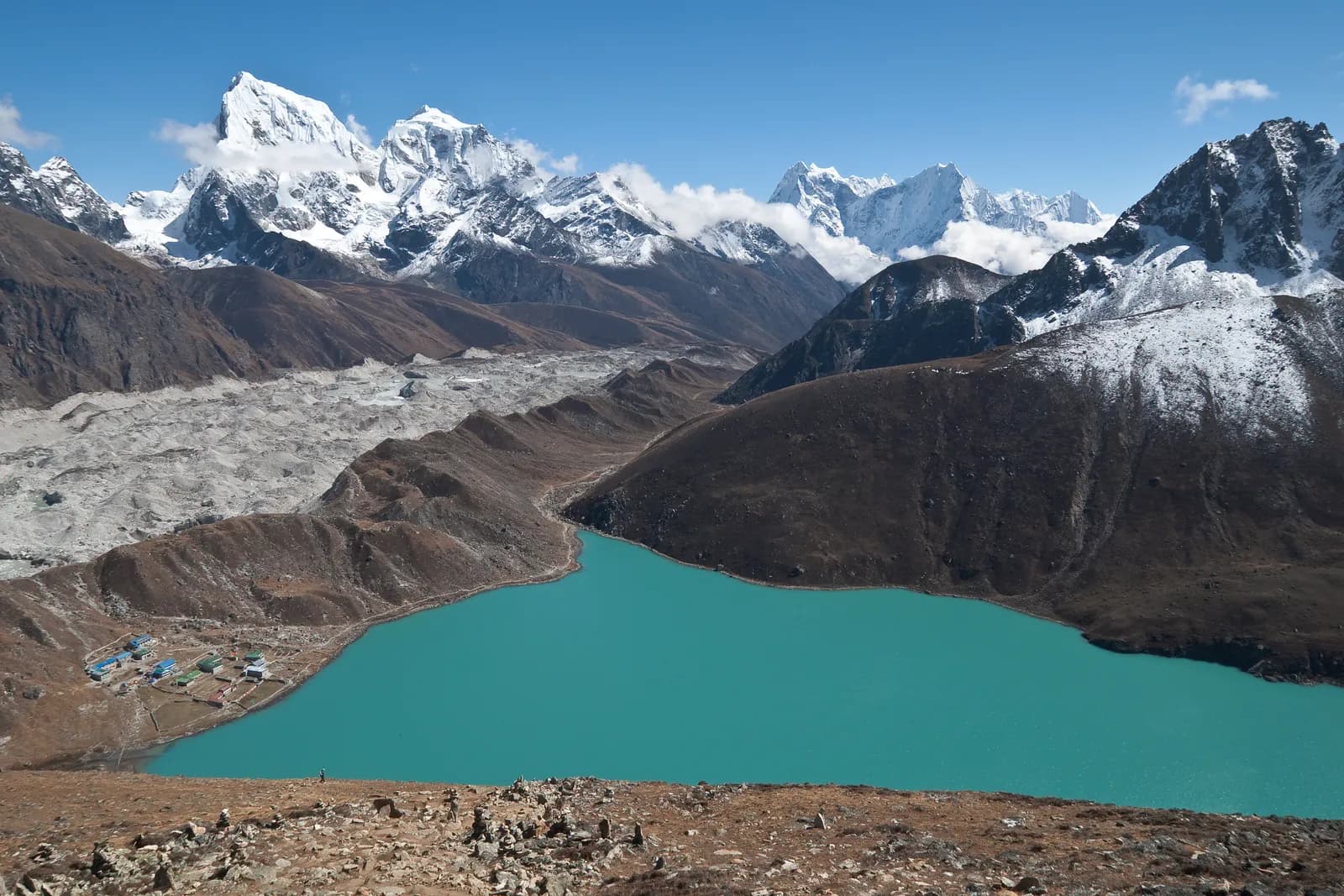
Gokyo Ri is a 5,357 m peak on the west side of the Ngozumpa Glacier, which Wikipedia calls the largest glacier in Nepal. Gokyo, the village at its base, is one of the highest settlements in the world, on the shore of a lake. From the summit it is possible to see four 8,000 m peaks, Everest, Lhotse, Makalu and Cho Oyu, along with Pumori, Nuptse and the Gokyo lakes. Wikipedia puts the summit at about a three-hour hike from the nearest village.
On our 12-day Gokyo plan, the rest day at Gokyo (day 7) is when you climb it, after nights at Dole (4,040 m), Machhermo (4,470 m) and Gokyo (4,790 m). That sequence makes it a better-acclimatised, quieter experience than Kala Patthar, with the lakes adding colour that Base Camp lacks. Our route page notes that Gokyo Ri's high point is slightly lower than Kala Patthar and the trail has fewer people. See Everest Base Camp versus Gokyo Lakes.
Which view is better?
They are different views, not better and worse.
- Closest Everest: Kala Patthar. If seeing the summit up close is the point, this is it.
- Widest panorama and the lakes: Gokyo Ri, with four 8,000 m peaks and the glacier.
- Photography: Kala Patthar at sunrise for Everest and Nuptse light; Gokyo Ri in the morning for the panorama and turquoise lake.
- Altitude comfort: Gokyo Ri, because it is lower and climbed on a rest day.
- Crowds: Gokyo Ri is quieter; Kala Patthar can be crowded at sunrise in October and April.
Both on one trek
The Three Passes trek links the two valleys. Our 18-day plan goes to Gorak Shep and Base Camp on day 9, crosses Cho La to Thagnak, reaches Gokyo, and has a rest day at Gokyo for the Gokyo Ri climb on day 13, then crosses Renjo La. That gives you both viewpoints, but it is a hard, high trek that needs experience; see Everest Three Passes versus Everest Base Camp. If you do not want the passes, adding Gokyo to a Base Camp trip means more days and more nights above 4,000 m.
Lower viewpoints for those who cannot go high
You do not need to reach 5,000 m for a great view.
| Viewpoint | Height | Where | Notes |
|---|---|---|---|
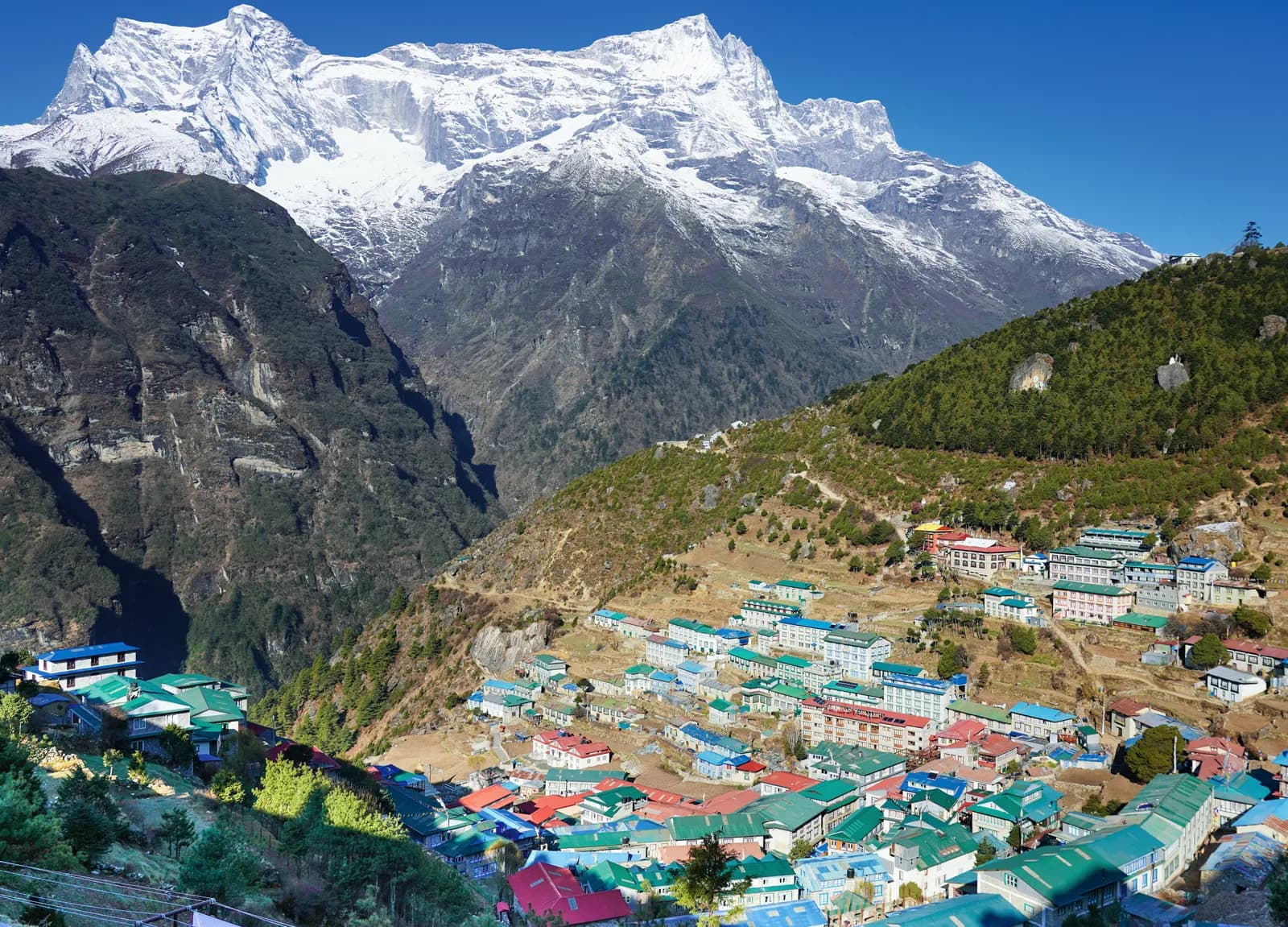
| Everest View Hotel | About 3,880 m | Above Namche, reached on the Namche acclimatisation day | Everest, Lhotse and Ama Dablam; a walk on to Khumjung and Khunde |
| Tengboche | About 3,860 m | Monastery on the Base Camp route | Ama Dablam in the evening and morning light |
| Nangkartshang ridge | About 5,000 m | Behind Dingboche, on the acclimatisation day | Makalu, Lhotse and the Chhukung valley; return to sleep at 4,410 m |
These come from our Base Camp day plan and are worth doing on the acclimatisation days anyway; the standard rule is to climb high and sleep low, which these walks follow.
Weather and timing
All of these are weather-dependent. Cloud can hide the peaks, especially in the afternoon, so early mornings are the best bet. Spring (March to May) and autumn (October to November) are the best seasons; our Everest best-time guide has more, and spring versus autumn compares them. In winter it is very cold at altitude. Build a spare day so that you can try again if cloud covers the view.
Permits and the guide rule
All Khumbu viewpoints sit in Sagarmatha National Park, so the entry permit (NPR 3,000 as of October 2026) and the Khumbu trek card (NPR 3,000) apply. The guide rule is reported not to be checked in Khumbu (the municipality opted out), so the framing is: a licensed guide through a registered agency is required in restricted areas (Department of Immigration) and, under the Nepal Tourism Board rule of April 2023, in national parks and conservation areas, where 2026 operator reports say checkpoints enforce it in Annapurna and Langtang but not in Khumbu (checked 19 October 2026). A guide is still sensible for the high days; see /guide-rule-nepal.
Which should you choose?
- First Everest trek, want the iconic view: Base Camp and Kala Patthar.
- Want a quieter trek with lakes and a panorama: Gokyo and Gokyo Ri.
- Fit and experienced, 18 days: the Three Passes, for both.
- Cannot or do not want to go above 4,000 m: the Everest View Hotel and Tengboche.
How the climbs are paced
The two viewpoints sit at the end of differently paced approaches. On the Base Camp plan the sleeping heights run from Namche (3,440 m) to Tengboche (3,860 m), Dingboche (4,410 m), Lobuche (4,940 m) and Gorak Shep (5,164 m), steps of roughly 420, 550, 530 and 225 m, with rest days at Namche and Dingboche. On the Gokyo plan they run from Namche (3,440 m, two nights) to Dole (4,040 m), Machhermo (4,470 m) and Gokyo (4,790 m), steps of about 600, 430 and 320 m, with a rest day at Gokyo itself. Both stay close to the NHS guide of about 500 m of extra sleeping height a night above 3,000 m, and both build in rest days, but Gokyo Ri is climbed from a village you have already slept in for two nights, while Kala Patthar is usually climbed on the morning after you arrive at Gorak Shep, at the top of a longer week. That is why many people find Gokyo Ri the easier of the two despite the similar height. Whichever you choose, treat any headache, nausea or poor sleep seriously; see altitude sickness basics.
Going with a partner
The cost of a guide and porter on any of these falls when shared. See the Everest Base Camp partner page and the Gokyo Lakes partner page, and read how to find a trekking partner in Nepal safely. More head-to-heads are in the comparisons category.