Easy Nepal treks for kids and families
Families should pick short, low treks near a road: Australian Camp, Ghandruk, Namo Buddha, Nagarkot or Poon Hill. All below about 3,300 m; pace and packing.

The best Nepal treks for families are short, low and close to a road: the three-day Australian Camp and Dhampus walk near Pokhara, the two-day Ghandruk village trek, day hikes from Kathmandu such as Namo Buddha and Nagarkot to Changu Narayan, and, for older children who can handle stairs and five to six hours a day, the four-day Poon Hill trek. All stay below about 3,300 m, and the shorter ones below 2,200 m.
This guide covers which routes suit which ages, how to set the pace, what altitude means for children, what to pack and how to keep it fun.
Travelling with another family? Find a trekking partner for the Poon Hill trek.
Poon Hill Trek (Ghorepani) için açık geziler
Partner arayan trekkingcilerin paylaştığı gerçek geziler.

Choosing by age and stamina
There is no official minimum age on the easy routes. What matters is how much your child can walk happily, how they cope with simple lodges and how you manage a tired or unwell child far from a road. As a guide:
- Toddlers and pre-school children: day hikes with a carrier and a fallback, or a short stay in a lodge at a road-accessible village.
- Ages 5 to 8: short overnight routes with walks of two to four hours, such as Australian Camp.
- Ages 9 to 12: Ghandruk or Poon Hill, with rests and a day of buffer.
- Teenagers: Poon Hill or Mardi Himal with proper training.
These are our own rules of thumb. Children vary a great deal, and enthusiasm matters more than age.
The routes
| Route | Days | Highest point | Longest walk | Notes |
|---|---|---|---|---|
| Namo Buddha hike | 1 | about 1,750 m | one day | Kathmandu Valley, easy |
| Nagarkot to Changu Narayan | 1 | about 2,175 m | one day | Kathmandu Valley, easy |
| Australian Camp and Dhampus | 3 | about 2,050 m | 3 to 4 h | Pokhara, easy |
| Ghandruk village | 2 | about 2,050 m | 4 to 6 h | Pokhara, moderate with stairs |
| Poon Hill | 4 | 3,210 m | 6 h | Annapurna, easy to moderate |
Namo Buddha and Nagarkot to Changu Narayan. Both are single-day hikes from the Kathmandu Valley in our data, rated easy. The Namo Buddha hike starts at Dhulikhel and reaches about 1,750 m, and the Nagarkot to Changu Narayan hike tops out at about 2,175 m. They are the gentlest introduction to a Nepali trail and let you sleep in a hotel at night. Our valley rim hikes guide lists more.
Australian Camp and Dhampus. The Australian Camp trek is three days from Pokhara: a drive of about an hour, two to three hours to Dhampus, three to four hours to Australian Camp and a return walk of one to one and a half hours with a one-hour drive. It is the usual family trek because the days are short, the lodges are comfortable and the view of the Annapurna range from the ridge is superb.
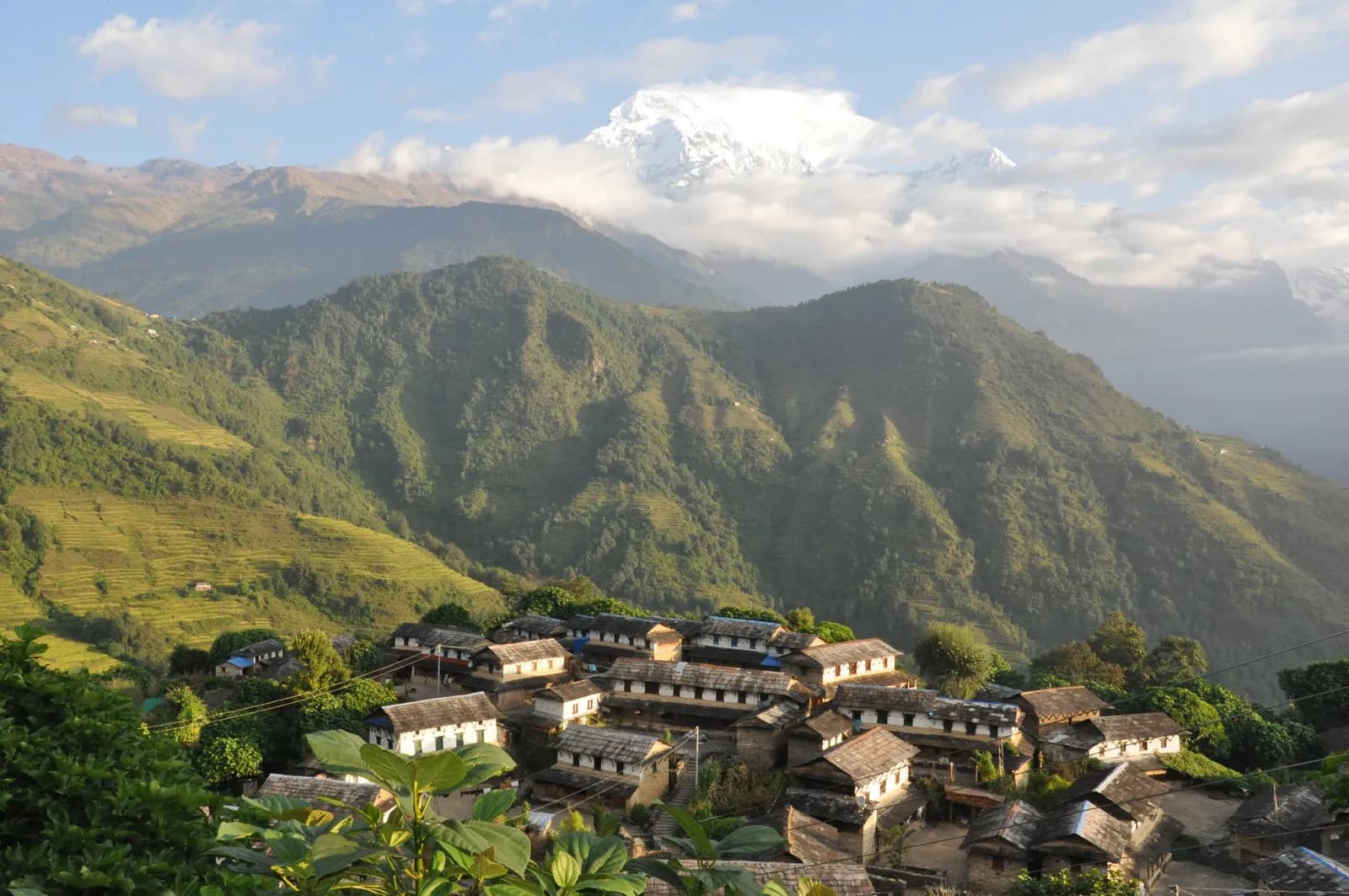
Ghandruk. The Ghandruk village trek takes two days, with four to six hours to reach the village and two to three hours on the second day to Kimche. It is moderate because of the stairs, so it suits children who can climb steps, and the large stone village makes a good stop. The terraced fields and lanes in the photographs show the sort of path.
Poon Hill. The Poon Hill trek is the classic first trek, at four days with a high point of 3,210 m. It suits children of about ten and up who can walk five to six hours and enjoy the stairs. You sleep at 2,860 m in Ghorepani and climb to the viewpoint before dawn; the sunrise is the reward. Children under 10 pay no entry fee for the Annapurna Conservation Area permit, which is NPR 3,000 for adult foreigners as of October 2026.
Altitude and children
Children can get altitude illness, and young children cannot always say how they feel. The CDC Yellow Book and the Wilderness Medical Society guidelines discuss altitude and children, and the sensible approach is conservative: choose routes that stay low, ascend slowly, watch your child closely and descend if in doubt. Warning signs in a small child include unusual crying or irritability, loss of appetite, vomiting, drowsiness or being unusually quiet. A paediatrician with travel-medicine experience can advise before you book, especially if your child is under five or has a medical condition. For adults and older children, above 3,000 m the CDC suggests raising your sleeping altitude by no more than about 500 m a night, with an extra night for every 1,000 m gained. Read our altitude sickness basics and stay on the lower routes.
Setting the pace
Plan for half the distance an adult would do. Walk at the pace of the smallest child, and build in long breaks for snacks, photos and play. Short days of two to four hours are better than long ones. Let children carry a small daypack with a toy, a water bottle and a snack, and let a porter or the guide carry the rest. Games such as spotting prayer flags, counting suspension bridges and learning a few Nepali words help. Keep a day or two in hand: a child with a cold or a blister needs time, and rushing on will cost you.
Our guide to short treks from Pokhara and short treks from Kathmandu have more options.
What to pack
- Layers for each child, a warm hat, gloves and a rain jacket.
- Sun hat, sunscreen and sunglasses; the sun is strong even when cool.
- Snacks they like, including treats for tired moments.
- A small first-aid kit, with plasters, rehydration salts, any prescribed medicine and a thermometer.
- A headtorch each, a book, cards or a small game.
- A child carrier for toddlers.
- Wet wipes, hand sanitiser and spare clothes.
Pack light and arrange a porter. Our minimum gear guide lists the essentials, and our toilets and hygiene guide covers what to expect.
Food, lodges and comfort
Lodges on the lower routes are used to families and will cook simple food: dal bhat, noodles, fried rice, eggs, soup and pancakes. Children often like momos and pancakes, and many eat dal bhat happily. Check that food is hot and freshly cooked, and use boiled or treated water. Rooms are simple twin or family rooms with foam mattresses and blankets, and nights can be cold, so bring sleeping bags. Choose lodges with a sunny terrace and a stove in the dining room, and book ahead in October and April. Our teahouse guide explains the system.
Guides, permits and safety
A guide is a good idea with children: they know the lodges, set the pace and can help if a child is unwell. A licensed guide through a registered agency is required in restricted areas (Department of Immigration) and, under the Nepal Tourism Board rule of April 2023, in national parks and conservation areas, where 2026 operator reports say checkpoints enforce it in Annapurna and Langtang but not in Khumbu (checked 19 October 2026). Permits are listed in our permits explainer, and children under 10 do not pay entry fees in the parks and conservation areas listed in our permit data. Buy insurance that covers the whole family and trekking at your route's altitude.
When to go
Spring (March to May) and autumn (October to November) are best, with clear mornings and mild days. Winter is cold but can be bright on lower routes; the monsoon brings rain and leeches. Check school holidays and book early. Our best time to trek in Nepal guide gives details.
A simple plan
If you have three days and a young family, take Australian Camp from Pokhara. If you have a weekend in Kathmandu, choose Namo Buddha or Nagarkot. If your children are ten or older and keen, take Poon Hill. Compare these with other options in short treks from Pokhara, and read the first-time trekking guide and the first-timers hub. To find another family to share a guide and costs, see the Poon Hill partner page.
Bu trekkingi planla
- Annapurna bölge rehberi
- Kathmandu Valley bölge rehberi
- Pokhara bölge rehberi
- Trekking partner for Poon Hill Trek (Ghorepani)
- Australian Camp and Dhampus Trek trekking partners
- Trekking partner for Ghandruk Village 2-Day Trek
- Namo Buddha Day Hike trekking partners
- Nagarkot to Changu Narayan Day Hike trekking partners
- Poon Hill Trek (Ghorepani) güzergahı
- Australian Camp and Dhampus Trek güzergahı
- Ghandruk Village 2-Day Trek güzergahı
- Namo Buddha Day Hike güzergahı
- Nagarkot to Changu Narayan Day Hike güzergahı