Should first-time trekkers hire a porter in Nepal?
Whether a first-time trekker should hire a porter, what it costs per day and per trek, how sharing works, what a fair load and fair treatment look like, and when you can manage without.
For most first-time trekkers on a multi-day teahouse route, hiring a porter is a good idea. A porter carries your main bag so you walk with a light daypack, which saves energy, protects your knees and leaves you with more attention for the scenery and for how your body feels at altitude. The day rate in our cost data is NPR 2,100 to 3,400 (as of October 2026), and the cost per person falls if you share a porter with a partner. This guide explains what a porter does, what it costs, how sharing works, what fair treatment looks like and when you might skip one.
ทริปที่เปิดรับใน Poon Hill Trek (Ghorepani)
ทริปจริงที่นักเทรคโพสต์เพื่อหาเพื่อนร่วมทาง

What a porter does
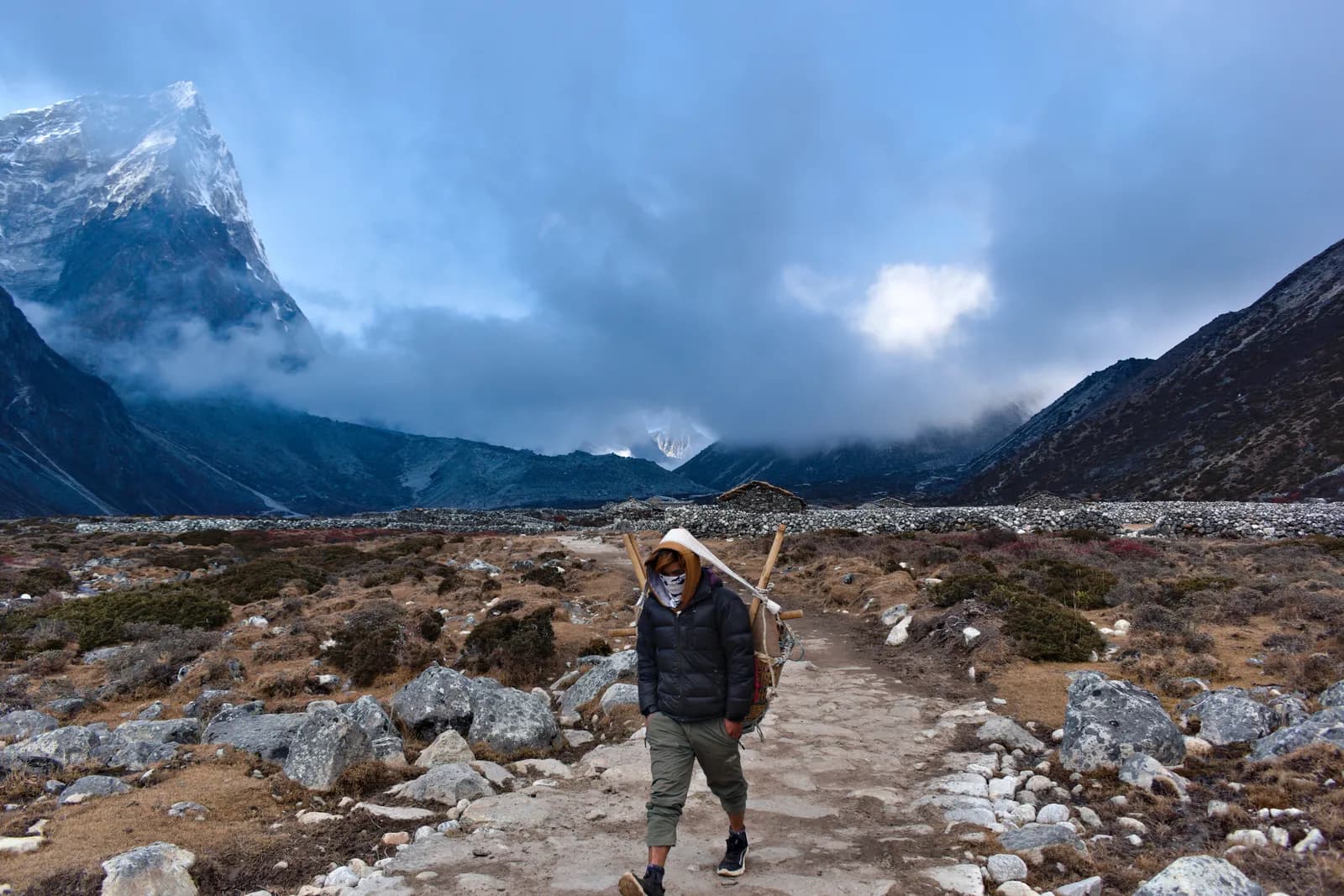
A porter carries your main bag, usually a soft duffel, between lodges. Porters walk ahead or behind and often reach the next lodge before you, so your bag is waiting when you arrive. They do not navigate for the group or manage permits, and they are not responsible for your health. That is the guide's job; see our guide on guide and porter roles. Some staff work as porter-guides, who carry a smaller load and help with the route, and these are common on shorter treks.
Porters are skilled, strong and often underpaid. Loads like the one in the cover photo are carried for days over steep, stony ground, and what you pay and how you treat porters matter.
Why a porter helps a first-timer
A daypack of 5 to 8 kg is easy to carry for six hours. A 15 kg bag is not. For a first trek the advantages of a porter are:
- Energy. You arrive less tired, with more energy for the next day.
- Knees and back. On long stairs, a lighter pack puts less load on joints.
- Altitude. Carrying a heavy pack at altitude makes you breathe harder and tire faster; a light pack helps you go slowly.
- Comfort. Warm clothes, a sleeping bag and a change of clothes are at the lodge when you arrive.
- Employment. A porter earns a wage that supports a family, and spending in trekking communities is the main source of income in many villages.
For many people, a porter turns a hard trek into an enjoyable one.
What it costs
The porter day rate in the pack, from operator guides and converted at NPR 134 to the US dollar, is NPR 2,100 to 3,400 (as of October 2026). It is a market range, not an official rate, because no current government or association minimum was found. The table shows what that looks like over a trek, based on the days in our plans.
| Route | Days | Porter cost at NPR 2,100 | at NPR 3,400 |
|---|---|---|---|
| Poon Hill | 4 | NPR 8,400 | NPR 13,600 |
| Annapurna Base Camp | 7 | NPR 14,700 | NPR 23,800 |
| Everest Base Camp | 12 | NPR 25,200 | NPR 40,800 |
If two trekkers share one porter, halve each figure. Check whether the rate includes the porter's meals, lodging and insurance, or whether you are expected to pay those separately; agencies handle this differently. Our cost guide and splitting guide and porter costs show how to build a budget and share it.
Sharing a porter
Sharing is common. Many agencies assign one porter to two trekkers, with a combined weight limit, and it halves the cost per person. It works best when the two of you pack to a clear limit, put your bags in one duffel or two matched ones and agree who carries what in the daypack. If you travel with a partner you met through FindTrekkingPartner, agree on sharing, the weight and the cost in advance; our guide on what to agree before you book covers it. If a friend's bag is much heavier than yours, you may need to reorganise.
Fair load and fair treatment
A porter's load should be limited and reasonable. Agencies set a weight limit for the bag, and welfare standards such as those of the International Porter Protection Group recommend maximum loads and decent shelter, clothing and care for porters. Ask your agency what limit it uses, and pack well under it. Do not add extras at the last moment. Responsible agencies:
- Pay a fair daily wage, and pay it promptly.
- Provide insurance for porters.
- Supply warm clothing, proper footwear and a sleeping bag for the higher parts.
- Make sure porters sleep in a warm place and eat enough.
- Look after a porter who is ill and arrange descent or evacuation.
Ask these questions when you choose an agency; our guide to choosing a trekking agency lists them. If you see a porter in sandals in snow or without warm clothing, say something to your guide. On the trail, greet porters, give them space on narrow sections and offer water or tea if appropriate.
Tipping
Tips are expected on top of the daily wage. The usual approach is to agree the total with your group on the last evening and hand it over together with thanks. Ask your agency what is customary for the length of the trek, and discuss it with partners beforehand. Our guide on supporting local businesses explains how to tip fairly.
When you can skip a porter
You do not always need a porter. On a two- or three-day route, a small pack of 6 to 8 kg is fine, and many people carry everything on short treks such as Australian Camp or an overnight at Ghandruk. If you are very fit, travel light and the route is low, you can carry your own bag. The cost of a porter for two days is small, but if you want to carry your own, that is a legitimate choice. If you carry a heavy bag on a long route at altitude, however, you may find yourself too tired to enjoy it.
The guide rule matters here too. A licensed guide through a registered agency is required in restricted areas (Department of Immigration) and, under the Nepal Tourism Board rule of April 2023, in national parks and conservation areas, where 2026 operator reports say checkpoints enforce it in Annapurna and Langtang but not in Khumbu (checked 19 October 2026). A porter is not a substitute for a guide, so hire a guide through an agency where the rule applies, and a porter in addition if you want one. A porter-guide can sometimes meet both needs on easy routes.
Choosing and booking a porter
Book a porter through your agency, not a stranger on the street, so that the person is insured, paid properly and accountable. Ask for the name, and meet them before the trek. Agree who pays for meals and lodging, what the weight limit is, and what happens if the porter is ill. A porter you met by chance may be excellent, but you will have no recourse if something goes wrong, and you would be taking on responsibility for their welfare.
On the trail, carry in your daypack everything you need during the day: water, a warm layer, a rain shell, sun protection, snacks, camera, passport copy, money, medication and a headtorch. Do not put essentials in the duffel, because the porter may be ahead of you or delayed. Pack the duffel the night before and label it with your name and the agency.
A quick decision guide
- Two or three days with a light pack: you can manage without a porter.
- Four to seven days, such as Poon Hill or Annapurna Base Camp: a porter is a good idea, ideally shared.
- Twelve days or more, such as Everest Base Camp: strongly recommended.
- Any age over 60, a health condition or a knee problem: hire one.
For more on how to plan, read first-time trekking in Nepal, how to book a Nepal trek and the first-timers hub. To find a partner to share a porter and guide, see the Annapurna Base Camp itinerary, the Everest Base Camp itinerary, the Annapurna Base Camp partner page and the Everest Base Camp partner page.
วางแผนเทรคนี้
- คู่มือภูมิภาค Everest (Khumbu)
- คู่มือภูมิภาค Annapurna
- คู่มือภูมิภาค Langtang
- Trekking partner for Poon Hill Trek (Ghorepani)
- Find someone to trek Annapurna Base Camp Trek with
- Trekking partner for Everest Base Camp Trek
- แผนการเดินทาง Poon Hill Trek (Ghorepani)
- แผนการเดินทาง Annapurna Base Camp Trek
- แผนการเดินทาง Everest Base Camp Trek