Can you trek in Nepal without an agency? What the permits allow
Which Nepal treks you can still arrange yourself, which need a registered agency for the permit or the guide, and where the written rule and checkpoint practice differ in 2026.

It depends on where you walk. On open trails outside national parks and conservation areas you can go without an agency. In restricted areas you cannot, because the permit is issued only through a registered agency, which also provides the licensed guide. In most national parks and conservation areas you can buy the entry permit yourself, but under the Nepal Tourism Board rule of April 2023 a licensed guide through a registered agency is required, and 2026 operator reports say checkpoints enforce it in Annapurna and Langtang but not in Khumbu (checked 19 October 2026).
That makes the real question "which of the three rules applies to my route". This guide sorts treks into those three groups and shows what you can do yourself in each. For the wider rule see the guide rule for foreigners explained.
Trip terbuka di Poon Hill Trek (Ghorepani)
Trip nyata yang diposting trekker yang mencari teman.

Group 1: open trails you can arrange yourself
Some walks sit outside the permit system or need only a cheap entry permit, and our route data lists no guide requirement for them. These include the Pikey Peak trek, the Panchase trek, the Sarangkot sunrise and World Peace Pagoda walks from Pokhara and most of the Kathmandu Valley hikes. Shivapuri Nagarjun National Park hikes need an entry permit, NPR 1,000 for foreigners as of October 2026, bought at the entrance.
Two cautions. The Pokhara foothill walks lie inside Kaski, which is part of the Annapurna Conservation Area, and our region data says sources disagree on whether they need the ACAP permit, so confirm with an agency or the Pokhara office. And Pikey Peak is outside Sagarmatha National Park, so that park's permit does not apply, but trails above Taksindu are lightly marked and lodging thin, so most trekkers use an agency or a local guide anyway. See short treks from Pokhara in 3 to 5 days, short treks from Kathmandu in 3 to 4 days and the Pikey Peak region guide.
Group 2: national parks and conservation areas
This is where most classic treks sit: Annapurna, Langtang, Manaslu's conservation area, the Everest region. Here you can buy the entry permit yourself, and as of October 2026 most are NPR 3,000 for foreigners (Kanchenjunga NPR 2,000, Shivapuri Nagarjun NPR 1,000), with children under 10 free. See where to buy trekking permits in Kathmandu and Pokhara.
What you cannot assume is that the entry permit is enough. The written rule is the Nepal Tourism Board announcement of April 2023, tied to its revised TIMS provision effective 31 March 2023, which asks for a licensed guide through a registered agency in protected areas. We found no separate Department of Immigration or DNPWC notice. Enforcement in practice, from 2026 operator reports that are not official:
| Region | What reports say |
|---|---|
| Annapurna (ACAP) | Checkpoints check for a guide; TIMS checks vary |
| Langtang | Strictest; TIMS checked |
| Most other parks | Guide checked at most |
| Khumbu (Everest) | Reported not checked; the municipality opted out |
So for a trek such as Poon Hill or the Langtang Valley you can buy the permit yourself, but a checkpoint may ask for a guide, and the guide has to come through a registered agency. Our route data marks a guide as required for Langtang Valley and as not required for the Poon Hill walking itself, which is a statement about the trail rather than about the checkpoint. Check the guide rule by region before you set out. Langtang's access road was also affected by floods in August 2026, so ask about conditions.
Group 3: restricted areas
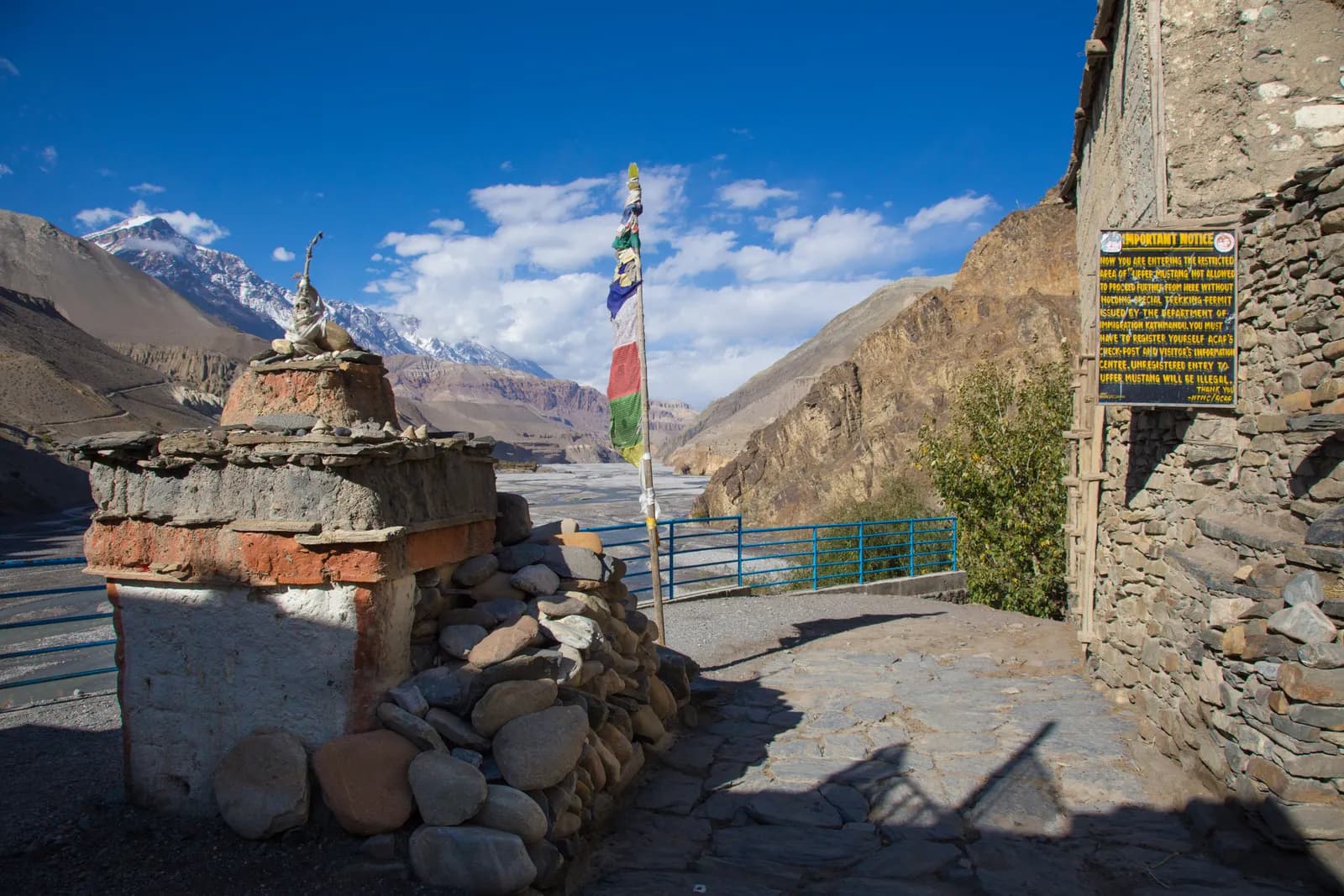
Restricted areas include Manaslu, Upper Mustang, Upper Dolpo, Nar Phu and Tsum Valley. The Department of Immigration issues the permit only through a registered trekking agency, and a licensed guide is part of the permit; the Department reminded stakeholders of this in June 2026. Individual foreigners have been able to apply since 22 March 2026, where a group of two was the old minimum, but the agency and the guide are still required. Press reports are the main source for the March change, so confirm it. Fees are in USD by area as of October 2026, for example Upper Mustang USD 50 per person per day and Manaslu USD 100 per week from September to November.
You cannot do these without an agency, so the question becomes how to get the agency's cost down. Sharing is the answer: the guide and a private jeep are fixed costs, so each extra trekker lowers everyone's share. The restricted-area permit stays per person. See the Manaslu restricted area permit guide, the Upper Mustang restricted area permit guide and the Manaslu Circuit partner page.
The Everest exception, and its limits
In Khumbu the Khumbu Pasang Lhamu municipality publicly opted out of the guide rule within days of the announcement (Kathmandu Post, 3 April 2023) and issues its own trek card, NPR 3,000 for foreigners as of October 2026, bought near Lukla. So an independent trek to Everest Base Camp is possible without a guide, and a guide is strongly advised but not required. That is a statement about checkpoints, not about safety: altitude, the Lukla flight and the weather are the same for solo trekkers, and an agency or guide handles evacuation. Read solo trekking in Nepal: is it safe and solo versus group trekking in Nepal.
Agency or guide: what is the difference
The rule is written as a licensed guide through a registered agency. That is narrower than "any licensed guide". A freelance guide you meet in Pokhara may be perfectly competent but may not satisfy a checkpoint unless the paperwork runs through a registered agency. If you want to hire a guide directly, ask the Nepal Tourism Board or an agency whether it will be accepted on your route, and keep the answer in writing.
You do not need to buy a package. Many agencies will sell only the guide and permits, leaving lodging and food to you, and a guide-porter combination is common. That is often the cheapest way to meet the rule while keeping control of the itinerary. See guide versus porter roles and TIMS card explained.
A practical checklist
- Decide which group your route is in: open trail, park or conservation area, or restricted area.
- For groups 2 and 3, ask a registered agency in writing what it will provide and what you buy yourself.
- Buy entry permits in advance, because check-post prices can be double.
- Carry the originals and copies, plus your passport.
- Keep a spare day for road and flight delays.
- Check the date: the rules have changed several times since 2023.
Sharing instead of going alone
Whichever group you are in, the guide is the biggest fixed cost, and the easiest way to cut it is a partner. Post your dates on the Annapurna Base Camp partner page, the Everest Base Camp partner page or the Langtang Valley partner page, and read how to find a trekking partner in Nepal safely. The permits category lists the rest of this series, and the Manaslu region page, Annapurna region page and Everest region page hold the route data.
Why the answer keeps changing
The rules in this area have moved several times since 2023: an announcement in April, an opt-out in Khumbu within days, a Department of Immigration reminder in June 2026 and press reports of a March 2026 notice for individual restricted-area applications. Operator blogs, which are most of what trekkers read, often repeat older versions. When you plan, trust dated statements from the Nepal Tourism Board and the Department of Immigration over undated blog posts, and write down the date you checked.
What an agency actually does for you
For a restricted-area trek the agency submits your application, supplies the guide and handles transport. For a protected-area trek it can buy TIMS and permits for you, book lodges and arrange porters. For an independent trek in Khumbu it may do nothing at all. Ask for an itemised quote so you can see what you are paying for, and consider a guide-and-permits-only arrangement if you want to keep control of the route and the budget. The cheapest option that meets the written rule is usually a registered agency's guide for the days that matter, and your own lodging choices.
Rencanakan trek ini
- Panduan wilayah Everest (Khumbu)
- Panduan wilayah Annapurna
- Panduan wilayah Langtang
- Panduan wilayah Manaslu
- Panduan wilayah Pokhara
- Trekking partner for Poon Hill Trek (Ghorepani)
- Trekking partner for Everest Base Camp Trek
- Find someone to trek Langtang Valley Trek with
- Find someone to trek Manaslu Circuit Trek with
- Itinerari Poon Hill Trek (Ghorepani)
- Itinerari Everest Base Camp Trek
- Itinerari Langtang Valley Trek
- Itinerari Manaslu Circuit Trek
Foto
Pertanyaan yang sering diajukan
Sumber
- Nepal Tourism Board: TIMS Card
- Department of Immigration, Nepal
- Diplomat Nepal: Department of Immigration reinforces mandatory guide rule for trekking in restricted areas (13 June 2026)
- Kathmandu Post: Everest region, Nepal Tourism Board dispute over solo trek ban heats up (3 April 2023)
- Nepal Tourism Board: Park Entry Fees