

Basic Nepali phrases for trekkers: 30 words that help
The Nepali words and phrases that matter most on a trek: namaste and thanks, asking prices and names, food and water, numbers, emergencies and directions, with simple spellings from Wikivoyage, notes on pronunciation and what to do in villages where other languages are spoken.
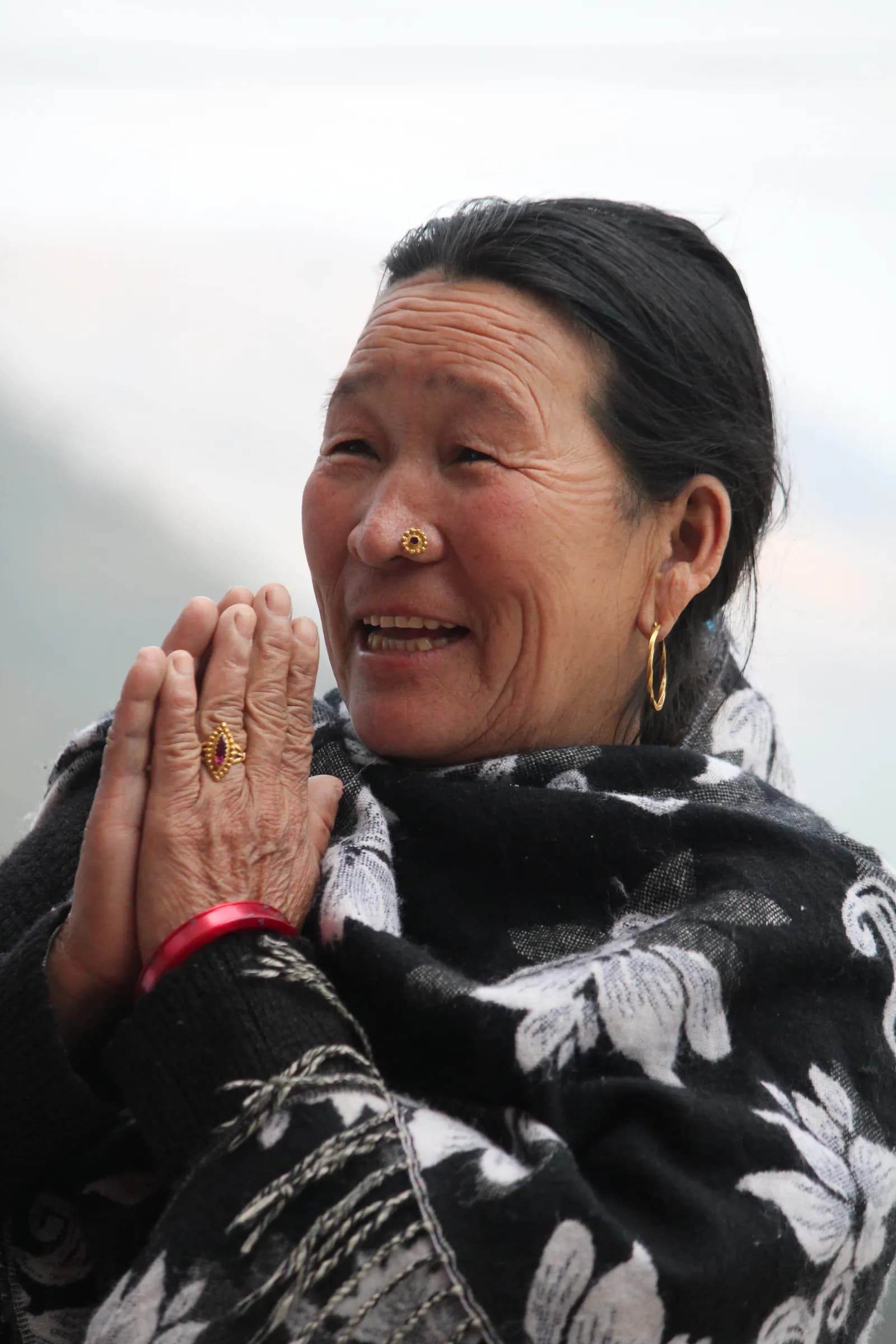
The most useful Nepali for a trekker fits on a postcard: namaste for hello, dhanyabad for thank you, kripaya for please, maaf garnus for excuse me and sorry, and a handful of questions about names, water and prices. Nepali is the official and most widely spoken language of Nepal and acts as a lingua franca, according to Wikipedia, so a few words are understood in almost every valley, including those where people speak Gurung, Tamang, Sherpa or a Tibetan dialect at home. English is common on the main routes, but nothing earns a warmer reaction than a greeting in the other person's language. This guide gives about thirty words and phrases, with the spellings Wikivoyage uses, notes on pronunciation, and advice on how to use them.
A note on accuracy: we are not language teachers. Every phrase here comes from the Wikivoyage Nepali phrasebook, which offers romanised spellings and rough pronunciations, and Wikipedia. Romanisation varies; Wikivoyage writes the sound "ch" as "ts", for example, so you may see the same word spelled differently. Ask your guide to say a phrase aloud before you use it, and copy how they say it.
Trip terbuka di Poon Hill Trek (Ghorepani)
Trip nyata yang diposting trekker yang mencari teman.

Why bother
Wikivoyage notes that learning even a few words of Nepali can be fun and very useful, especially outside the tourist district and while trekking. Most Nepalis speak at least some Nepali, even though more than 100 different languages and dialects are spoken in the country. On a trek this matters in two ways. First, it is courtesy: you are a guest, and a greeting is the smallest courtesy there is. Second, it is practical: the person behind the lodge counter may speak little English, and "how much is this?" in two words saves a long mime.
You will also hear other languages. In Gurung villages around Ghandruk, in Tamang villages in Langtang, in Sherpa Khumbu and in the Tibetan-speaking valleys of Nubri and Mustang, people speak their own language at home. See our guides to Gurung culture, Tamang culture, Sherpa culture and Nubri culture. Nepali remains the common thread, and it is a courtesy in every one of these places.
The first ten phrases
| English | Nepali (romanised, Wikivoyage) |
|---|---|
| Hello | Namaste |
| How are you? (formal) | Tapaii kasto hununts'ha? |
| Fine, thank you | Santsai ts'hu, dhanyabad |
| What is your name? | Tapaiko nam ke ho? |
| My name is ... | Mero nam ... ho |
| Nice to meet you | Tapai lai bhetera khusi lagyo |
| Please | Kripaya |
| Thank you | Dhanyabad |
| Thank you very much | Dherai dherai dhanyabad |
| Excuse me / I am sorry | Maaf garnus |
The spellings above are Wikivoyage's own, which write the sound many other sources spell "ch" as "ts" and use dz for "j". Wikivoyage also lists "no" as hoina and "yes" as ho, and gives "see you again", Pheri bhetaula, as the usual way to say goodbye, because Nepali has no exact word for it.
Namaste. According to Wikipedia, namaste is a customary Hindu manner of respectfully greeting and honouring a person or group, used at any time of day and by people of the Hindu, Buddhist and Jain traditions. It is usually spoken with a slight bow and hands pressed together, palms touching and fingers pointing upwards, thumbs close to the chest. Offer it first, to the lodge owner, a porter on the path, a monk in a doorway. In Buddhist villages you will hear it as often as in Hindu ones.
Food, water and the lodge
| English | Nepali |
|---|---|
| Water | Pani |
| Tea | Tsiya |
| Rice | Bhat |
| Lentils | Daal |
| Salt | Nun |
| It was delicious | Mito ts'ha |
| I am finished | Pugts'ha (or Pugyo) |
| May I have a glass of ... ? | Malaai ek gilaas ... dinus? |
| Can I look at the menu? | Ma menu herna sakts'hu? |
Dal bhat, the lentils-and-rice meal, is the staple of the trail; read dal bhat and the teahouse menu explained for what comes on the plate, and teahouse etiquette for how to eat in a shared dining room. "Mito ts'ha", it was delicious, is a good phrase for the cook, and "pugts'ha" tells a host you have had enough when they offer a second helping, which they will.
For water, ask for boiled or filtered water in English if you are not sure, and read water bottles, filters and tablets compared before you rely on a tap.
Money, prices and bargaining
| English | Nepali |
|---|---|
| How much is this? | Yes ko kati parts'ha? |
| That is too expensive | Yo ekdam mahango bhayo |
| Expensive | Mahango |
| Less / more | Kam / dherai |
Prices on the trail rise with altitude because supplies are carried in, as our route pages explain, and many lodges post fixed rates. Ask the price first, politely, and do not argue the price of a room or a meal in a remote village. Bargaining is normal for souvenirs and gear in Thamel and Lakeside; see renting gear in Kathmandu. Our route pages say there are no machines on many trails, so carry rupees.
Numbers
| 1 | 2 | 3 | 4 | 5 | 6 | 7 | 8 | 9 | 10 |
|---|---|---|---|---|---|---|---|---|---|
| ek | dui | tien | char | panch | chha | saat | aath | nau | das |
Wikivoyage also lists 100 as ek saye and 1,000 as ek hadzar. Numbers help with prices, with bus and jeep fares, and with time: Wikivoyage gives "bihana ko ek badze" for one o'clock in the morning, using bihana for morning, diuso for afternoon, beluka for evening and rati for night.
Directions and questions
- Can you show me on the map? Malaai naksamaa dekhunus? Pair it with an offline or paper map; see offline maps, GPX and navigation.
- Today, tomorrow, yesterday: aaja, bholi, hijo.
- Now, later, before: ahile, pachi, agadi.
- Hours, days, weeks: ghanta, din, hapta, in Wikivoyage's list of durations.
Time on the trail is elastic. A villager's estimate of "two hours" may be your four, so treat it as a clue and check with your guide.
Emergencies and health
Learn these, and save them in your phone with your guide's number. Wikivoyage lists:
- I need your help: Malaai sahayog garnuhos.
- It is an emergency: Aapat paryo.
- I am lost: Ma haraye.
- I am sick: Malaai santso ts'haina.
- I have been injured: Malaai tsot lagyo.
- I need a doctor: Malaai doctor tsaiyo.
- Can I use your phone? K ma hadzur ko phone prayog garna sakts'hu?
Do not rely on your accent in a crisis. Your guide, your partner and your agency are the real emergency plan, and our partner safety and emergency guide explains it. But a villager who understands "aapat paryo" is more likely to help.
Pronunciation: three tips
- Vowels are open and steady. Wikivoyage describes the vowels as like "a" in "all" or "u" in "fun", and so on. Say each syllable clearly, and do not drop the ends.
- Some consonants are aspirated. Wikivoyage lists several breathy and dental consonants that English lacks. Do not worry; listen and copy.
- Speak slowly. Slow, clear speech and a smile help more than accuracy.
Using the words well
- Greet first, then ask. Namaste, then your question.
- Use the formal forms with strangers and elders; Wikivoyage marks several phrases as formal.
- Learn the words in the local language too if you can, but expect Nepali to work.
- Write it down. A small notebook of five phrases beats a long phrasebook.
- Practise with your guide and porter. They enjoy teaching, and it is a good way to start a conversation that is not about money.
- Do not worry about mistakes. People appreciate the effort.
Planning and sharing
If you are trekking with a partner, learn the words together and practise in the evenings. A shared notebook of phrases is a small, warm part of a shared trek. Our guide to what to agree with trekking partners before you book covers the other conversations to have. The Poon Hill partner page and the Everest Base Camp partner page list people planning those routes, and the Poon Hill itinerary and Everest Base Camp itinerary show where you will meet villages. For the rest of the customs, go to the trail etiquette and culture guide. Namaste, dhanyabad and a smile are the best three words in your pack.


