Nepal trekking permits explained
ACAP, TIMS, national park, municipality and restricted-area permits: what each one is, which treks need which, who issues it and how to avoid the common mistakes.
Permits are the part of trek planning that confuses almost everyone. Most treks need only two or three, and your agency or guide will usually help. This guide explains the types, which route needs which, who issues them and the mistakes that cost people a day in Kathmandu. Every fee below is as of October 2026 (checked on 18 October 2026) and comes from an official page listed under Sources. Amounts change and differ by nationality, so confirm at the counter, and use our permits page for the current table.
In one line: open-area treks need a protected-area entry permit (national park or conservation area) and sometimes a TIMS card or local municipality permit; restricted-area treks add a Restricted Area Permit that only a registered agency can obtain.
Everest (Khumbu) के ओपन ट्रिप
पार्टनर खोज रहे ट्रेकर्स के असली ट्रिप।

The permit types at a glance
| Permit | Issued by | What it covers | Typical routes |
|---|---|---|---|
| National park entry | Department of National Parks and Wildlife Conservation | Entry to Sagarmatha, Langtang and other parks | Everest region, Langtang |
| Conservation area entry (ACAP, MCAP) | National Trust for Nature Conservation | Annapurna and Manaslu conservation areas | Annapurna, Mardi Himal, Poon Hill, Manaslu |
| Local municipality permit | The rural municipality | Local entry fee | Khumbu Pasang Lhamu (Everest region) |
| TIMS card | Trekking Agencies' Association / Nepal Tourism Board | Records trekkers for safety | Where required |
| Restricted Area Permit | Department of Immigration, via an agency | Controlled border areas | Manaslu, Upper Mustang |
Which treks need which
| Route | Permits to expect |
|---|---|
| Everest Base Camp, Gokyo, Three Passes | Sagarmatha National Park permit and the Khumbu municipality permit |
| Annapurna Circuit, Annapurna Base Camp, Mardi Himal, Poon Hill | ACAP entry permit, TIMS where required |
| Langtang Valley, Gosaikunda | Langtang National Park permit, TIMS where required |
| Manaslu Circuit | Restricted Area Permit, Manaslu Conservation Area permit and ACAP |
| Upper Mustang | Restricted Area Permit and ACAP entry permit |
These come from the route pages on this site: see Everest Base Camp, Manaslu Circuit and Upper Mustang.
What the permits cost, as of October 2026
Entry permits are per person per entry, and children under 10 are free. Foreigner rates:
| Permit | Foreigners | SAARC nationals |
|---|---|---|
| Sagarmatha, Langtang, Makalu Barun, Rara or Shey Phoksundo National Park | NPR 3,000 (about USD 22) | NPR 1,500 |
| Shivapuri Nagarjun National Park | NPR 1,000 | NPR 600 |
| Annapurna (ACAP) or Manaslu (MCAP) Conservation Area | NPR 3,000, tax included | NPR 1,000 |
| Kanchenjunga Conservation Area | NPR 2,000 | NPR 500 |
| Gaurishankar Conservation Area | NPR 3,000 | NPR 1,000 |
| Khumbu Pasang Lhamu trek card (Everest region) | NPR 3,000 | NPR 2,000 (SAARC and China) |
For ACAP and MCAP, online payment adds a 2.9% gateway charge and a permit issued at a check post costs double. Restricted Area Permits are priced in US dollars and differ by area:
| Restricted area | Fee as of October 2026 |
|---|---|
| Upper Mustang | USD 50 per person per day (Nepal Tourism Board figure; the trade body TAAN lists USD 500 for the first 10 days, then USD 50 a day, the same total for 10 days) |
| Upper Dolpo | USD 50 per person per day |
| Manaslu | September to November: USD 100 per week plus USD 15 a day beyond one week. December to August: USD 75 per week plus USD 10 a day |
| Tsum Valley | September to November: USD 40 per week plus USD 7 a day beyond one week. December to August: USD 30 per week plus USD 7 a day |
| Nar Phu | September to November: USD 100 per week plus USD 15 a day beyond one week. December to August: USD 75 per week plus USD 15 a day |
| Kanchenjunga (Taplejung) | USD 20 per week for the first 4 weeks, USD 25 per week after |
| Makalu (Sankhuwasabha) | USD 20 per week for the first 4 weeks, USD 25 per week after |
| Rolwaling (Dolakha) | USD 20 per week |
The TIMS card is the exception: the Nepal Tourism Board lists it at NPR 2,000 for foreigners (SAARC nationals NPR 1,000), issued only through an agency, for the listed routes; it is not required on the Everest route. The "What it costs" section of each route page, for example Everest Base Camp or Manaslu Circuit, adds the right permits to lodging, transport and guide costs for that trek.
National park and conservation area permits
These are entry fees for protected areas. Foreigners, SAARC nationals and Nepali citizens pay different amounts, as the table above shows. The permit is checked at the park gate (for example at Monjo for Sagarmatha National Park) and at checkpoints inside the Annapurna Conservation Area.
Local municipality fees
In the Everest region the Khumbu Pasang Lhamu Rural Municipality collects its own entry fee at Lukla or Monjo, separate from the national park fee. Because it is paid on the trail in rupees, carry enough cash and keep the receipt.
TIMS card
The Trekkers' Information Management System card records who is on the trail, which helps in an emergency. Where it is needed, and which colour or price applies, has changed over the years and sources disagree, so ask the agency issuing your permits to confirm it for your route and dates in writing.
Restricted Area Permits (RAP)
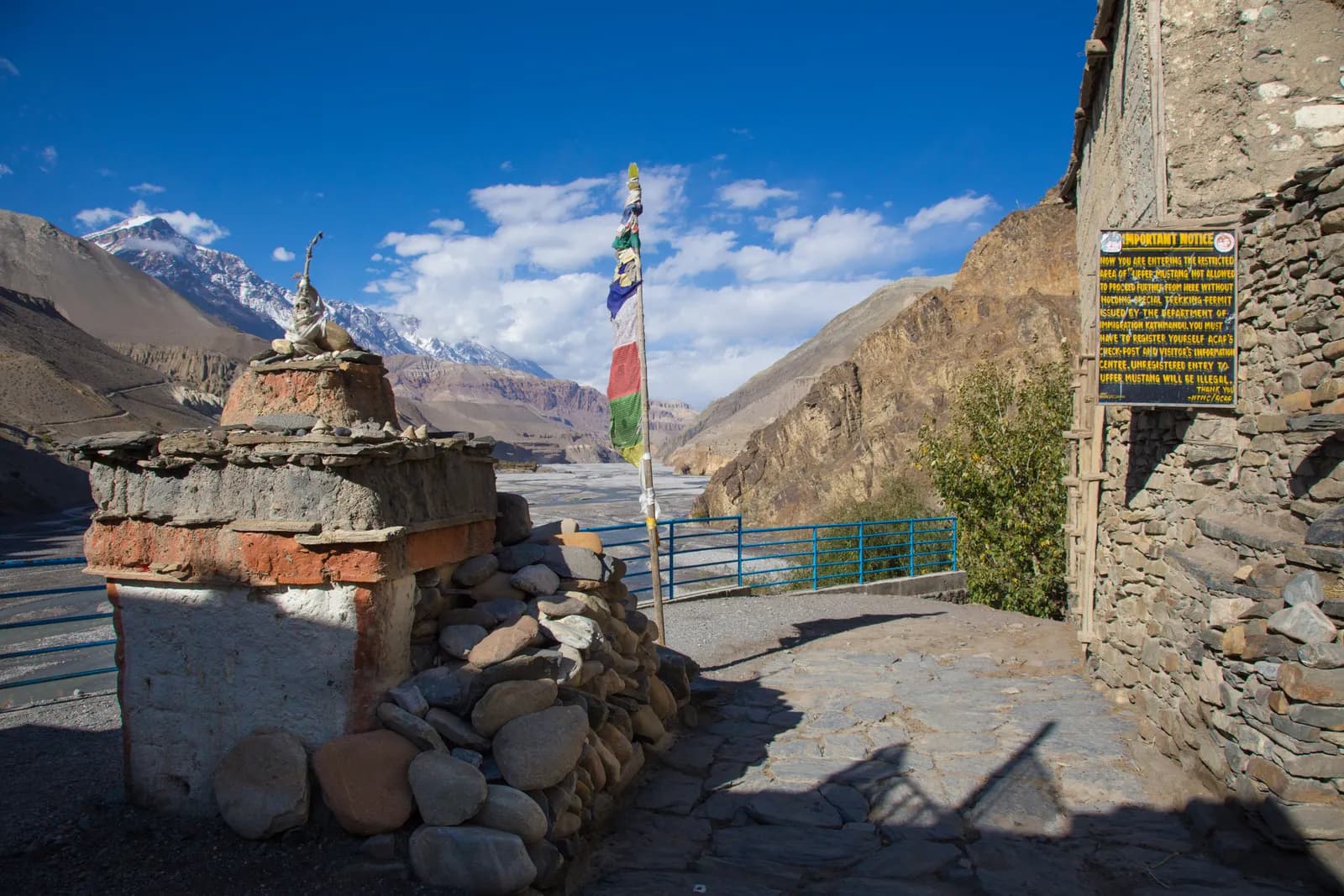
Regions near the Tibetan border, including Manaslu and Upper Mustang, are controlled. There you need:
- a registered trekking agency to apply for you (you cannot buy a RAP yourself),
- a licensed guide from that agency,
- passport copies, photos and your itinerary, because the permit lists your route and dates.
Minimum group size and per-day pricing for restricted areas have been revised more than once. A May 2026 report in Kantipur says the Department of Immigration introduced a permit system for foreigners trekking in controlled areas of 13 districts, so ask the agency for the rule that applies on your start date rather than relying on an older blog.
This is where finding partners really helps: solo you pay the whole guide and agency fee yourself, while a group splits it. Our guide rule explainer covers who needs a guide and why.
Where to get permits
Conservation area and national park permits are issued in Kathmandu (Nepal Tourism Board office at Bhrikutimandap) or Pokhara, and at some park entrances. Restricted Area Permits are processed in Kathmandu by your agency, usually in a day or two once your documents are ready. Offices close on public holidays and Saturdays, so allow a working day.
Documents you need
- Passport (and a copy)
- Passport photos, or digital photos if your agency accepts them
- Travel insurance details, ideally covering helicopter rescue to 6,000 m
- Your itinerary and, for a RAP, your visa details
Step by step: an open-area trek such as Annapurna Base Camp
- Confirm the route and dates. Permits are checked against the route you give, so decide whether you are doing the seven-day Annapurna Base Camp trek or something longer first.
- Collect your documents. Passport, photos, insurance details and a rough itinerary.
- Go to the permit office in Kathmandu or Pokhara, or let your agency or guide do it. Pokhara is the easier place to do it if you are starting from there, because the trailhead is a short drive away.
- Check every line on the permit before you leave: your name, passport number, route and dates.
- Photograph the permits and keep the originals dry. A zip bag in your daypack is enough.
- Present them at the first checkpoint and again wherever the trail passes a gate. Checkpoints stamp or record you in.
What checkpoints do
On the main trails the checkpoints are small offices or a desk in a lodge: a staff member writes your name and permit number in a ledger, sometimes takes a photocopy and waves you on. Their purpose is safety. If the weather closes a pass or a landslide blocks a road, the ledger shows who is where. On restricted-area routes such as Manaslu the checkpoint at Jagat is stricter, because the guide and the permit have to match the people walking. Plan to arrive at checkpoints during daylight, as many close in the evening.
Why this matters when you share a trek
If you are travelling with partners found online, make sure everyone's permits are bought for the same route and dates. A person who joins late or leaves early changes nothing for a national park permit, but for a RAP the agency must list every trekker, so late changes cost time. Agree who holds the group paperwork and keep one photographed copy of everybody's permit on each phone.
Tips
- Carry permits at all times. They are checked at gates and checkpoints.
- Keep receipts until the end of the trek.
- Check before you go. Rules and prices change. Our region pages show the source list and a link to report outdated information.
Common mistakes
- Forgetting the municipality fee in the Khumbu: it is paid on the trail, so carry rupees.
- Buying the wrong conservation permit on combined routes. The Manaslu Circuit, for example, needs the Annapurna (ACAP) permit too, because it exits via Dharapani.
- Assuming a RAP can be extended on the trail. Extra days must be arranged through your agency, so plan buffer days from the start.
- Leaving it to the last day. Allow a working day in Kathmandu or Pokhara.
Plan the route
The Annapurna region guide lists the other treks in the area, and the Upper Mustang guide covers the restricted-area permit that changes the maths. For costs, start with the Nepal trekking cost guide.
इस ट्रेक की योजना बनाएँ
फ़ोटो
अक्सर पूछे जाने वाले सवाल
स्रोत
- Nepal Tourism Board
- Nepal Tourism Board: Park Entry Fees
- Nepal Tourism Board: Trekking Permit (restricted areas)
- NTNC e-permit (ACAP and MCAP)
- Department of National Parks and Wildlife Conservation, Nepal
- Department of Immigration, Nepal
- National Trust for Nature Conservation (ACAP)
- Annapurna Conservation Area (Wikipedia)