Mardi Himal itinerary, day by day
A 5-day Mardi Himal itinerary from Pokhara: Forest Camp, Low Camp and High Camp, the pre-dawn climb to about 4,500 m, the knee-hard descent to Siding and what to do with a sixth day.
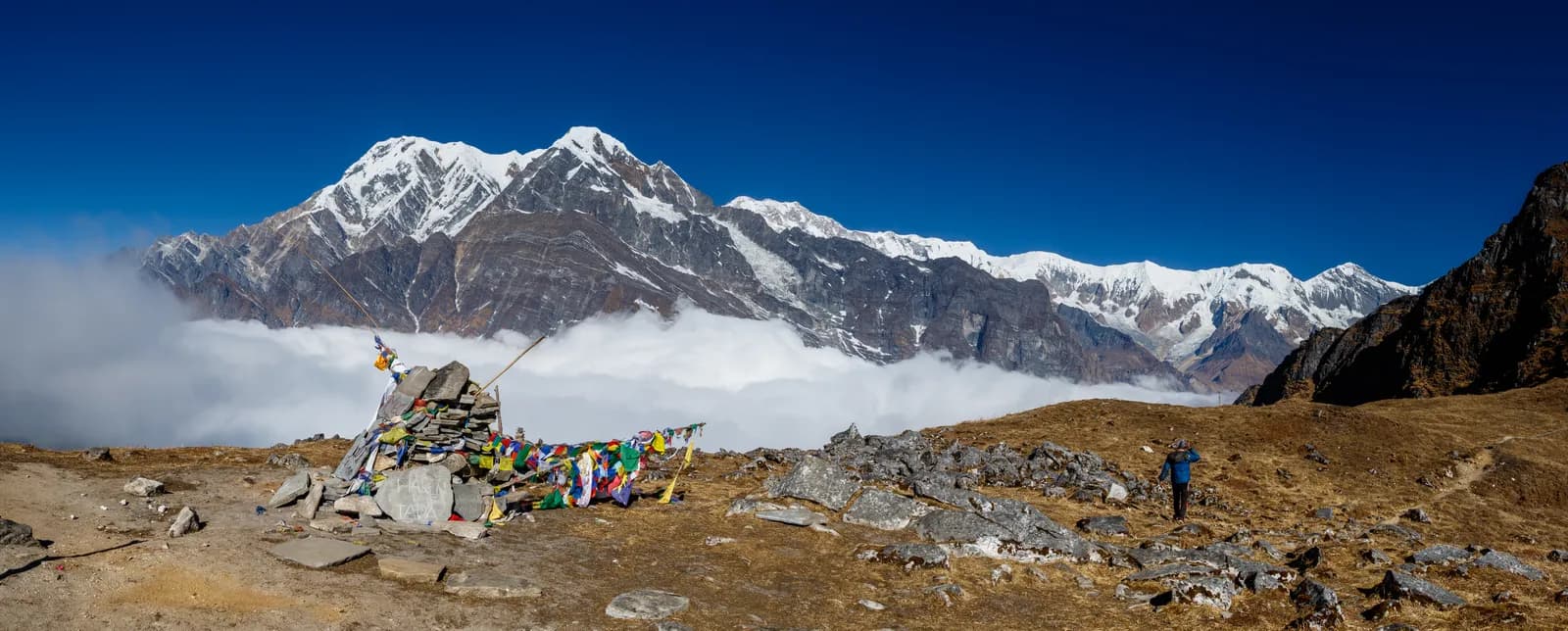
The Mardi Himal itinerary here takes five days from Pokhara: a short drive to Kande, a climb through forest to Forest Camp, Low Camp and High Camp on the ridge, a pre-dawn walk to the Mardi Himal viewpoint at about 4,500 m and a long descent to Siding. You sleep at about 2,500, 2,970 and 3,550 m, with Machapuchare (the Fishtail peak) almost overhead at High Camp. It is one of the best short treks near Pokhara and quieter than Annapurna Base Camp, but the ridge is steep and exposed.
This page gives the day-by-day plan, the timings that matter on summit day and ideas for adding a day. The route data is on the Mardi Himal route page and the Annapurna region guide.
Mardi Himal Trek के ओपन ट्रिप
पार्टनर खोज रहे ट्रेकर्स के असली ट्रिप।

The 5 days at a glance
| Day | From - to | Time | Sleep |
|---|---|---|---|
| 1 | Pokhara - Kande - Forest Camp | 5-6 h | about 2,500 m |
| 2 | Forest Camp - Low Camp | 3-4 h | about 2,970 m |
| 3 | Low Camp - High Camp | 3-4 h | about 3,550 m |
| 4 | High Camp - viewpoint (about 4,500 m) - High Camp | 6-7 h | about 3,550 m |
| 5 | High Camp - Siding - Pokhara | 5-6 h plus drive | 820 m |
Day 1: Pokhara to Forest Camp (about 2,500 m)
Drive about an hour to Kande, then walk up through Australian Camp, a clearing with views of the Annapurna range, and Pothana, a small ridge village. The trail climbs steeply through oak and rhododendron to Forest Camp, a handful of lodges in the trees. The forest is shaded and cool, with active birdlife. In clear weather you get views through gaps in the canopy. The climb from Pokhara (820 m) is large, so go at an even pace.
Day 2: Forest Camp to Low Camp (about 2,970 m)
More dense rhododendron forest, gradually thinning as the ridge opens up. Low Camp is a larger cluster of lodges on the ridge with views of Machapuchare and Annapurna South. It is a good place to rest and acclimatise, and the lodges can be busy in season. Walk up the ridge in the afternoon for the view.
Day 3: Low Camp to High Camp (about 3,550 m)
Climb above the treeline onto a grassy ridge with views on both sides, passing Badal Danda, a high pasture with a few lodges. The path follows the ridge crest to High Camp, with Machapuchare rising almost overhead and Annapurna South beyond. The wind can be strong and the temperature drops quickly after sunset. The sleeping altitude rises about 580 m, a little above the roughly 500 m per night that the CDC suggests above 3,000 m, which is why you should keep day 3 slow and drink steadily.
Day 4: viewpoint at about 4,500 m
Start before dawn and climb along the ridge to the Mardi Himal viewpoint and base camp, about three hours of steady, exposed climbing. The path catches wind and sometimes snow. At the top, Mardi Himal, Machapuchare, Annapurna South and Annapurna III are close. Return to High Camp for breakfast and rest, or continue down to Low Camp if you feel well. You gain about 950 m during the day but sleep at the same altitude as the night before, which is the right pattern.
Day 5: down to Siding and Pokhara
Descend through Badal Danda and Low Camp, then through forest and the villages of Siding and Lwang to the road at Siding. It is five to six hours of descent that is hard on the knees, so use poles. At the bottom terraced fields and small villages appear and the air turns warm. A jeep to Pokhara takes about two hours.
Making the trek safer or longer
- Add a spare day at High Camp. If cloud covers the ridge on summit morning, a buffer day lets you try again.
- Sleep at Low Camp on the way down. Splitting the last day cuts the descent and gives time for the ridge views you missed.
- Take poles. The downhill sections punish knees.
- Check conditions in winter. Snow on the ridge changes both the timing and the risk, so ask lodge owners and your guide before leaving High Camp.
Summit-day timing
The pre-dawn start on day 4 is about the light and the wind, not about speed. Clouds usually build on the ridge from mid-morning, so the clearest views are early. A sensible plan is to leave High Camp with a headlamp about two to three hours before sunrise, set a turnaround time with your guide (for example, if you have not reached the viewpoint by a fixed hour, turn back) and stick to it. Pack gloves, a hat, a windproof shell and a flask, because the exposed ridge is much colder than the lodge. If anyone has a headache that is getting worse, the right decision is to stay at High Camp: the view is not worth a night of altitude trouble.
Season and what changes
Spring (March to May) brings rhododendron flowers in the lower forest and increasingly hazy afternoons. Autumn (October to November) gives the clearest skies and busy lodges. In winter the upper ridge can be snow-covered and demands more care, while in the monsoon the forest is wet, leeches are common and views are scarce. The best-time guide puts these months side by side with other regions.
Permits and paperwork
Mardi Himal lies inside the Annapurna Conservation Area, so you need the ACAP entry permit and a TIMS card where it is required. Both are usually organised in Pokhara or Kathmandu and take little time. The ACAP permit is NPR 3,000 for foreigners as of October 2026 (about USD 22, double at a check post) and the Nepal Tourism Board lists the TIMS card at NPR 2,000 for foreigners (SAARC nationals NPR 1,000), and the agency that issues it may add a service charge, so check that one with your agency. Our permits explainer shows how the permit types fit together.
What lodges and food are like
Lodges are small, simple and often unheated, with a communal dining room. Menus are shorter than at the busiest Annapurna villages, and supplies are carried up by porters, so prices rise with height and the choice narrows. Carry a warm sleeping layer for High Camp, where nights are cold. Phone signal and charging are patchy, so bring a power bank.
Sharing the trek
Because the route is short and the lodges are inexpensive, the biggest costs are the guide, any porter and the road transfers at each end. A group of three or four splits those lines and also makes the early summit-day start easier, because someone is always awake and checking on the others. If you are travelling alone, read how to find a trekking partner safely before you commit to a stranger.
Is Mardi Himal right for you?
It suits fit beginners who have a few days and want a high-ridge view without a pass. It is a poorer choice if you have bad knees, are afraid of exposed ridges or need guaranteed clear weather. If you only have four days, choose the Poon Hill itinerary. If you have a week and want a bigger amphitheatre, choose the Annapurna Base Camp itinerary. See all the options in our itinerary index, and read the altitude sickness basics before you go.