Trekking With Knee Problems: Poles and Descents
How to protect sore or weak knees on a Nepal trek: the descents that hurt most on real routes, how to use poles, pacing and strengthening, what the NHS says about knee pain, and when to see a doctor.

Knees take the beating on a Nepal trek, and mostly on the way down. Use two poles, shorten your steps on descents, strengthen your thighs before you go, plan rests on the long downhill days and tell your guide and partners about the problem before you start. If a knee is already sore, see a doctor or physiotherapist before you book, because a trek will not heal it. The NHS gives clear lines on when knee pain needs urgent advice, and we repeat them below. This guide shows where the hardest descents are on real routes, how to use poles, which exercises help and how to pace a descent so that your knees last the whole trek.
This is general information, not medical advice. If you have a known knee condition, arthritis, an old ligament injury or a surgery in the past, ask a professional who knows your history.
טיולים פתוחים בAnnapurna Base Camp Trek
טיולים אמיתיים שפרסמו מטיילים שמחפשים שותפים.

Where the knees really suffer
Altitude gets the attention, but descents are what wear the joints. The route data in our pack shows where the big drops are. On the Gosaikunda trek, the day from the lakes at 4,380 m to Thulo Syabru at 2,210 m is a long drop of about 2,170 m, with a 7 to 8 hour walking time. On Annapurna Base Camp, the descent from the sanctuary at 4,130 m to Bamboo at 2,310 m drops about 1,820 m in 6 to 7 hours. On the Annapurna Circuit, the day over Thorong La drops from 5,416 m to Muktinath at 3,800 m, a long walk of 8 to 10 hours that starts with the climb. On Everest Base Camp, the way back from Gorak Shep is three consecutive 7-hour days to Pheriche, Namche and Lukla. These are long days of repeated impact, and the stone staircases, such as Ulleri on the way to Ghorepani, add big steps that load the knee on every downward move.
How poles help, and how to use them
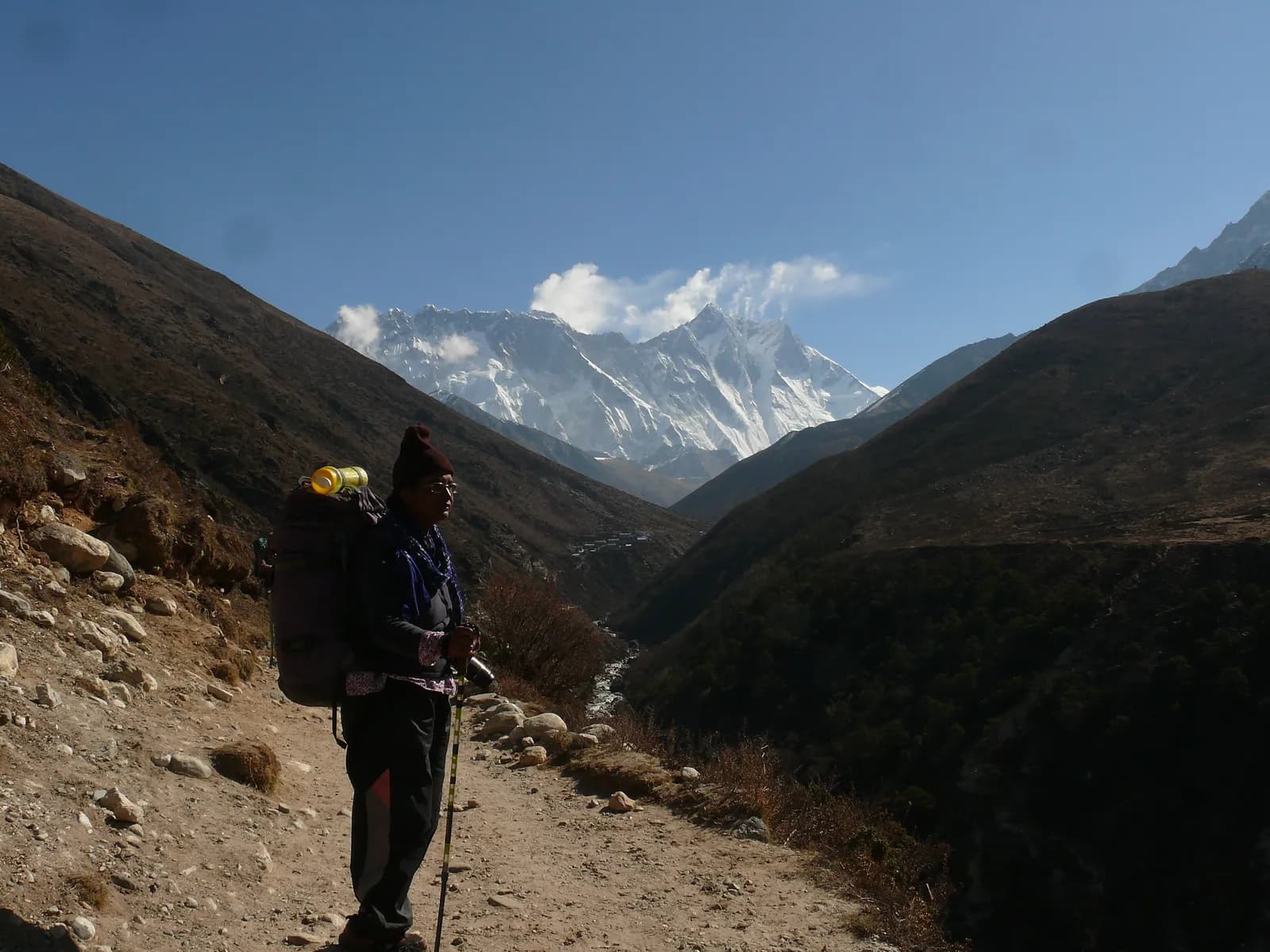
Poles share the load with your arms and give you balance on loose ground and steps. On a descent, plant the poles slightly ahead, bend the knee a little as you step down, and let the poles take part of your weight. Lengthen the poles a few centimetres for descents and shorten them for ascents, and use the wrist straps by putting your hand up through the loop from below, so that the strap bears the load and you do not need a tight grip. Two poles are better than one for knee protection. Practise at home on stairs and slopes, because a pole used badly can cost you balance, and check that you can strap and unstrap with gloves on. Collapsible poles pack small, and most lodges and shops in Kathmandu and Pokhara sell or rent them; see our packing list for the rest of the kit.
Technique for the descent
Shorten your stride and keep your knees slightly bent. Step down from the whole foot, not the heel, and avoid locking the knee on each step. Zigzag on steep ground, even when the trail goes straight. Take stone steps one at a time, choosing the stable edge, and use a pole on the downhill side. Pause to stretch and shake out your legs every hour. Keep your pack light and snug, so it does not push you forward on steps. Let faster partners go ahead; a slow, steady descent protects your joints better than a quick one, and the afternoon is safer than a dash at the end of a long day. If you are tired, a rest stop and snack is better than pushing on.
Strengthen before you go
Strong thighs, hips and calves take a share of the load that otherwise goes to the joint. Our 12-week training plan includes step-ups, lunges, controlled lowering steps and stair work, which cover most of what you need, in line with the NHS advice to strengthen the major muscle groups at least twice a week. Add single-leg balance practice and, if you have time, walking downhill with a pack on a real slope. If you have a knee condition, ask a physiotherapist for a programme tailored to it. Strengthening takes weeks to work, so start early, and build slowly: sudden big sessions are a common cause of knee pain in themselves.
Pain on the trail: what the NHS says
For ordinary knee pain, the NHS suggests resting the knee and putting as little weight on it as possible, applying a cold pack wrapped in a towel for up to 20 minutes every 2 to 3 hours, and taking paracetamol or ibuprofen, as tablets or gel. It says to see a GP if the pain does not improve within a few weeks. It lists symptoms that need urgent advice now: severe pain, being unable to move the knee or put weight on it, a badly swollen or changed-shape knee, locking, giving way or painful clicking, and a high temperature with a hot, red knee. On the trail, treat those as stop signs. Tell your guide, rest at the nearest lodge, and consider whether a jeep, a mule or a helicopter is the sensible way down. Our emergency steps guide lists the order of action.
Planning a trek around bad knees
If your knees are a concern, choose a route with gentler descents or a shape that lets you finish with a ride. Poon Hill and Ghandruk routes near Pokhara involve many steps, so check your tolerance on stairs first; routes with jeep access at the end, such as parts of the Annapurna Circuit and the Kali Gandaki valley, allow you to skip a day of descent. Ask your agency to plan shorter downhill days and to include a spare day. Choose a route where a flight or road is available as an exit, and tell your insurer about the condition so that a claim is not refused. For choosing a route, see which Nepal trek is right for you, and for adding days, buffer days and itinerary flexibility.
Sharing the load with partners
Partners can help each other. Agree that the group descends at the pace of the slowest knee, that rest stops are called when anyone asks and that nobody makes a joke of a sore joint. If someone has to stop, the group can decide whether to wait, split or turn back; our what if your partner cannot continue guide covers the money and the plan. When you look for partners, say about your knees in your profile and in your first chat; the Annapurna Base Camp partner page and the Everest Base Camp one are good places to start. The altitude and health hub links the rest of the series.
Before you book: a medical check
If you have had a knee injury, surgery, arthritis or pain on stairs, see a doctor or physiotherapist before you pay for a trek, and tell them the real numbers: a day of 6 to 8 hours, repeated for 10 to 14 days, with descents of 1,800 to 2,200 m on single days on some routes. Ask whether a trek is sensible, what exercises to do, whether supports or poles are advised and what symptoms should make you stop. The NHS says to see a GP if knee pain does not improve within a few weeks, which is a good rule for a trekker too: a niggle at home in week 6 of training becomes a problem on day 4 of a trek. Tell your insurer about the condition so that a claim for an injury is not refused on a technicality.
A pacing example for a long descent
Suppose you are descending from Annapurna Base Camp at 4,130 m to Bamboo at 2,310 m, a drop of about 1,820 m in 6 to 7 hours. A sensible plan is to leave early so that the knees are fresh and you are not rushing in the afternoon. Walk the first hour slowly, then stop every 60 to 75 minutes for water, a snack and a stretch of calves and thighs. Take the steepest steps with a pole on the downhill side and sidestep the worst of them. Do not run or jog on the last flat stretch to get it over with; the end of the day is when tired muscles stop protecting the joint. At Bamboo, rest with the legs raised, eat well and decide in the morning whether the next descent needs a shorter day. A little ice and an easy evening stroll often help more than another painkiller.