Everest Base Camp trek cost for Nepali citizens in NPR
A Nepali citizen pays roughly NPR 38,000 to 56,000 for Everest Base Camp in 12 days without a guide: flights, NPR 100 park fee, lodging, and a group of five.
The Everest Base Camp trek costs a Nepali citizen roughly NPR 38,000 to 56,000 for the standard 12-day trek, about NPR 47,000 in the middle, if you fly to Lukla and walk without a guide or porter. Food and lodging at NPR 2,000 to 3,000 a day (average 2,500) come to NPR 24,000 to 36,000, the two Lukla flights are NPR 14,000 to 20,000 at NPR 7,000 to 10,000 each way, and fees add about NPR 100.
Nepali citizens pay NPR 100 for the Sagarmatha National Park, against NPR 3,000 for foreigners. Sharing a guide or porter in a group of five cuts those lines further. Nepali citizens also pay far less than foreigners for the flight, and no guide is needed in Khumbu. Prices and rules were checked on 21 October 2026, and where sources conflict we show a range and say so; sources are listed below.
More on permits, guide rules and group trips in our trekking for Nepali citizens hub.
טיולים פתוחים בEverest Base Camp Trek
טיולים אמיתיים שפרסמו מטיילים שמחפשים שותפים.
How much does the Everest Base Camp trek cost for Nepali citizens?
Most English-language cost guides for Everest Base Camp are written for foreigners, so they quote dollars and foreign permit fees. A Nepali citizen pays very different amounts for three things: the park permit, the Lukla flight and, in practice, the guide. Everything else, the lodge bed and the plate of dal bhat, costs about the same for everyone because the lodge owner charges per room and per meal.
The table below is for one Nepali trekker on the classic 12-day plan in our Everest region guide and Everest Base Camp itinerary, flying in and out of Lukla, with no guide and no porter. All figures are NPR.
| Line | Low | Average | High |
|---|---|---|---|
| Food and lodging, 12 days at NPR 2,000 to 3,000 | 24,000 | 30,000 | 36,000 |
| Lukla flights, two one-way at NPR 7,000 to 10,000 | 14,000 | 17,000 | 20,000 |
| Sagarmatha National Park fee (Nepali rate) | 100 | 100 | 113 |
| Total per person | 38,100 | 47,100 | 56,113 |
The daily food-and-lodging band comes from the same price tables behind our cost calculator. The flight range is the Nepali one-way fare in our flight tables, not the USD 190 to 240 foreigners pay. Our full-price view for foreign trekkers is in the Everest Base Camp cost breakdown.
What does a Nepali citizen pay for permits on the Everest trek?
There are up to three fees on the Everest route. We checked each against the best source available and some of them conflict, so here is what we found rather than a single confident number.
Sagarmatha National Park. The Nepal Tourism Board park entry fee page lists NPR 100 per person for Nepali citizens, NPR 1,500 for SAARC nationals and NPR 3,000 for foreigners, with children under 10 free (checked 21 October 2026). The page does not mention VAT. One travel site adds 13 percent, which would make it NPR 113, so we show a range. The same page lists NPR 100 for the Annapurna Conservation Area, which is useful for the sibling guides in this series.
Khumbu Pasang Lhamu Rural Municipality fee. The municipality collects its own entry fee from foreigners; a Himalayan Times report put it at NPR 2,000 when collection began on 1 October 2017, and today's guides give NPR 2,000 to 3,000. For Nepali citizens, the Kathmandu Post wrote on 3 April 2023, citing a municipality press statement, that Nepali trekkers are not required to hire a guide and pay the trekking fee. That is the only direct statement we found. The municipality's own trek-card page did not load for us on 21 October 2026, so treat zero as the likely figure and carry a little cash in case the checkpoint asks for something.
TIMS. Nepali citizens do not need a TIMS card; it is a permit for foreign trekkers (NPR 2,000, or NPR 1,000 for SAARC nationals), and it is not needed on the Everest route at all. There is no TIMS line in the table. Our explainer on the TIMS card covers the foreign-trekker position.
Whatever the checkpoint charges, carry your citizenship certificate or another Nepali ID. Our Sagarmatha permit guide explains the Sagarmatha permits in more detail.
Do Nepali citizens need a guide for Everest Base Camp?
No guide is needed on the Khumbu route for a Nepali citizen, and the foreign-trekker rule is reported not to be checked there either. Our guide-rule record, last checked on 19 October 2026, reads: a licensed guide through a registered agency is required in restricted areas (Department of Immigration) and, under the Nepal Tourism Board rule of April 2023, in national parks and conservation areas, where 2026 operator reports say checkpoints enforce it in Annapurna and Langtang but not in Khumbu. The Kathmandu Post report above adds that the municipality said Nepali trekkers do not have to hire a guide. Everest Base Camp is an open route, not a restricted area. The current position for each region is on our guide rule page.
That does not make a guide pointless. Everest Base Camp reaches 5,364 m, the highest point of the trek, and the trail above Dingboche is where people get altitude sickness. Many Nepali groups hire a guide for one reason: someone to make the call on descending. If you do, share the guide across the group; our post on splitting guide and porter costs shows the arithmetic.
Is the Lukla flight or the jeep to Surke cheaper?
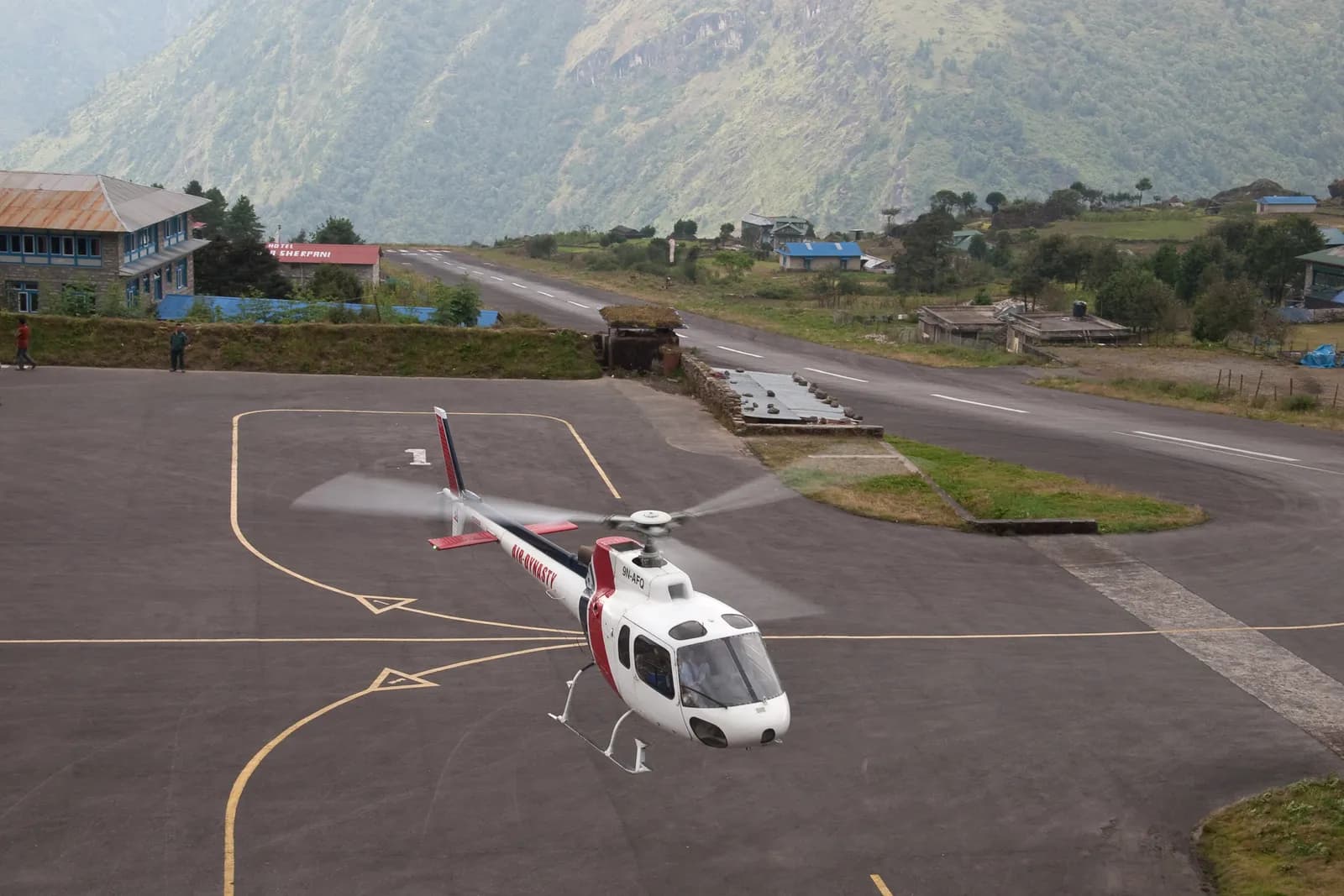
On the ticket alone, the jeep is cheaper. A shared jeep seat from Kathmandu to Surke costs NPR 5,000 to 6,000 in our tables, against NPR 7,000 to 10,000 for the Lukla flight for a Nepali citizen. Both are one way, so the return trip doubles each.
| Option | One way | Return | Extra days |
|---|---|---|---|
| Lukla flight (Nepali fare) | NPR 7,000 to 10,000 | NPR 14,000 to 20,000 | none |
| Shared jeep to Surke | NPR 5,000 to 6,000 | NPR 10,000 to 12,000 | walking days on the road side |
The catch is time. Driving to Surke puts you on the trail at the road-head instead of at Lukla, and an operator guide to the road route says it adds 5 to 6 trekking days when you start from Salleri. Every extra day on the trail costs about NPR 2,500 for food and lodging, so even two extra days wipe out the saving. The road is worth choosing if flights are full, if you want a slower approach for acclimatisation, or if you are travelling in the monsoon shoulder weeks when Lukla flights are cancelled often. Read the full road logistics in our Kathmandu to Surke and Salleri jeep guide and the comparison in flying to Lukla versus driving to Ramechhap or Phaplu.
What does a group of five save on Everest Base Camp?
Group size matters less than people expect, because the biggest lines are per person. A group of five still buys five flights, five beds and five park permits. What sharing does is spread the costs that belong to the group as a whole:
- A guide or porter. One person's day rate, divided by five, is a fifth of the line.
- A private jeep. If you drive to Surke, a private jeep is USD 300 to 350 for the vehicle, so USD 60 to 70 a seat in a group of five. That is more than a shared seat, but you leave when you like.
- Spare days. A group can agree a fixed buffer day for the weather; alone you pay for your own.
Our default group in the cost calculator is five for exactly this reason. Put in the routes and the Nepali rates and it gives each person's share.
How much should you carry in cash and what else costs money?
The table above covers the trekking lines but not the pieces around it. Budget a buffer on top for hot showers, device charging and Wi-Fi, which cost extra and rise with altitude; bottled water or purification tablets; a night in Kathmandu before the flight if the departure is early; and local transport to the airport or bus stop. We have no Nepali-specific price for these, so we do not invent one. A buffer of around 10 percent of the trek total, about NPR 4,000 to 5,000, is a sensible starting point for a first trek, and it is our rule of thumb rather than a published rate. Card payments rarely work above Namche, so carry rupees. The posts on hot showers, charging and Wi-Fi extra costs and Lukla flight delays explain why a spare day matters.
Insurance is the one line we would not skip. Altitude sickness evacuation by helicopter is a major expense, and it is not a Nepali-rate item. See helicopter evacuation costs and trekking insurance.
Where do you find people to share the trip with?
Splitting only works if there are five of you. Our pillar guide, trekking in Nepal for Nepali citizens, covers the whole picture across regions. For Everest specifically, read finding a trekking partner for Everest Base Camp. If you already have a date in mind, post a trip free on FindTrekkingPartner and other Nepali trekkers can ask to join; contact details stay hidden until both sides agree. Our trekking partner page explains how the matching works.
What should you check before you go?
Rates change, and the Nepali figures in particular are scattered. Before you book, check three things: the Lukla fare for your date with the airline or a ticket agent (our NPR 7,000 to 10,000 is a range, not a tariff), the park fee at the Monjo checkpoint, and whether the municipality wants anything from Nepali citizens. Take a citizenship certificate, passport photos and a few small notes. This post will be updated when we get an official figure for the municipality fee.
תכננו את הטרק
שאלות נפוצות
מקורות
- Nepal Tourism Board: Park Entry Fees (checked 21 October 2026)
- Kathmandu Post: Everest region, Nepal Tourism Board dispute over solo trek ban heats up (3 April 2023)
- Himalayan Times: Collection of tourist entry fee starts in Khumbu (3 October 2017)
- Himalayan Times: Solo travellers allowed to trek without a guide in Everest region (27 March 2023)
- Himalayan Hero: Everest Base Camp trek by road, cost guide