

Helicopter Tour versus Trek to Everest Base Camp
A helicopter gets you to the Everest viewpoints in hours; a trek takes 12 days. What you gain and lose, why flying straight up is the riskier way to arrive at 5,000 m, what is different about the experience and when a helicopter makes sense.

A helicopter tour reaches the Everest viewpoints in a few hours, but it skips the 12 days of walking, the acclimatisation and the villages, and the NHS advice is not to fly directly to a high altitude; trek if you want the Everest Base Camp experience, and fly only if you cannot walk, accepting a short visit and an altitude risk you must manage. The two are not the same thing at different speeds: the trek is a journey up the Dudh Koshi valley through Namche, Tengboche and Dingboche to Gorak Shep, and the helicopter is a scenic flight with a short stop.
This guide compares them on time, experience, altitude risk, weather and when a flight is sensible, using our Everest Base Camp route data. We publish no helicopter prices because fares vary with operator and change often. The comparison hub is which Nepal trek is right for you.
سفرهای باز Everest Base Camp Trek
سفرهای واقعی که ترکرهای جویای همراه ثبت کردهاند.
At a glance
| Factor | Trek | Helicopter tour |
|---|---|---|
| Time | 12 days in our plan | A few hours |
| Highest point | Kala Patthar, about 5,545 m, reached after acclimatising | A viewpoint at similar height, reached in hours |
| Acclimatisation | Built in: two rest days and a gradual climb | None |
| What you see | Villages, monasteries, glaciers, summit views | Aerial views and a short time on the ground |
| Weather risk | Delays and cold | Delays and cancellations |
| Cost basis | Guide, porter, lodges, permits, flights | Quoted by the operator; not published here |
| Altitude illness risk | Managed by pacing | Highest, by design |
What the trek gives you
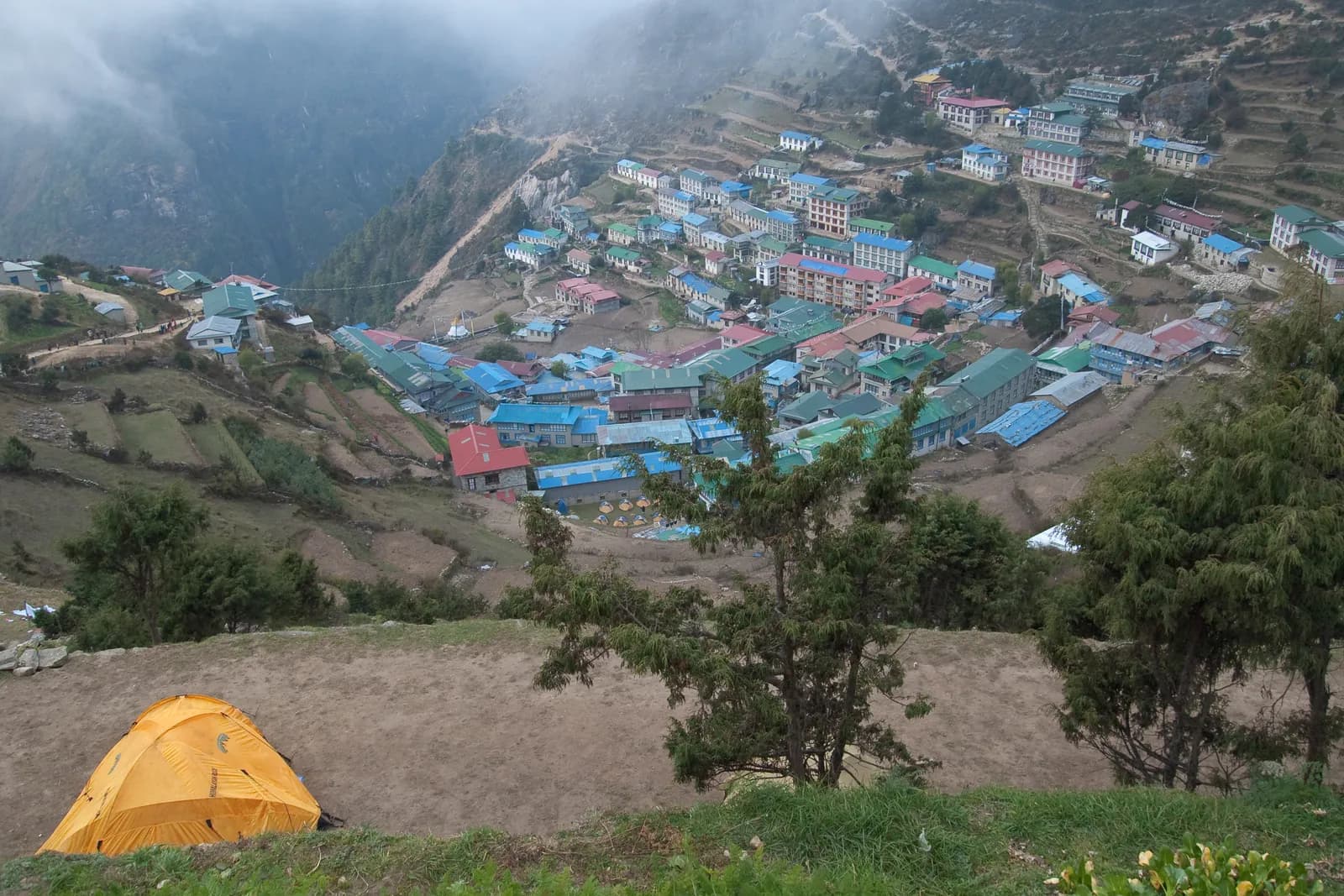
Our 12-day plan flies to Lukla (about 2,846 m), walks to Phakding (2,610 m), climbs to Namche Bazaar (3,440 m) with a rest day, goes on to Tengboche (3,860 m) and Dingboche (4,410 m), rests again, then continues to Lobuche (4,940 m) and Gorak Shep (5,164 m), where you visit Everest Base Camp at about 5,364 m and climb Kala Patthar, the ridge that gives the closest view of Everest, for the summit. The return takes about three days. Along the way you pass Sherpa villages and Tengboche Monastery, cross suspension bridges and walk beside the Khumbu Glacier. Most of the value is the walking: the pace lets your body adjust and the days give the place context.
What a helicopter tour gives you
A helicopter flight, typically from Kathmandu or Lukla, flies up the valley and offers aerial views of the peaks, the glaciers and sometimes a short landing at a high viewpoint. It suits people who cannot walk for medical or time reasons, who want a quick look, or who want a gift trip with a view. It also costs a lot per hour of experience compared with a walking trek, but we cannot give a figure; operators quote their own fares, and you should get an itemised written quote and check whether a landing and time on the ground are included.
What it gives you is a view and a story. What it does not give you is the trek: the people, the villages, the pace and the sense of arriving under your own power. Kala Patthar, which Wikipedia describes as the most accessible close-up view of Everest, is reached on foot from Gorak Shep for a reason: the ridge is high and the effort is part of it.
The altitude problem
This is the central issue. The NHS says altitude sickness is usually a risk above about 2,500 m, more likely if you travel or climb quickly, and advises that you try not to fly directly to a high altitude; if that is not possible, rest for one day before going higher. It also advises trying not to go from below 1,200 m to above 3,500 m in one day, spending a few days below 2,500 m before going higher, not sleeping more than 500 m higher than the night before above 3,000 m, and taking a rest day every three to four days above that.
A helicopter flight from Kathmandu (about 1,400 m) to a viewpoint above 5,000 m breaks all of that in a few hours. Symptoms such as headache, loss of appetite, nausea, tiredness, dizziness and poor sleep usually start six to ten hours after arrival, by which time the helicopter has gone, so the risk is that you feel unwell after you have landed or flown back. The NHS says to rest at the same altitude if symptoms are mild and go down if they worsen; with a helicopter, going down is quick, but you must be prepared to do it. Read altitude sickness basics and HAPE and HACE warning signs. If you have a heart or lung condition, talk to a doctor before any high-altitude visit; see trekking with medical conditions.
Weather and reliability
Both depend on weather. Wikipedia notes that high winds, cloud cover and changing visibility often delay or close Lukla airport, and helicopters face the same limits, so a tour can be cancelled or cut short on a cloudy day. A trek has the flexibility of spare days; a tour usually does not. If the view matters, ask what happens if the mountains are in cloud and whether you can rebook.
Walk up, fly down
A hybrid exists: walk up and fly out. If you trek in and your knees or schedule give out, a helicopter or flight out from a high lodge is a recognised use of the service, and whether your insurance pays depends on your policy wording. This is very different from flying in, because you have already acclimatised on the way up. Our route page lists insurance covering helicopter evacuation to about 6,000 m among the Base Camp permits and preparations; the details of cover vary, so check your policy. See Everest Base Camp trek cost breakdown.
If the flight out is a medical one, our guide to how helicopter evacuation works in Nepal and what it costs explains the sequence, the delays and who pays.
Cost
The trek is priced by days: as of October 2026 our Everest data gives NPR 3,400 to 4,700 a day for a guide and NPR 2,100 to 3,400 for a porter, with about USD 190 to 240 each way for the Lukla flight, plus lodges, food and permits (NPR 3,000 for the park and NPR 3,000 for the Khumbu trek card). A helicopter tour is priced by the operator and we do not publish a figure. The honest comparison is cost per unit of experience, not cost per day: the trek is slower and cheaper per day, the helicopter faster and dearer per hour.
Permits and the guide rule
A trek needs the park permit and the trek card; a helicopter visit has its own arrangements through the operator. On the trek the guide rule is reported not to be checked in Khumbu, so the framing is: a licensed guide through a registered agency is required in restricted areas (Department of Immigration) and, under the Nepal Tourism Board rule of April 2023, in national parks and conservation areas, where 2026 operator reports say checkpoints enforce it in Annapurna and Langtang but not in Khumbu (checked 19 October 2026). See /guide-rule-nepal.
Which should you choose?
- You want Everest Base Camp as an experience: trek, with 12 days and spare days.
- You cannot walk, or have a few hours: a helicopter tour, with a doctor's advice and realistic expectations.
- You want a view but not a high trek: walk to Namche and the Everest View Hotel, which our route page puts at about 3,880 m.
- You want lakes and fewer people: the Gokyo Lakes trek.
- You are worried about knees or time: walk up, and keep a flight out as a fallback.
Questions to ask an operator
If you decide a helicopter is right for you, ask the operator exactly where it flies and lands, how long you will be on the ground, how many people share the aircraft, what happens if the weather stops the flight and whether you can rebook or get a refund. Ask what medical equipment and oxygen are carried, and whether the crew will descend if a passenger feels unwell. Get the answers in writing, with the price and what it includes, and check that your travel insurance covers the activity and any evacuation. A reputable operator will answer these directly.
Finding a partner
Trekking with others spreads the cost of the guide and porter and makes the 12 days more enjoyable. See the Everest Base Camp partner page and how to find a trekking partner in Nepal safely. For more comparisons, see Everest Base Camp versus Gokyo Lakes and the comparisons category.


