

Tibetan Buddhist culture in Upper Mustang and Lo Manthang
What to understand about Lo, the old Kingdom of Lo, before you walk to Lo Manthang: the walled city and its four temples, the Lhoba people, cave paintings, mani walls and Ghar Gompa, and how to behave in monasteries in a place that was closed until 1992.
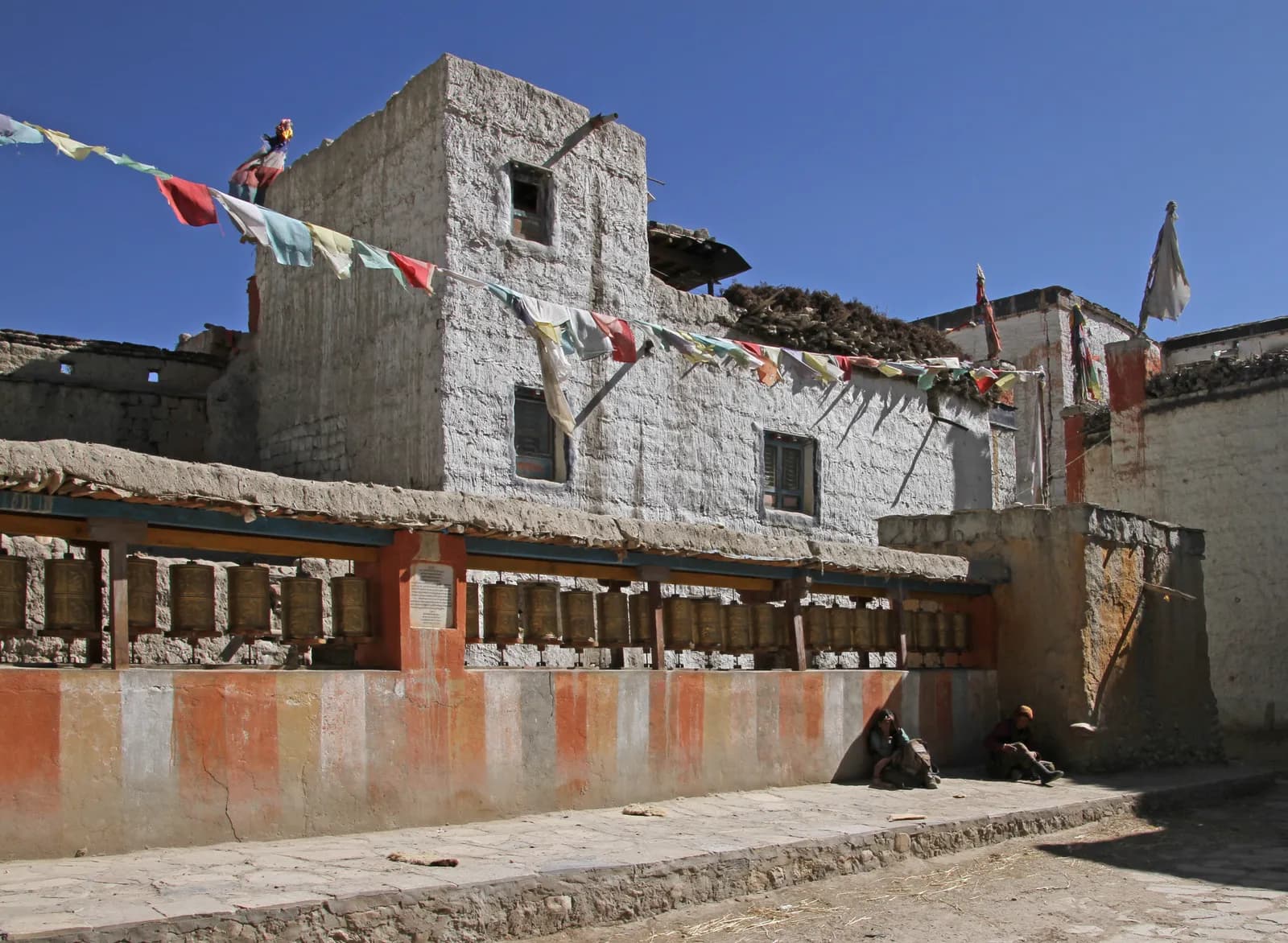
Upper Mustang is the most Tibetan place you can walk to in Nepal: a high desert of ochre cliffs and cave dwellings where whitewashed chortens line the path, mani walls stretch a hundred metres beside the trail and the walled city of Lo Manthang still has the palace and monasteries of a kingdom that lasted until 2008. To appreciate it, understand three things: the old Kingdom of Lo was a Tibetan-culture state closed to outsiders until 1992, its monasteries are active places of worship and not museums, and the village customs you are asked to follow (walk clockwise, ask before photographing, do not touch paintings) are the way the place keeps itself intact. This guide is a short cultural introduction for trekkers on the Upper Mustang itinerary, based on Wikipedia, our route page and the Nepal Tourism Board.
Open trips on Upper Mustang Trek (Lo Manthang)
Real trips posted by trekkers looking for partners.
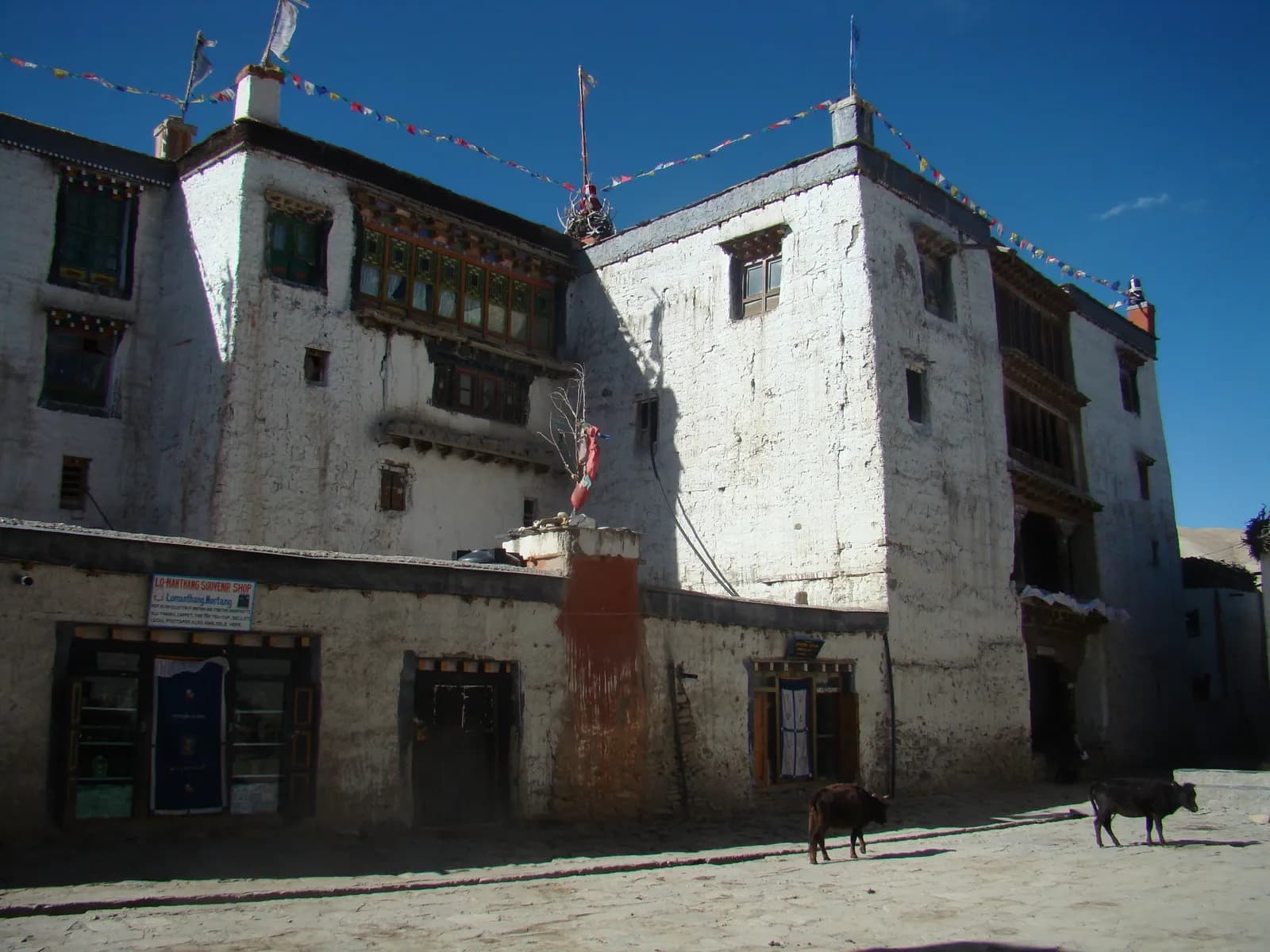
What Upper Mustang is
Wikipedia describes Upper Mustang, or Lo Tsho Dyun, formerly the Kingdom of Lo, as the northern part of Mustang District in Gandaki Province. It was a closed territory until 1992, which Wikipedia says made it one of the most culturally preserved regions in the world, with a majority of the population still speaking traditional Tibetic languages. It consists of two rural municipalities, Lo Manthang and Lo-Ghekar Damodarkunda. The southern third of the district, called Thak, is the homeland of the Thakali community, who speak the Thakali language and whose culture combines Tibetan and Nepalese elements. The region between Cheile and Pandakhola is called Baragau, and the people in its upper villages (Chusang, Tangbe, Tetang, Gyaka and Cheile) retain their own original language, called Seke, according to Wikipedia.
The climate matters to culture: Upper Mustang is trans-Himalayan, cool and semi-arid, with precipitation of 250 to 400 mm a year, in the rain shadow of the Annapurna and Dhaulagiri ranges. Wikipedia notes that the harsh conditions cause a large winter migration into lower regions of Nepal, which is why many lodges close in winter, as our route page also says. Life in Mustang, in its words, revolves around tourism, animal husbandry and trade; the Kali Gandaki valley once carried a major salt trade between Tibet and India.
The Kingdom of Lo and Lo Manthang
According to Wikipedia, Mustang was once an independent kingdom closely tied by language and culture to Tibet. From the 15th to the 17th century its position gave it control of trade between the Himalayas and India. In the late 18th century it was annexed by Nepal and became a dependency in 1795, keeping its hereditary rulers. The monarchy ceased to exist on 7 October 2008, when Nepal became a republic. The last king, Jigme Dorje Palbar Bista, traced his lineage to Ame Pal, the warrior who founded the kingdom in 1380.
Lo Manthang was the walled capital from the founding. Wikipedia says Ame Pal oversaw the building of the city wall and many structures that still stand, and that the walled city has changed little in appearance since. Visitors notice the tall whitewashed mud-brick walls, the Raja's palace, a nine-cornered, five-storey structure built around 1400, and four major temples:
- Jampa Lhakhang (Jampa Gompa), the oldest, built in the early 15th century and also known as the "God house".
- Thubchen Gompa, a huge red assembly hall of the late 15th century, just south-west of Jampa Gompa.
- Chodey Gompa, now the main city gompa.
- Choprang Gompa, popularly the "New Gompa".
Wikipedia adds that the April 2015 earthquake cracked the 600-year-old royal palace. At the 2021 census Lomanthang Rural Municipality had 1,430 residents, and in 2011 87.6 per cent identified as Lhopa (Lhoba) and 92.8 per cent were Buddhist. Our route page puts Lo Manthang at 3,840 m and gives a rest day there.
Monasteries, caves and mani walls on the trail
The Upper Mustang route page lists the places that carry the culture:
- Kagbeni, the medieval gateway to the old kingdom, where the restricted area begins.
- Chele and Syangboche cliff villages, and Ghami, with the long mani wall that is one of the trek's best-known sights.
- Tsarang, with a fortress and monastery.
- Lo Manthang, with its walls, palace and three great monasteries (Wikipedia names four temples) and the Chhoser caves nearby.
- Ghar Gompa, an ancient monastery, also called Lo Gekar, near Dhakmar and Ghami, visited on the return, and the red cliffs of Dhakmar.
Wikipedia reports that in 2007 a shepherd discovered a collection of 55 cave paintings depicting the life of the Buddha, and that a series of at least twelve caves north of Annapurna near Lo Manthang were found with ancient Buddhist paintings in cliffs at about 4,300 m, dated to about the 13th century with Newari influence. These caves are not routine visits; do not disturb caves, and ask your guide what is open. For the etiquette of mani walls, chortens, prayer wheels and gompas, read monastery etiquette; it uses Mustang examples.
What to do and not do
Our route page gives clear rules, which we repeat because they matter more here than anywhere:
- Ask permission before photographing inside monasteries. If there is nobody to ask, do not photograph.
- Do not touch paintings, and never use flash on wall paintings. Flash and fingers damage pigments that have lasted centuries.
- Avoid disturbing caves and monasteries.
- Walk clockwise around mani walls, chortens and monasteries, keeping them on your right.
- Dress modestly in villages and in monasteries; cover shoulders and knees and carry a scarf.
- Do not give sweets or money to children. Make a donation to a monastery or a school through your guide.
- Keep your voice low in prayer halls and switch your phone to silent.
These are not arbitrary. Mustang's monasteries and wall paintings are maintained by small communities with few resources, and they receive visitors all year. A respectful, quiet visit is worth more to them than a large donation made with a camera in hand. See photography etiquette: people and monasteries for how to ask.
The Tiji festival and other festivals
Our route page says the Tiji festival is held in Lo Manthang in spring. The town is crowded then and the ceremonies are the main event. Wikipedia's article on Mustang does not give dates, and the Tibetan calendar moves them each year, so ask your agency and book early. If you attend, keep back from dancers and processions and follow the monks' and your guide's instructions. Spring is also a good time for the trek in general; September and October are the most popular months, according to the route page, and the monsoon is a good option because Upper Mustang is in the rain shadow, though flights to Jomsom may be disrupted. We cover the timing in best time for Upper Mustang.
Permits, guides and responsible visiting
Upper Mustang is a restricted area. The route page says you need a Restricted Area Permit from the Department of Immigration through a registered agency, an Annapurna Conservation Area permit and a licensed guide, and that individuals are reported to be able to apply from March 2026 but the agency and guide requirements remain (checked 19 October 2026). Our Upper Mustang permit guide has the details. Wikipedia notes that the guide requirement is described as protecting local tradition and the environment; whatever the origin, the effect is that a Nepali guide travels with you, and he or she is your best source of local manners.
Spend your money locally: eat and sleep in family lodges, buy from village shops and hire local guides and porters. The route page asks you to conserve water, carry out your rubbish and avoid disturbing caves and monasteries. The wind is the main discomfort, so start early each day, as the route page advises.
Reading the landscape and the people
Mustang's culture is inseparable from the terrain. The desert, the wind and the thin supply of water shape where people live and how they build; the prayer flags catch the afternoon wind that makes walking tiring. Notice where the villages sit, how the walls and chortens mark the edge of settled ground and how green the fields are against the bare cliffs; they are signs of a community managing hard conditions, and they will tell you more than a plaque.
Do not take the Tibetan character as a museum piece. Wikipedia notes that the influence of the outside world, especially China, is growing and contributing to rapid change in people's lives, and that development work has increased. The road to Lo Manthang is a daily reality; many trekkers use a jeep for some sections, as the route page notes. Respect people who want change as much as people who want to keep things as they are.
Sharing and planning
Because the permit, guide and vehicle costs are fixed, partners help. Post your dates on the Upper Mustang partner page to find others, and read what to agree with trekking partners before you book. For the rest of Nepal's cultures on the trail, return to the trail etiquette and culture guide and to the Upper Mustang itinerary. Go quietly, listen to your guide and leave the walls and paintings as you found them.


