Nepal trekking questions answered: what trekkers really ask
Answers to the practical questions trekkers keep asking about Everest Base Camp, Annapurna Base Camp, the Annapurna Circuit, Tilicho Lake and Manaslu: partners, sharing a guide, solo safety, seasons, permits, costs, altitude and jeeps.
Trekkers ask the same practical questions again and again in Nepal trekking Facebook groups, in comment threads and in our messages. This guide collects the ones we see often for the five treks people ask about most: Everest Base Camp, Annapurna Base Camp, the Annapurna Circuit, Tilicho Lake and the Manaslu Circuit. The questions are paraphrased and grouped by theme, and the answers are short and specific. Route pages with day plans and costs: Everest Base Camp, Annapurna Base Camp, Annapurna Circuit and Manaslu Circuit. For the broad basics, read our top 30 Nepal trekking questions first.
FindTrekkingPartner is not a trekking agency: it does not sell treks, employ guides or handle money. We help trekkers find partners to share a licensed guide, porters and transport. Fees and prices are as of October 2026 and are market ranges, not offers. Rules change, so confirm with your registered agency before you pay.
رحلات مفتوحة في Everest Base Camp Trek
رحلات حقيقية نشرها متنزهون يبحثون عن شركاء.

Finding partners and sharing a guide
How do I find a trekking partner for the dates I already have?
Post your trip with the route, start date and a flexible window, or browse open trips for that month. Most people find a match faster by moving the start date two or three days than by waiting for an exact fit. Our trekking partner hub explains the matching, and each route has its own page: Everest Base Camp, Annapurna Base Camp, Annapurna Circuit, Tilicho Lake and Manaslu Circuit. Posting is free and your contact details stay hidden until both sides agree.
Can I find someone starting from Pokhara on a specific date?
Yes, for Annapurna Base Camp, Poon Hill and Mardi Himal Pokhara is the usual start, so many trips begin there. Filter open trips by start place and month, then message the host about the exact day. Our departures page is month-based by design, so agree the precise date in the chat. A 7-day Annapurna Base Camp plan from Pokhara needs a day or two of slack at either end for buses, taxis and weather, so avoid pairing it with a tight flight home.
How do I join an open trip, and who sees my phone number?
Open the trip, send a short request saying your dates, fitness and trekking experience, and wait for the host to accept. Nobody sees your phone number or email at that point. Contact details are shared only after both of you agree, and for an agency-run departure you still deal with the agency for the permit and payment. FindTrekkingPartner is not an agency and does not handle money, so agree costs and the guide arrangements in writing before you commit.
Is it safe to trek with someone I met online?
It is reasonable if you vet them first: video call before you commit, compare itineraries and fitness honestly, and never send money to a stranger. Tell a third person your route and partner's name, and share live location on the trail. Be wary of anyone who pushes you toward one particular agency, since agents also post on buddy boards. Our partner red flags guide and vetting checklist list the warning signs and the questions to ask.
Can two or three of us share one guide, and who pays?
Yes. The guide's daily fee is a per-group cost, so each extra trekker lowers the per-person share. Operator guides put a guide at roughly NPR 2,700 to 4,000 a day in the Annapurna region and NPR 3,400 to 4,700 on Manaslu (2026 market ranges, not official rates). Agree the split before you start, including the guide's food, lodging and tip. A group of more than four or five is usually too many for one guide; see how many trekkers should share one guide.
What if my partner gets sick or cannot continue?
Decide this before day one. The usual rule is that the healthy partner is free to continue only if the guide stays with the person who is unwell or arranges safe descent with a porter or another guide. Never let someone with altitude symptoms descend alone. Agree who pays for an early jeep or helicopter and whether the shared guide costs continue. Our guide to what to do if your partner cannot continue gives a written template you can agree on.
Solo trekking, safety and the guide rule
Is solo trekking banned in Nepal?
No single clear ban applies everywhere, and sources conflict, which is why the question keeps appearing. The written position is this: A licensed guide through a registered agency is required in restricted areas (Department of Immigration) and, under the Nepal Tourism Board rule of April 2023, in national parks and conservation areas. Follow the rule everywhere, although 2026 operator reports say Khumbu uses a trek card instead (checked 19 October 2026). Whatever you read in a forum, the safe plan is to trek with a licensed guide, either alone or sharing one with partners. See what is true about the 2026 solo ban.
Do I need a guide for Annapurna Base Camp?
Treat it as yes. The Nepal Tourism Board rule of April 2023 asks foreign trekkers to use a licensed guide in conservation areas, and 2026 operator reports say Annapurna checkpoints check for one (checked 19 October 2026). Practice varies, so follow the rule rather than test it. Hiring a guide through an agency also gives you someone who knows the avalanche-prone stretch between Deurali and the sanctuary after snow, which matters more in winter and spring. Sharing the guide with one or two partners keeps the cost sensible.
Is a guide mandatory in the Everest region?
The honest answer is that it depends on which rule you follow. Khumbu is reported to use a municipal trek card (NPR 3,000 for foreigners) issued at Lukla instead of the national guide rule, and the Sagarmatha National Park entry permit is also NPR 3,000. Still, the recommendation on this site is to follow the rule and trek with a licensed guide: flights get cancelled, altitude is real and a guide handles rebooking, lodges and emergencies. You can read the full wording in our guide rule page.
Is it safe for a woman to trek with a guide or with a mixed group?
Most trekkers report feeling safe on the main routes, which are busy with other trekkers and lodge owners. Sensible steps help: use a registered agency, ask for the guide's licence number, share your itinerary with someone at home, and tell your partner or guide immediately if anything feels wrong. Women often look for a female partner through trips here. Our solo female trekking tips cover lodges, night travel and what to say if a guide behaves badly.
A guide messaged me directly offering a cheap trek. Should I accept?
Be careful. Unsolicited direct messages from guides are common on social media and in trekking groups, and some are unlicensed or work outside an agency. Ask for the licence number and the agency name, check them, and pay only through the registered agency and never to a personal account you cannot verify. A genuinely cheap offer usually leaves something out, such as a permit, a flight or insurance. Our red flags guide lists what to check.
Dates and seasons
When is the best time for each of the five treks?
For all five, the two main windows are October to November and March to May. Autumn gives the clearest skies and busiest trails; spring brings rhododendrons and warmer days but more haze. The monsoon makes the lower valleys wet, leech-prone and landslide-affected, and winter can close high sections such as Thorong La. Manaslu is not recommended in the monsoon because rain and landslides affect the lower valley and the road is often closed. Pick the season first, then look for partners in that month.
Is early December too late for the Annapurna Circuit or Manaslu?
It is possible but riskier. Days are shorter, nights are far colder above 4,000 m, and snow can close Thorong La or Larkya La, so you need spare days. Some lodges at the highest points close for the winter. If you go, carry a proper down jacket and a -15 degree C sleeping bag, start before dawn on the pass day and be willing to turn back. For flexible trekkers, late October to mid November is the safer choice, with more partners available too.
What about trekking during Dashain and Tihar?
Buses and domestic flights are busy and prices rise, and some Nepali staff go home for the festival. Trails in October are often otherwise excellent. Book transport early, expect fuller lodges and keep spare days. Our Dashain and Tihar planning guide covers closures and travel days. Many trekkers also use the festival period to find partners, since lots of people have the same window free.
How many spare days should I add?
Add at least one for any trek that begins with a flight, and two for Everest Base Camp because Lukla flights are delayed or cancelled in bad weather. Our Everest Base Camp plan is 12 days from flight to flight, and we suggest adding at least one spare day. Annapurna Circuit and Manaslu are 14 days on our plans including rest days, and landslides on the jeep road can add a day. Book an international flight home with a buffer, not the morning after you finish.
Permits and paperwork
Which permits does each of the five treks need?
Everest Base Camp: Sagarmatha National Park entry (NPR 3,000) and the Khumbu municipal trek card (NPR 3,000). Annapurna Base Camp, Annapurna Circuit and Tilicho: the Annapurna Conservation Area permit (NPR 3,000) and a TIMS card (NPR 2,000) where required. Manaslu adds a Restricted Area Permit plus the Manaslu and Annapurna conservation area permits. Fees are for foreigners, checked October 2026; SAARC rates are lower and ACAP permits bought at a check post cost double. Your agency normally arranges them. See the permits page.
Can I get the permits myself without an agency?
For conservation-area permits you can pay online through the NTNC e-permit system, but TIMS is issued only through a government-registered trekking agency, and the Manaslu Restricted Area Permit also requires an agency and a licensed guide. In practice you will use an agency for the whole package if you want a guide anyway. Buying at a check post is costly because the ACAP fee is double there. Ask the agency for receipts for each permit so you can compare against the official fees.
How much does the Manaslu restricted area permit cost?
From September to November it is USD 100 per person for the first week plus USD 15 per day beyond that. From December to August it is USD 75 a week plus USD 10 a day beyond a week. A 14-day trek therefore needs about 12 permit days on our plan. Add the Manaslu Conservation Area permit (NPR 3,000), the Annapurna Conservation Area permit (NPR 3,000) and TIMS. The permit must come through a registered agency, so you cannot buy it yourself.
Do two people need to trek Manaslu together? What is a ghost trekker?
A minimum of two used to apply. Reports say a single trekker can apply since 22 March 2026, but a licensed guide and a registered agency are still required, so confirm the current rule with the agency before you pay. A ghost trekker is a fake second name added to a permit to meet the old minimum. We advise against it: if the permit shows two people but one walks, you risk problems at checkpoints. Our Manaslu permit guide explains it.
Costs and transport
How much does each trek really cost per person?
Costs vary by season, group size and comfort level, so use a calculator rather than a single headline number. Build the total from lodges (for example NPR 1,300 to 1,600 for dal bhat above 3,800 m on Annapurna), permits, guide and porter days, and transport. Guide and porter days are per group, so sharing helps. Our cost breakdowns cover Everest Base Camp, Annapurna Circuit and Manaslu. Figures are market ranges as of October 2026, not offers.
Is the Lukla flight worth it, or should I take the jeep to Surke?
The Kathmandu to Lukla flight is about USD 190 to 240 one way for foreigners, so about NPR 25,500 to 32,200 return, and it saves roughly two days of walking. The Kathmandu to Surke shared jeep is USD 45 to 50 per person one way over 325 km, and a private jeep is USD 300 to 350 per vehicle, but you then walk about two extra days to Lukla. Flights are cancelled in bad weather, so keep spare days either way. See Kathmandu to Surke by jeep.
What does the road to the Annapurna Circuit start cost now?
A local or tourist bus from Kathmandu to Besisahar is USD 10 to 20 per person, and a private jeep is USD 150 to 220 per vehicle, so a group of four splits it easily. From Besisahar, jeeps run on to Dharapani and beyond, which is why many trekkers now start at Chame or Pisang and finish in 8 to 12 days. Prices change with fuel and season, so confirm the day before. Our jeep and bus costs guide lists each leg.
Should I hire a porter, and how much do they cost?
One porter is usually shared by two trekkers, with a combined weight limit the agency sets (often around 20 to 25 kg). Operator guides put porters at roughly NPR 2,100 to 3,400 a day in 2026, plus their lodging and food. Hiring one makes long, high days far more comfortable and supports local income. Check that the agency insures its porters and supplies warm clothing at altitude. Splitting a porter between two partners halves the cost, and you can agree this in your trip request.
Altitude, Tilicho and the high passes
How do I avoid altitude sickness on these treks?
Go up slowly, drink water often, and follow the sleeping-altitude rule of about 300 m a night above 3,000 m, with a rest day every 1,000 m or so. Do not trek with symptoms such as persistent headache, nausea or loss of balance; descend instead. Diamox does not replace slow ascent. The highest points are Everest Base Camp at about 5,364 m, Thorong La at 5,416 m, Larkya La at 5,106 m and ABC at 4,130 m. Read the acclimatisation schedule and the altitude sickness basics.
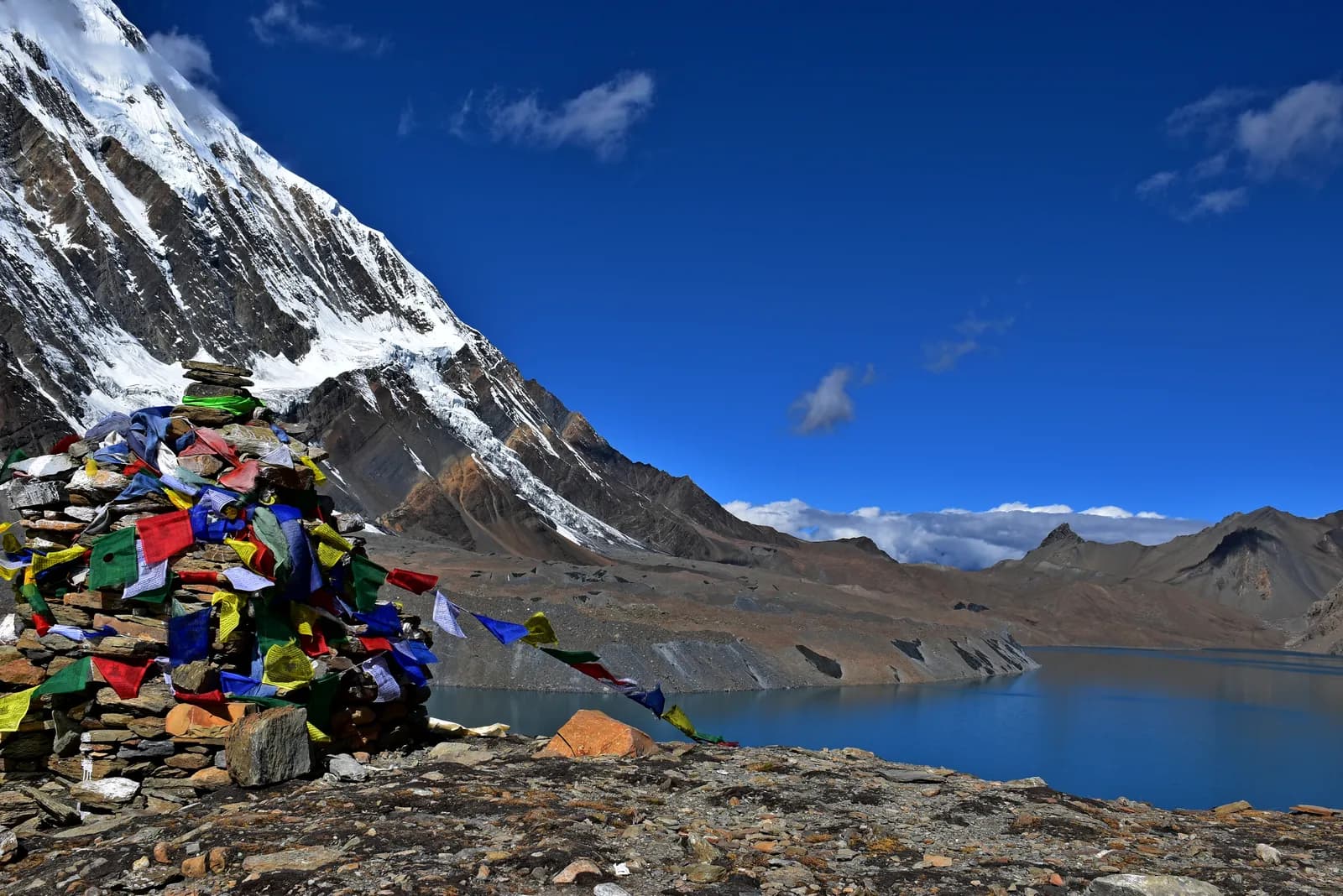
How many days does the Tilicho Lake side trip add, and is it dangerous?
Plan on two or three extra days from Manang, usually a night at Khangsar or Shree Kharka and a night at Tilicho Base Camp, which sits at about 4,140 m. The lake is about 4,919 m, though one source says 4,949 m. The risk is a landslide section between Shree Kharka and Base Camp, with wind and rockfall later in the morning, so cross early and follow your guide. Read the Tilicho itinerary.
Does Tilicho need extra permits or a guide?
Our route data lists the same Annapurna Conservation Area permit (NPR 3,000) and TIMS card (NPR 2,000, where required) as the Annapurna Circuit, so ask your agency whether anything else applies. Tilicho is inside the Annapurna Conservation Area, where 2026 operator reports say checkpoints enforce the guide rule (checked 19 October 2026), and the landslide section makes a guide sensible regardless. There is no separate Tilicho trek form: add it as a side trip and look for partners on the Tilicho Lake partner page.
How hard is Thorong La, and which direction is best?
Thorong La is a long day of eight to ten hours, climbing about 1,000 m and descending 1,600 m, at up to 5,416 m. It needs good acclimatisation and good weather, so start before dawn and be ready to turn back. Counter-clockwise (Manang to Muktinath) is the standard direction because the altitude gain is gradual and the descent to Muktinath is steep but short. The October 2014 blizzard is a reminder that storms arrive suddenly. See the Annapurna Circuit itinerary.
What is the Larkya La crossing like on Manaslu?
Larkya La is 5,106 m and the crossing is a serious high-altitude day, not a technical climb. Lodges are basic, days are long and the circuit is rated hard. Our plan takes 14 days from Kathmandu with two rest days, which helps acclimatisation. Go in October to November or March to May, because the monsoon brings rain, landslides and often a closed road. Since the permit requires a guide and an agency, many trekkers look for one or two partners to split those costs.
Can I see Everest from Base Camp, and is Everest Base Camp too hard for a beginner?
You cannot see Everest from Base Camp, which sits below the Khumbu Icefall behind Nuptse; the best view is from Kala Patthar at about 5,550 m. The trek is long rather than technical, with most days 4 to 7 hours and no climbing skills needed, but it is rated moderate to hard because of altitude, cold and 12 days of endurance. Fit beginners do it with spare days and a slow pace. Our Everest Base Camp itinerary gives each stage.
Insurance and emergencies
What insurance do I need, and does it cover helicopter evacuation?
Buy travel insurance that explicitly covers trekking to the altitude you will reach, with helicopter evacuation and medical costs included. For Everest Base Camp, the permit list asks for cover for evacuation to about 6,000 m. Read the policy for the altitude limit, because some stop at 2,500 m or 4,500 m. Keep the policy number and the insurer's emergency line offline in your phone. Details are in our high altitude insurance guide and the helicopter evacuation guide.
Looking for company on the trail?
Pick the trek that fits your dates and see who else is going: Everest Base Camp, Annapurna Base Camp, Annapurna Circuit, Tilicho Lake and Manaslu Circuit, or start at the trekking partner hub. Posting a trip is free, and your contact details stay hidden until both sides agree.
خطط لهذه الرحلة
- دليل منطقة Everest (Khumbu)
- دليل منطقة Annapurna
- دليل منطقة Manaslu
- Trekking partner for Everest Base Camp Trek
- Find someone to trek Annapurna Base Camp Trek with
- Trekking partner for Annapurna Circuit Trek
- Trekking partner for Tilicho Lake Trek
- Find someone to trek Manaslu Circuit Trek with
- مسار Everest Base Camp Trek
- مسار Annapurna Base Camp Trek
- مسار Annapurna Circuit Trek
- مسار Tilicho Lake Trek
- مسار Manaslu Circuit Trek