Mountain weather forecasts and Lukla flight delays
Why Lukla flights are delayed (visual landings, cloud and afternoon wind), which forecasts are worth reading, how season changes the odds, and how to build a schedule and budget that survive a bad-weather day.

Lukla flights are delayed because the airport works only in good visibility and calm morning conditions, and no forecast can promise either. Wikipedia explains that landings at Lukla follow visual flight rules, so a sudden loss of visibility closes the airport immediately, that strong southwest winds from mid-to-late morning cause crosswinds or tailwinds, and that the 527 m runway has an 11.7% gradient with go-arounds rarely viable. The practical answer is to read the forecast as a guide, fly as early as you can, and build one to two spare days and a budget for them into your plan.
This guide explains why the airport is so sensitive, which forecasts are worth reading and what they cannot tell you, how the season changes the odds, and how to plan a schedule, a budget and a backup so that a bad-weather day is an inconvenience rather than a crisis. It complements the Kathmandu to Lukla flight guide, which covers booking, baggage and the flight day itself.
رحلات مفتوحة في Everest Base Camp Trek
رحلات حقيقية نشرها متنزهون يبحثون عن شركاء.
Why Lukla is different
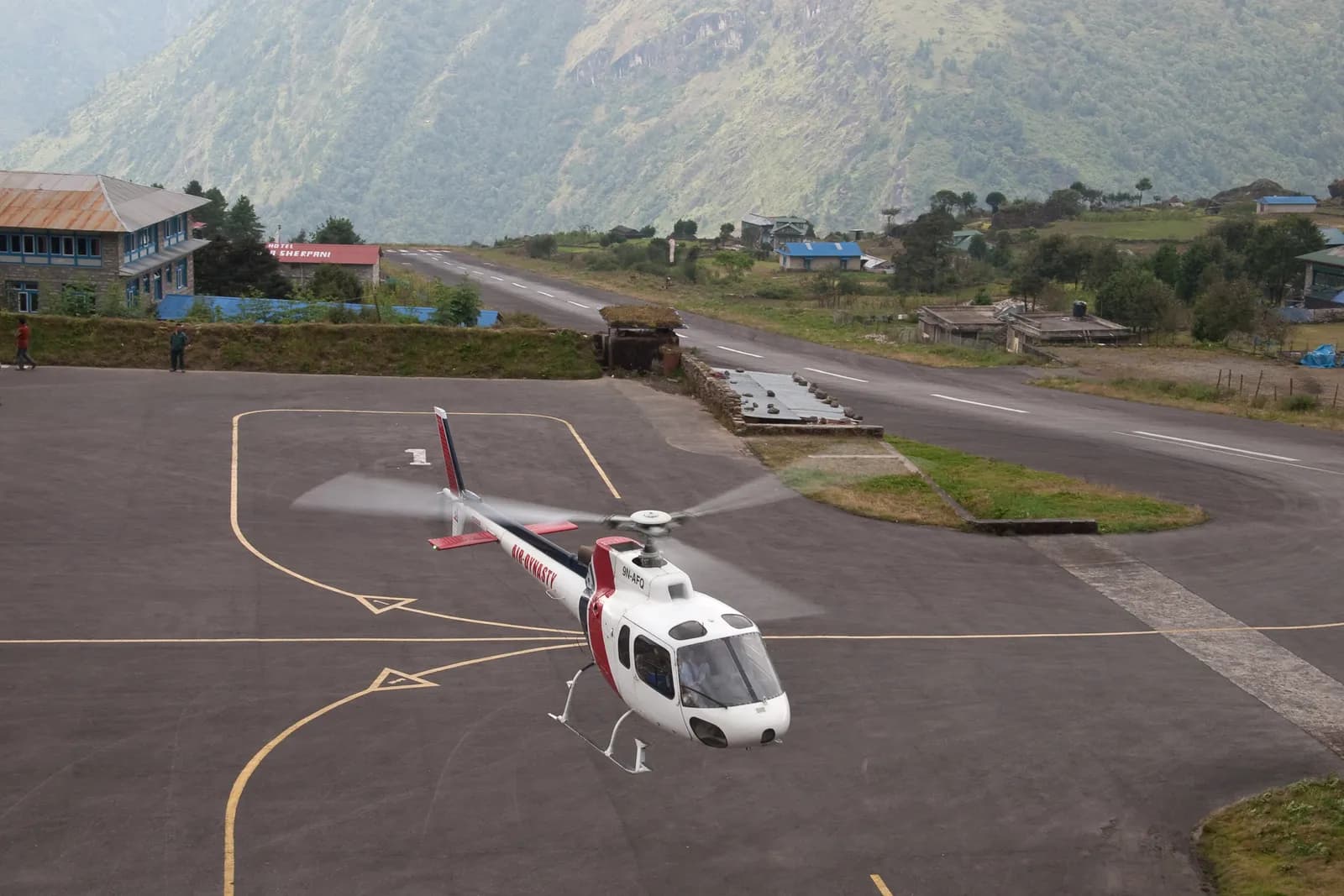
The airport sits at about 2,850 m with a single sloping runway: Wikipedia gives the runway as 527 m by 30 m with an 11.7% gradient, with arrivals on runway 06 and departures on runway 24. Because high terrain lies beyond the north end and there is a steep drop at the south end, a missed approach is rarely an option, so pilots will land only when they can see the runway the whole way in. Three things follow:
- Visibility decides. If cloud covers the approach, the aircraft waits or turns back. Rain often falls at Lukla while Ramechhap or Kathmandu is sunny, Wikipedia notes, so a clear sky at your departure airport says little.
- Wind builds through the morning. Strong southwest winds from mid-to-late morning cause crosswinds or tailwinds, so flights are usually scheduled early, and the first departures are the most likely to go.
- A queue forms. Once the weather stops flights, the backlog moves to the next day, so a short closure can become a longer delay.
None of that is a safety defect so much as the reason the system is cautious. Our Kathmandu to Lukla guide explains the Ramechhap alternative: in busy months many flights leave from Ramechhap (Manthali), a four to five hour drive from Kathmandu, because shorter flights from there allow more trips a day.
Which forecast to read
The Department of Hydrology and Meteorology (DHM) of Nepal is the official source. Its website at dhm.gov.np lists a weather forecast, a 24-hour forecast, a three-day weather bulletin, a special weather forecast, point forecasts, a tourism forecast and aviation information, along with a monsoon onset bulletin. We did not find a separate mountain or airport-specific forecast on the site, so DHM is a good guide to the broad pattern, such as an approaching rain system or the arrival of the monsoon, rather than a prediction of whether Lukla will be open at 8 a.m.
How to use forecasts sensibly:
- Look at the pattern, not the hour. A forecast of widespread rain or cloud across the region means a high chance of delays; a clear spell means better odds.
- Check several days ahead. The three-day bulletin tells you whether to expect a backlog on your day.
- Remember point forecasts are for places, not valleys. Mountain weather changes within a few kilometres and a few hundred metres of altitude.
- Listen to the airline and your guide on the day. They know whether flights have left that morning and whether the airport is open. A forecast of fair weather does not override a closed airport.
- Ask lodge owners about conditions on the trail, which may differ from the airport.
If you want a bigger picture before you choose dates, our best time for Everest Base Camp guide shows the seasonal pattern.
How the season changes the odds
Our Everest region page and Wikipedia give the pattern:
| Season | What our sources say | Flight outlook |
|---|---|---|
| March to May | Clear mornings with afternoon cloud and wind | Busy; delays on cloudy days |
| June to August | Monsoon; flights to Lukla are cancelled often; views are mostly cloud | Poor; Wikipedia says visibility closes the airport about 50% of the time in the monsoon |
| September | Monsoon fades through the month; air clears by the end | Improving |
| October | The steadiest weather and the busiest lodges | Best odds, but heavy demand |
| November | Colder but very clear | Good |
| December to February | Very cold, short days | Fewer trekkers; weather generally clear |
Even in the best months, the earlier the flight, the likelier it is to go. If you have a choice of departures, take the first.
Planning the schedule
Our Everest region page says to keep one to two spare days for flight delays. A schedule that works looks like this:
- Before the flight. Arrive in Kathmandu with at least one free day in hand, so a delay on the outbound does not eat into the walk. Our buffer days guide explains how to hold them.
- On the trek. The Everest Base Camp plan runs 12 days with the flight on days 1 and 12; the Gokyo Lakes plan adds a Kathmandu buffer day as day 12 for exactly this reason.
- After the flight home. Keep one or two days between the last Lukla flight and your international flight. The cost of a missed international connection usually exceeds the cost of two extra nights.
- Visa. If your visa has little slack, extend it before you trek; see the visa guide.
What a delay costs
Our cost data lets you price a delay. As of October 2026 the Kathmandu to Lukla fare is NPR 25,500 to 32,200 one way (about USD 190 to 240), and fares rose on 1 March 2026. A spare day on the trail costs a guide day at NPR 3,400 to 4,700 and a night of budget lodging and food at NPR 4,200 to 5,900 between 2,500 and 3,800 m, so roughly NPR 7,600 to 10,600 a day at the budget level. With partners only the guide day is divided among the group; your lodging and food stay your own. A delayed return adds hotel nights and, if you miss it, a changed international ticket. Our Everest Base Camp cost breakdown shows how those lines add up. Our data has no price for helicopter charters, so ask for a written quote if you consider one.
Check what your insurance covers: some policies cover delay costs and others do not, and the policy must cover helicopter evacuation to the altitude you reach.
If the flight is cancelled
- Stay calm and stay close. Airlines and agencies rebook in order, and being present helps.
- Ask for the new time in writing and when the next window is likely.
- Decide a cut-off. Agree with your partners how many days you will wait before choosing a different plan.
- Consider the alternatives. Our Everest page says you can drive to Phaplu or Salleri, or to Jiri, and walk, which adds days. Compare the added days and cost with the spare days you have.
- Shorten the trek, not the safety. If you lose days, drop a side trip, not an acclimatisation day; see the acclimatisation schedule.
The guide rule and partners
The guide rule does not change with delays. The Khumbu Pasang Lhamu municipality opted out of the Nepal Tourism Board rule of April 2023, so a guide is reported not to be checked in Khumbu but is strongly advised; 2026 operator reports say checkpoints enforce it in Annapurna and Langtang (checked 19 October 2026). A guide also handles rebooking and local information. See the guide rule explainer.
Partners matter in a delay: agree beforehand who rebooks, how you split extra nights and a possible helicopter charter, and when you will decide. Our guide on what to agree with partners covers it, and you can find people on the Everest Base Camp partner page. Browse the Everest and Solu regions for routes by road, including Dudh Kunda. All our seasonal guides are in the seasons and weather hub.