Independent trek or agency in Nepal, what each costs
What arranging a Nepal trek yourself saves compared with an agency, region by region: where the guide rule lets you drop the guide, where it does not, and the one place an agency is compulsory.

Arranging a trek yourself can save money in Nepal, but how much depends almost entirely on one rule: the guide rule. As of October 2026, on Everest Base Camp, where the rule is reported not to be checked, our cost data puts an independent trek with no guide or porter at about USD 810 to 1,060, against about USD 1,085 to 1,450 with a guide, a gap of USD 280 to 390 for a solo trekker. In Annapurna and Langtang you need a licensed guide in practice, so the saving mostly disappears, and in restricted areas such as Manaslu and Upper Mustang you cannot go without a registered agency at all.
So the honest answer is "it depends where". This guide separates the lines that cost the same either way from the ones that differ, shows the Everest arithmetic, and sets out what the rules let you do yourself, region by region. The numbers use the cost files behind our route pages (verified on 18 October 2026, converted at NPR 134 to the dollar).
رحلات مفتوحة في Everest Base Camp Trek
رحلات حقيقية نشرها متنزهون يبحثون عن شركاء.

What the guide rule decides
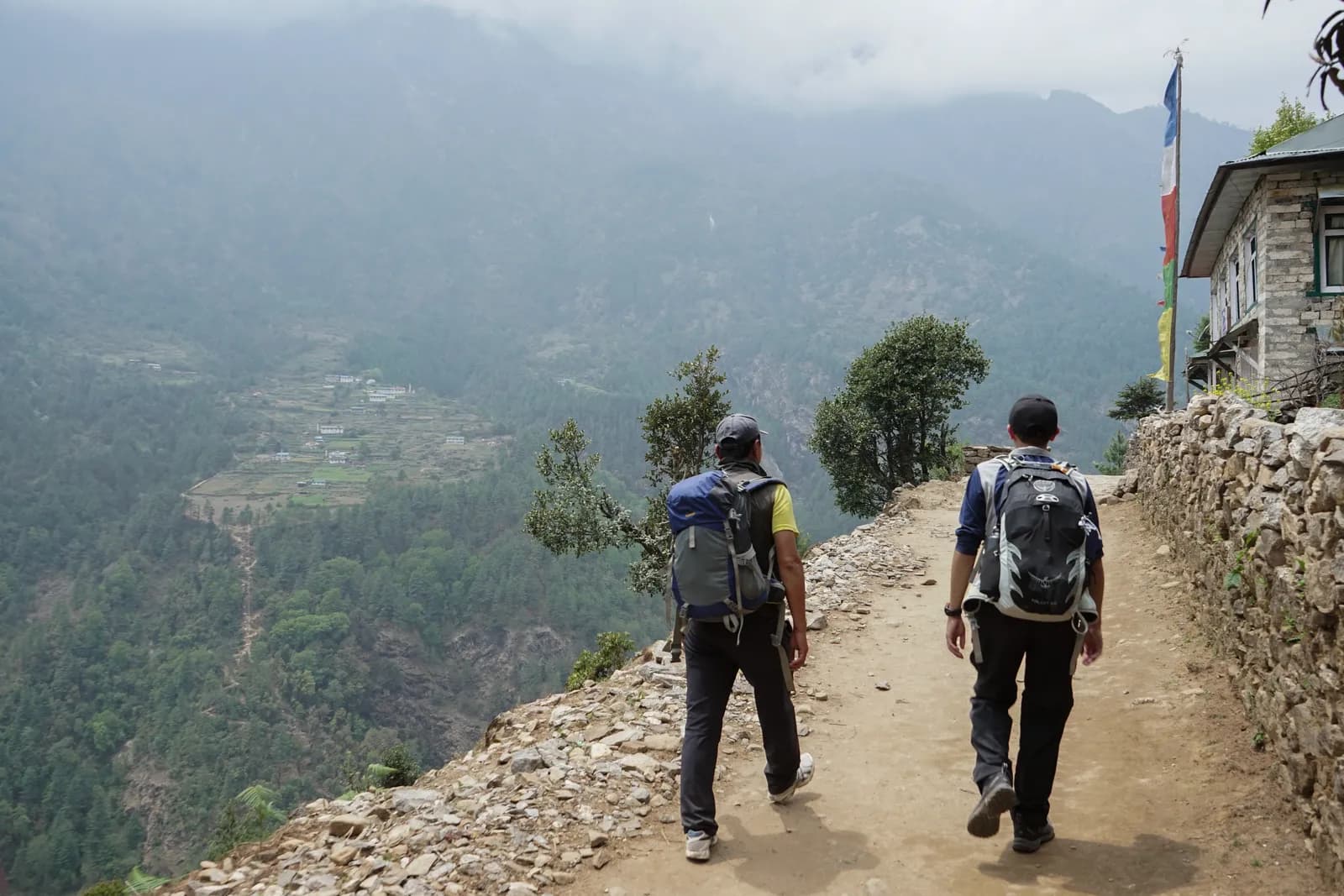
The Nepal Tourism Board announced in April 2023 that foreign trekkers must use a licensed guide in national parks and conservation areas. We found no separate Department of Immigration or park-authority notice for that rule; in restricted areas the Department of Immigration requires a licensed guide through a registered agency as part of the permit, and reminded stakeholders in June 2026. Individual trekkers have been able to apply for restricted-area permits since 22 March 2026, but the guide is still required. 2026 operator reports say checkpoints enforce the 2023 rule in Annapurna (ACAP) and Langtang, the strictest, and most other parks, but not in Khumbu, where the municipality opted out and issues its own trek card (checked 19 October 2026). The guide rule explainer and the guide rule page give the sources.
| Where | Guide in practice | Agency needed? |
|---|---|---|
| Khumbu (Everest, Gokyo) | Reported not checked; strongly advised | No |
| Annapurna and Langtang | Enforced at checkpoints, per 2026 operator reports | Not for the permits, but you still hire a licensed guide |
| Other parks and conservation areas | Reported enforced at most | Check with the checkpoint |
| Restricted areas (Manaslu, Upper Mustang, Upper Dolpo) | Part of the permit | Yes, a registered agency |
What costs the same either way
Several lines do not depend on who arranges the trek:
- Entry permits. The Sagarmatha National Park permit is NPR 3,000 and the Khumbu Pasang Lhamu trek card NPR 3,000 for foreigners as of October 2026; the ACAP and MCAP permits are NPR 3,000 each. You can buy ACAP and MCAP yourself on the NTNC e-permit page, though online payment adds a 2.9% gateway charge and a permit issued at a check post costs double.
- Lodging and food. Teahouses charge the same price to you whether you walk in alone or with an agency group. For the Khumbu our data puts a budget night at NPR 4,200 to 5,900 between 2,500 and 3,800 m and NPR 5,000 to 7,100 above 3,800 m.
- Flights. The Kathmandu to Lukla flight is NPR 25,500 to 32,200 each way in our data (USD 190 to 240), and it is charged per person; if an agency books it for you, ask whether the quote adds a handling charge. Our Lukla flight guide covers booking.
What can differ
The lines that move are the guide, the porter, how you get to the trailhead, who handles the paperwork and what a problem costs you in time. Agencies may bundle food and lodging for staff, a private vehicle and rescue arrangements into one price, while a freelance guide quotes a day rate. Our cost data does not separate an agency margin from the staff pay, so we cannot give a percentage and would not trust one that does not show its sources. The practical answer is to ask for an itemised quote from an agency and from a freelance guide for the same dates, then compare line by line.
Hiring directly has a cost of its own: you check the credentials, agree the terms in writing, arrange insurance for the staff and pay the staff on time. Our guides on verifying a licensed guide and checking a registered agency cover the checks.
Worked example: Everest Base Camp
The Everest Base Camp plan in our data has 12 days, 5 nights between 2,500 and 3,800 m, 6 nights above 3,800 m, the return Kathmandu to Lukla flight and the two permits. The guide is 11 days at NPR 3,400 to 4,700 a day. For a budget trekker, as of October 2026:
| Line | Independent, no guide | With a guide, one trekker | With a guide, four sharing |
|---|---|---|---|
| Lodging and food (budget) | NPR 51,000 to 72,100 | NPR 51,000 to 72,100 | NPR 51,000 to 72,100 |
| Flights, return | NPR 51,000 to 64,400 | NPR 51,000 to 64,400 | NPR 51,000 to 64,400 |
| Permits (park plus Khumbu card) | NPR 6,000 | NPR 6,000 | NPR 6,000 |
| Guide, 11 days | none | NPR 37,400 to 51,700 | NPR 9,350 to 12,925 |
| Total (NPR) | 108,000 to 142,500 | 145,400 to 194,200 | 117,350 to 155,425 |
| Total (USD) | about 810 to 1,060 | about 1,085 to 1,450 | about 875 to 1,160 |
The TIMS card (NPR 2,000 for foreigners, SAARC nationals NPR 1,000) is left out of the totals. Three things stand out. First, dropping the guide saves about USD 280 to 390 for a solo trekker. Second, four trekkers sharing a guide cut that gap to about USD 70 to 100 each, so the saving from going without is small once you have partners. Third, the flights and lodging, which are the same either way, are the bulk of the bill. A guide in the Khumbu is strongly advised but not required; see the Everest Base Camp cost breakdown and the Sagarmatha permit guide for the detail.
Annapurna and Langtang: independent permits, still a guide
On the Annapurna Circuit our data has a budget solo trek at about USD 630 to 920 including a guide (see the Annapurna Circuit cost breakdown). Since the guide is required in practice, you cannot subtract it. What you can arrange yourself is the ACAP permit and the guide: hire a licensed guide directly or through an agency, buy ACAP online, and book buses yourself. What you save by skipping an agency is only the margin, which our data does not separate. In Langtang the rule is the strictest, so the same applies.
Restricted areas: the agency is part of the price
For Manaslu, Upper Mustang and Upper Dolpo the Restricted Area Permit is issued by the Department of Immigration through a registered agency, and a licensed guide is part of the permit, so there is nothing to compare. The agency is not an optional extra, and the question is only which one. Our Manaslu cost breakdown shows what the permits and guide add up to, and the Upper Mustang permit guide covers the application.
The hidden costs of arranging it yourself
- Time. Buying permits, flights and buses, and finding and checking a guide, takes days of attention, mostly in Kathmandu.
- Replacement. If a porter falls ill or a guide drops out, you find a substitute yourself, often at short notice.
- Rescue. Evacuation arrangements and insurance claims are yours to run, so choose a policy that covers helicopter evacuation to the altitude you will reach.
- Responsibility for staff. You are the employer for the time of the trek, so agree pay, food, lodging and equipment in writing.
How to compare two quotes
Whether you choose an agency or a freelance guide, ask for an itemised quote in writing and compare these lines, which our cost files treat separately:
- Permits. Each permit by name, with the fee, so you can check it against the official figure. A restricted-area permit should show the days or weeks it covers.
- Guide. The day rate, the number of days and whether the guide's food, lodging and insurance are included.
- Porter. The same, with the number of porters and the load limit.
- Transport. Each leg, whether it is a private vehicle or a seat, and who pays if the date changes.
- Lodging and food. Whether they are included or paid on the trail, and at which style.
- Extras and margin. Any service fee, deposit and cancellation terms.
Put the two quotes side by side and divide each by the number of trekkers. The difference between them is the price of the service you are or are not buying, and the useful question is whether you would otherwise spend that time and effort yourself. If one quote is silent on a line, assume the line is not included and ask.
How partners change the answer
Sharing narrows the gap between the two routes because it divides the lines that differ. A guide split four ways costs a quarter, and a private vehicle likewise. If you are deciding whether to go alone at all, read solo versus group trekking and is solo trekking safe, then how to find a trekking partner safely. For routes in these regions see Everest, Annapurna and Manaslu, the Everest Base Camp partner page, and our other budgets in the costs and budget hub.
خطط لهذه الرحلة
الصور
الأسئلة الشائعة
المصادر
- Department of Immigration, Nepal
- Nepal Tourism Board: Trekking Permit (restricted areas)
- NTNC e-permit (ACAP and MCAP)
- Kathmandu Post: Everest region, Nepal Tourism Board dispute over solo trek ban heats up (3 April 2023)
- Himalayan Times: solo travellers allowed to trek without a guide in Everest region (27 March 2023)
- Nepal Tourism Board: Park Entry Fees